
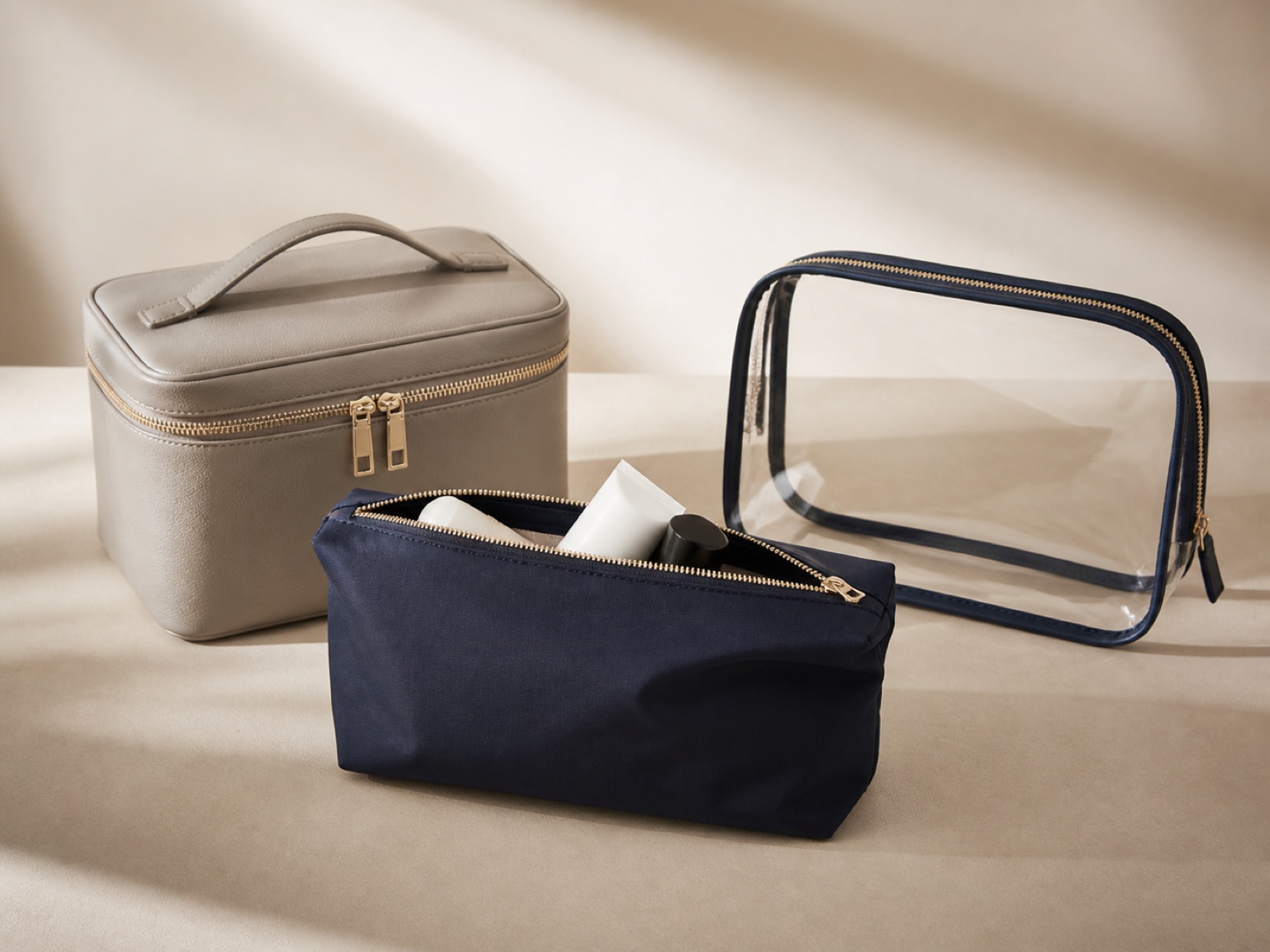
How to Launch a Private-Label Cosmetic Bag Line in 2026
A practical sequence for beauty and lifestyle brands working with an OEM/ODM partner, from first brief to bulk delivery.
To launch a private-label cosmetic bag line, define the range and target retail price first, then choose OEM (your design) or ODM (a factory base design), lock materials and branding methods, approve a sample and a pre-production sample (PPS), collect compliance documents for your markets, specify packaging, and budget for tooling, samples, inspection and freight as well as unit price.
A private-label cosmetic bag line means bags made by a manufacturer but sold under your brand. Most delays in a first launch come from decisions made in the wrong order, not from the sewing itself. This guide sets out the order that tends to work, with links to deeper guides on each step.
What should you decide before contacting a cosmetic bag manufacturer?
Decide the range, the target retail price and the quantity per style before you contact a manufacturer. A short brief should state how many styles and colourways you need, what each bag must hold (for example, full-size bottles or a flat makeup kit), the sales channel, and the markets you will sell in, because those markets decide the compliance work later.
Then choose between OEM (the factory produces your own design and tech pack) and ODM (you adapt a design the factory has already developed). ODM is usually quicker to sample; OEM gives you a unique shape. Our guide on choosing an OEM/ODM partner covers how to compare suppliers.
Which cosmetic bag styles and materials should a new line start with?
Start with two or three proven silhouettes, such as a flat zip pouch, a boxy toiletry bag and a travel organizer, in one or two materials, and expand once sell-through is known. Fewer materials mean fewer lab tests, fewer colour approvals and simpler minimums. For fabric choices, compare nylon and RPET for cosmetic pouches and ripstop nylon vs RPET for travel organizers.
If you plan a recycled or eco claim on the hangtag, collect evidence before artwork is final. The US FTC Green Guides expect environmental claims to be substantiated; see how to verify a recycled material claim.
Which branding method suits a private-label cosmetic bag?
The right branding method depends on the material, the logo detail and how premium the bag should feel. The table below compares common options; for more depth, read embroidery vs debossing and choosing a print method. Always approve a physical strike-off of the logo, not only a digital mock-up.
Colour is the other branding decision that causes rework. Give the factory a physical colour standard or a named reference for each fabric, zip tape and print colour, and state an acceptable tolerance. Remember that nylon, PU and printed ink take dye differently, so a perfect match across every component is rarely possible; agree which component is the master colour before sampling starts.
What do the sample and pre-production sample (PPS) confirm?
A development sample confirms shape, size and function; the pre-production sample (PPS) confirms that production materials, colours, trims, logo and labels match what you approved before bulk production begins. Check zip pulls, lining, seam finishing and whether your products actually fit. Keep a signed PPS as the reference for inspection; see what a PPS actually confirms.
Agree the inspection plan at the same time. Many buyers use AQL sampling under ISO 2859-1; our guide on setting an AQL inspection plan explains defect classes and levels.
Which compliance documents does a cosmetic bag line need?
The documents depend on where you sell, so list your markets first. In the EU, the General Product Safety Regulation (EU) 2023/988 requires products to be safe and traceable, and REACH Annex XVII restrictions limit certain substances in materials. In the US, California's Proposition 65 may require warnings, and imported goods must be marked with country of origin under 19 CFR Part 134.
Ask the factory which test reports it can supply for your exact materials and trims. For a market-by-market checklist, read compliance documents for the US and EU, whether PFAS bans apply and which HS code applies.
How should private-label cosmetic bags be packed and labelled?
Specify packaging in writing at the same stage as the PPS, because it affects cost, carton size and freight. Define the polybag or dust bag, hangtag, barcode or SKU sticker, inner pack quantity, carton marks and the country-of-origin label. Retailers often have their own labelling and carton rules, so share their vendor manual with the factory early.
How do you plan the timeline and budget for a cosmetic bag launch?
Work backwards from your launch date and ask the factory to confirm lead times for each stage in writing, since they vary with materials, branding and order size. The stages are brief and quotation, development sample, revisions, PPS approval, bulk production, inspection, and shipping. Build in time for lab testing and for at least one extra sample round.
For the budget, unit price is only one line. Add sample and tooling charges, logo plates or embroidery set-up, lab tests, third-party inspection, packaging, freight, duties and a contingency. Our guide to what drives the unit price of a custom cosmetic bag shows which specification choices move cost most.
What should you send ROOTSMEN to start a private-label cosmetic bag line?
Send ROOTSMEN your range plan, reference images or tech packs, target quantities, logo files, target markets and launch date. Founded in Taipei in 1981 and operating its own factory in Guangdong since 1993, ROOTSMEN offers OEM and ODM development with an in-house design team; for a line like this, the MOQ is typically 300–500 pcs per style and colourway. Certifications are listed on our About page.
See what to send for an accurate first quote, explore our solutions, or contact the team with your brief.
| Method | Best suited to | Look and feel | What to check |
|---|---|---|---|
| Screen printing | Flat nylon, polyester, canvas | Crisp solid colours | Colour match, rub resistance |
| Heat transfer | Multi-colour or fine logos | Smooth, slightly raised | Adhesion after flexing |
| Embroidery | Canvas, cotton, heavier fabrics | Textured, premium | Stitch density, backing inside |
| Debossing or embossing | PU, leather-look, coated fabrics | Tonal, understated | Depth and sharpness of edges |
| Woven label or metal badge | Most materials | Retail-style detail | Attachment strength, plating finish |
Event Details
From the Stand
Frequently Asked Questions
The questions this topic actually raises when a program is being scoped.
A private-label cosmetic bag is made by a manufacturer and sold under the buyer's brand. The brand controls the specification, logo, packaging and price, while the manufacturer handles development and production, either from the brand's own design (OEM) or by adapting an existing factory design (ODM).
With OEM, the factory produces your own design from your tech pack, giving you a unique product. With ODM, you start from a design the factory has already developed and change materials, colours and branding. ODM usually needs fewer sample rounds; OEM needs a more detailed brief.
A PPS, or pre-production sample, is made with the actual production materials, trims, colours and branding before bulk production starts. Once the buyer signs it off, it becomes the reference standard for production and for quality inspection, so any difference found later can be measured against it.
MOQ varies by factory, material and branding method, and is usually set per style and per colourway. For private-label cosmetic bag lines, ROOTSMEN typically works with 300–500 pcs per style and colourway. Custom-dyed fabrics or special trims can raise the minimum, so confirm it in the quotation.
Cosmetic bags sold in the EU must be safe under the General Product Safety Regulation (EU) 2023/988 and comply with REACH substance restrictions. Testing is the usual way to show that materials, zips and coatings meet those restrictions, so ask your supplier for reports matching your exact materials.
Related Products
Builds where this decision applies.

Have a product requirement of your own?
Tell us the product, the quantity and the timeline — we'll scope a development plan.