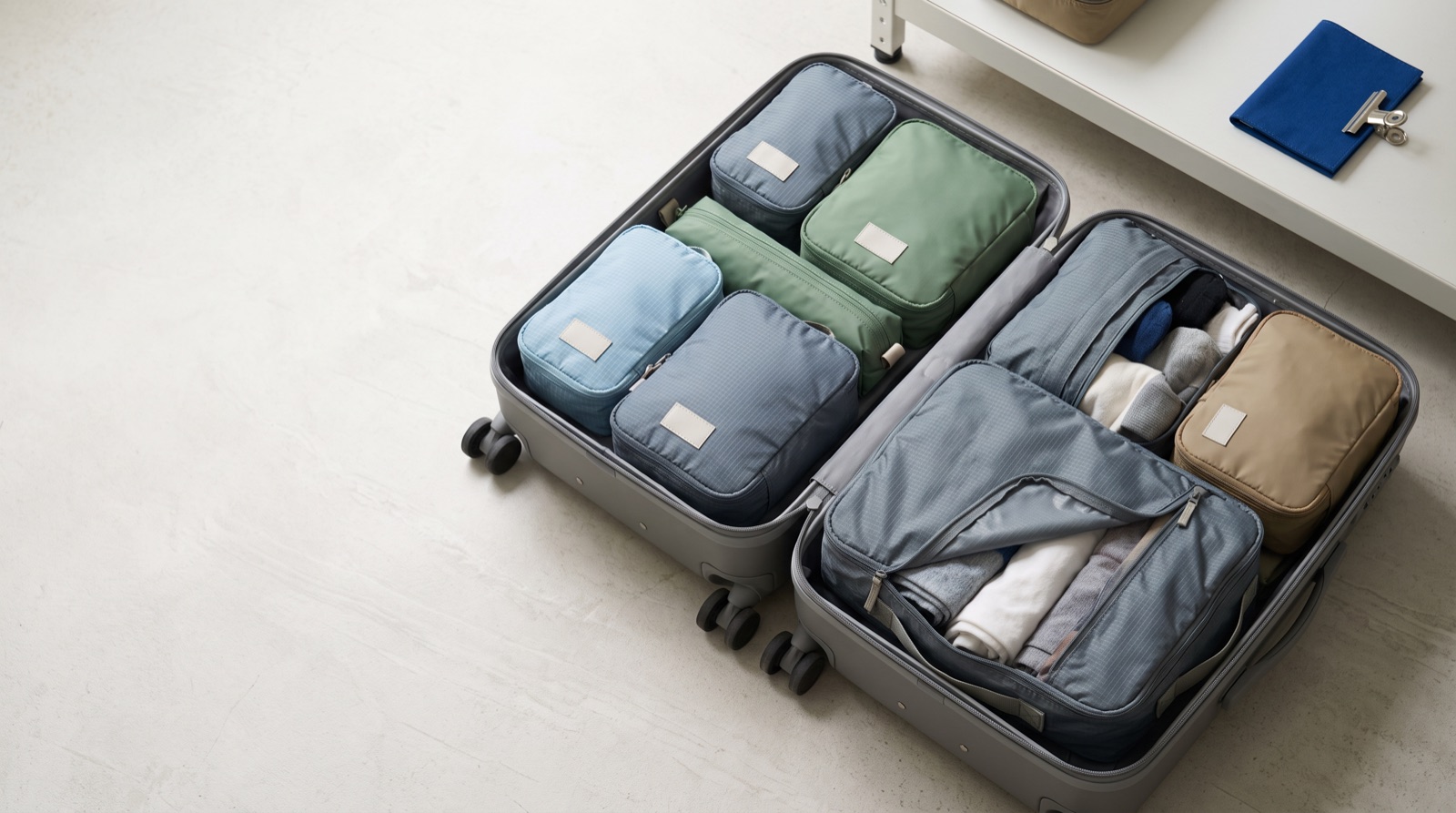
For travel organizers the shell has to survive being over-packed, compressed, dragged across an airport floor and unpacked again — repeatedly. That changes the material comparison from the one you would run for a retail pouch that spends its life on a shelf.
Ripstop nylon and RPET are both viable, and both are specified constantly in this category. They fail in different ways, which is the useful thing to know before choosing. One is a weave structure, the other is a fibre source — and that mismatch is the first thing to clear up, because it is why the comparison is so often argued badly.
One is a weave, the other is a feedstock#
Ripstop describes a weave, not a fibre. Heavier reinforcement yarns are woven in at regular intervals, forming the visible grid that gives the fabric its name. That grid is what stops a tear propagating: a cut that starts in one square is arrested at the next reinforcement thread instead of running the length of the panel.
RPET describes where the polyester came from — recycled PET, typically post-consumer bottle flake — not how it was woven. RPET can itself be woven as a ripstop, and increasingly is. So the honest comparison is usually between ripstop nylon and plain-woven RPET polyester, which is how the two are most often quoted, and it is worth saying which you mean in the brief.
Once that is clear, two separate decisions appear: fibre (nylon or polyester, virgin or recycled) and structure (plain weave, ripstop, or a heavier construction). They can be made independently.
Abrasion, tear and the failure modes that matter#
For a piece that will be packed tight and pulled at the seams, tear resistance is the single most relevant property, and it is why ripstop dominates the travel category. A tear that starts at a stress point — usually a corner, a zip end, or a handle attachment — stays local instead of running.
Nylon is generally the tougher of the two fibres for abrasion and tear at comparable weight; polyester holds up better to prolonged UV exposure and absorbs less water. For an organizer living inside a suitcase, abrasion and tear are the properties being tested daily and UV is nearly irrelevant, which tilts the fibre choice towards nylon unless something else outweighs it.
RPET in a comparable weight abrades acceptably but, in a plain weave, does not have the same tear-arresting behaviour. For a product used lightly this rarely surfaces. For a packing cube stuffed past its intended volume, it does — and the failure is visible, because it runs.
Weight, denier and how to compare like with like#
Fabric weight is quoted in denier — the mass in grams of 9,000 metres of yarn. It is a yarn measure, not a strength measure, but within one construction it tracks robustness closely enough to be useful: 70D and 210D are light shells, 420D and 600D are workhorses, 1680D is luggage-grade. Our note on denier explained covers where each sits.
Comparing a 210D ripstop nylon against a 600D RPET is not a material comparison, it is a weight comparison — and most disagreements about these two shells turn out to be exactly that. Fix the denier, or fix the finished weight target, and then compare.
Ripstop nylon is available in low weights that stay strong, which matters when a set of organizers is sold on how little it adds to the bag. RPET at equivalent strength is usually the heavier of the two, and on a set of five or six pieces that difference is noticeable in hand and measurable in freight cost.
Coatings, water resistance and what can honestly be claimed#
Both shells are usually coated on the reverse — PU is the common choice — and both can carry a durable water repellent finish on the face. Neither the fibre nor the weave makes a bag waterproof on its own; seams and zips decide that, as set out in our note on waterproof versus water repellent.
Repellent finishes are also where a compliance question enters. Some fluorinated treatments are restricted in a growing number of markets, and travel accessories are explicitly named in several of them. If a repellent finish is wanted, decide it at brief stage so the finish and its documentation are chosen together — our note on PFAS rules for fabric bags covers which markets reach this category.
Polyester absorbs less moisture than nylon, which means an RPET shell dries faster and is less prone to holding a damp smell if a wet item is packed. On a wash bag rather than a dry-goods organizer, that is a genuine point in RPET's favour.
Colour, print and lot-to-lot behaviour#
Nylon takes saturated colour predictably. RPET can shift slightly between dye lots, because the input is recycled feedstock with its own variation, and that shows most on pale and mid tones where a small shift is visible when two pieces sit side by side.
For a set — and travel organizers are usually sold as sets — this is the practical risk. Five cubes in one colourway have to match each other, not just the standard. Either lock the set to a single dye lot at order stage or choose a colour with more tolerance for variation. The approval discipline is the same one described in lab dips and why colours shift.
Mesh panels complicate this further: a mesh top and a solid body dyed separately will not match exactly unless they are matched deliberately. Decide at sampling whether they must match or should contrast.
Packability and how the product presents#
Both fold flat. Ripstop tends to recover its shape faster after compression, which affects how the product looks when the customer first unpacks it — a small thing that carries a lot of the perceived quality, and one that photographs badly if it goes wrong.
Where the piece has structure — a stand-up base, a rigid top opening — that structure comes from an interlining or a board, not from the shell, and the same insert works behind either material. It is worth separating "the shell feels flimsy" from "the piece has no structure", because they have different fixes.
The features buyers actually reach for in this category — compression zips, grab handles, mesh tops, ID windows — are largely shell-independent. Our note on travel organizer features buyers want covers which ones earn their cost.
The sustainability claim, and what it rests on#
If the programme carries a sustainability message, RPET is the route that supports it — with the caveat that applies everywhere: the claim rests on documentation for the specific material, not on the material category. Recycled content is evidenced with transaction certificates and a chain of custody, and that evidence is requested at material selection, not after the hangtag has been printed.
Recycled nylon exists too, and is worth asking about where tear performance is the deciding factor but the programme still needs a recycled position. It is less widely stocked than RPET and usually carries a longer material lead time, which is a schedule question rather than a technical one.
Our note on verifying a recycled material claim sets out what to ask for and in what order.
The fit test, and what to do at sample stage#
Whichever shell is chosen, travel pieces deserve one check the schedule should allow for: loading the sample with the contents it is actually designed for. A cube that measures correctly on a table can still fail once packed — the zip path tightens, the corners stack, the mesh bows — and that is far cheaper to discover at sample stage than after bulk.
Ask for the sample to be compressed and released a few times, not just filled once. What you are looking for is whether the seams at the corners still sit square and whether the zip still runs cleanly under load. Those two checks catch most of what separates a well-built organizer from one that fails in the second month.
Our note on what to check when your first samples arrive lists the rest, and what a pre-production sample confirms covers the gate after it.
Choosing#
Hard-use organizers, light weight, tear resistance the priority: ripstop nylon, with the denier fixed in the brief. A programme that must carry a documented recycled position: RPET, ideally in a ripstop construction so the tear behaviour is not given away with the fibre. A wash bag that will be packed damp: polyester, for the drying.
Whichever way it goes, fix the weight and the construction in writing before comparing quotations, and put the shell decision in the brief rather than after the first sample. Changing shell material after sampling means re-cutting the pattern, because the two do not behave the same at the seams. The travel accessories range shows where each shell is typically used.
| Ripstop Nylon | RPET | |
|---|---|---|
| Tear behaviour | Grid weave arrests a tear locally | Tears can propagate under load |
| Weight at equal strength | Lower | Higher |
| Shape recovery after compression | Faster | Slower |
| Print surface | Grid texture shows under pale flat ink | Even; takes full coverage well |
| Recycled position | No | Yes, subject to documentation |