
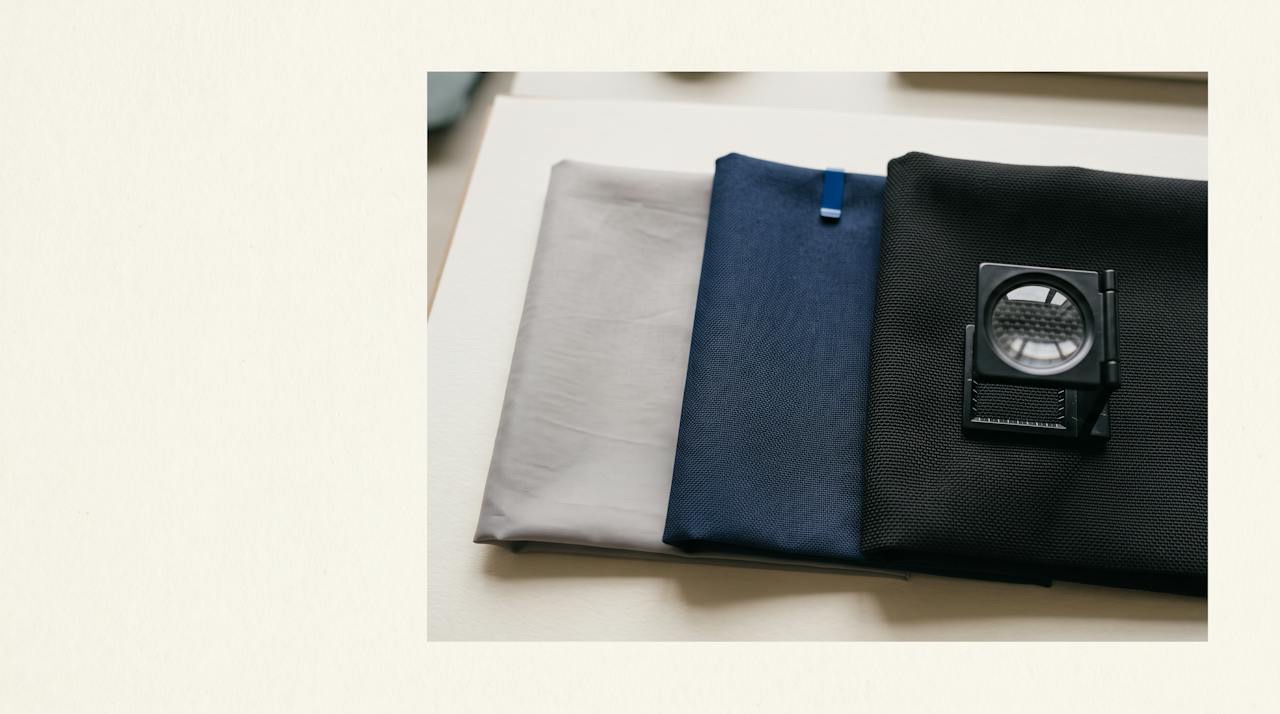
Denier Explained: 210D, 600D and 1680D for Bags and Pouches
What denier measures, how it differs from GSM and weave, and how to write a fabric line your factory can quote accurately
Denier measures the linear density of the yarn in a fabric: the weight in grams of 9,000 metres of that yarn. A higher number means a thicker, heavier yarn, so 210D suits linings and light pouches, 600D suits totes and structured cosmetic bags, and 1680D suits luggage panels. Denier alone does not define weight, weave, coating or strength.
Most bag quotations start with a number and a letter: 210D, 600D, 1680D. Buyers treat that number as shorthand for quality, and suppliers let them, because it is quick. But denier describes only one property of a fabric, and two 600D polyesters can differ sharply in weight, tear strength and hand feel.
This guide sets out what denier measures, what it does not, how it relates to GSM and weave, what each weight suits, and how to write a fabric line so the quote you receive is priced against the fabric you have in mind.
What denier actually measures
Denier is a direct linear density unit: the mass in grams of 9,000 metres of yarn. A 600 denier yarn weighs 600 grams per 9,000 metres. The 9,000-metre basis is inherited from the silk trade, and the unit sits alongside tex, the metric equivalent, which uses 1,000 metres as its basis — so one tex equals nine denier. The international convention for designating linear density is set out in ISO 1144, Textiles — Universal system for designating linear density (Tex System).
Two consequences follow. First, denier is a yarn property, not a fabric property: it tells you how heavy the thread is, not how much thread went into a square metre. Second, it measures mass per length, not strength — fibre type, filament count, twist and finishing all move tensile and tear results independently of the denier figure.
Denier is not GSM, and neither is weave
GSM — grams per square metre — is the mass of the finished fabric per unit area, measured by methods such as ASTM D3776/D3776M. It tells you how substantial the material feels in the hand and how much it adds to freight weight. Denier feeds into GSM, but so do warp and weft density, the weave, and every coating applied afterwards.
This is why a loosely woven 600D at around 200 gsm and a densely woven, PU-backed 600D at 350 gsm both answer honestly to "600D" while behaving like different materials. The rule for buyers: quote denier and GSM together, and treat GSM as the tie-breaker. A supplier who gives denier but not GSM is quoting a yarn, not a fabric.
Ripstop, oxford and twill: what the weave name adds
Weave describes how warp and weft interlace, and it changes behaviour as much as yarn weight does. Oxford is a basket-type plain weave in which two or more yarns run together in one direction, giving a dense, slightly textured, hard-wearing surface; it is the default for 600D and 1200D bag shells. Twill gives the diagonal rib seen in luggage and laptop bags, with softer drape and better crease recovery than a plain weave of equal weight.
Ripstop is less a weave than a reinforcement grid: heavier yarns inserted at regular intervals so a puncture stops at the next grid line instead of running. It is why a light 210D ripstop can outperform a plain 300D in service, and it is worth specifying explicitly for packable travel goods — compared in our note on ripstop nylon versus rPET for travel organizers.
What each common weight suits
70D to 210D is lining and light-shell territory. Fabric at these weights packs down small, takes bright colour well and adds almost nothing to shipping weight, which matters for a gift-with-purchase programme. It will not hold a shape unaided, so structure has to come from interlining, foam or a moulded base.
300D to 600D is the working range for most cosmetic bags, wash bags, totes and organizers. At 600D a fabric holds a boxed shape with light interlining, takes print, embroidery and heat transfer reliably, and stands up to daily handling. 900D to 1680D belongs to luggage, tool bags and high-abrasion panels, at the cost of stiffness, carton bulk and harder sewing at multi-layer seams. Going heavier than the use case needs adds cost without adding perceived value — one of several drivers in what drives the unit price of a custom cosmetic bag.
Coatings, finishes and what they commit you to
Most bag fabrics are coated on the reverse. PU (polyurethane) backing is the common choice: it blocks light water penetration, stabilizes the weave and gives a clean inner face. PVC coatings are heavier, glossier and cheaper, but carry a regulatory tail — plasticised materials fall under the phthalate restriction in Regulation (EU) 2018/2005, which restricts DEHP, DBP, BBP and DIBP at 0.1 % by mass in plasticised material in articles. Many beauty brands now specify PVC-free by default.
Water-repellent finishes deserve separate attention. Fluorinated durable water repellents are under sustained regulatory pressure: California AB 1817 prohibits regulated PFAS in new textile articles placed on the state market from 1 January 2025, and the EU is assessing a group-wide PFAS restriction under REACH. If your brief says "water resistant", say whether you mean a PFAS-free repellent finish, a coating, or both, and ask for the declarations at material stage.
Making the claim checkable: the tests that matter
A fabric line becomes enforceable only when it names the test a lab will run, and for bags the short list is small. Abrasion resistance is normally assessed by the Martindale method in ISO 12947-2, which determines the cycle count at specimen breakdown. Surface water repellency is graded by the spray test in ISO 4920, and resistance to water penetration under pressure as hydrostatic head under ISO 811.
Pick the one or two that match the product's real failure mode — corner abrasion on a travel organizer, splash resistance on a wash bag — and set a target against them. Everything else is better handled at inspection than in the specification; see how to set an AQL inspection plan for where those lines belong.
How to write the fabric line in a tech pack
A quotable fabric line carries seven elements: fibre and content, denier, weave, GSM with tolerance, coating, finish and colour reference. Written out: "Shell: 100 % recycled polyester, 600D oxford, 320 gsm ±5 %, PU backing, PVC-free, PFAS-free water-repellent finish, colour to Pantone 19-4052 TCX, approved lab dip to govern."
That single line removes most of the ambiguity that produces a surprise at sampling. Put the reverse side and lining on their own lines, state whether the mill is nominated or open, and name the swatch you are matching to. Then confirm the approved construction at pre-production sample stage, the last practical point to change it — our note on what a PPS actually confirms explains why.
Choosing with your manufacturer, not after them
Fabric selection works best as a conversation held before the first sample, not a correction made after it. A maker who handles the construction daily can tell you where 600D is over-specified, where a ripstop grid will save a returns headache, and where a coating will complicate a decoration method you have already committed to.
ROOTSMEN has been making custom cosmetic bags, pouches, travel organizers and promotional soft goods since 1981, with its own factory in Guangdong since 1993, and works to FAMA (Disney), ISO 9001, SMETA, GMP and BSCI. If you have a reference bag, a target look or only a rough brief, send the swatch and the use case and talk it through with our team before the fabric line is locked.
| Denier | Typical weave | Character | Best-fit applications | Watch-outs |
|---|---|---|---|---|
| 70D–210D | Plain, ripstop, taffeta | Light, packable, drapes freely | Linings, dust bags, packable pouches, GWP inserts | No shape without interlining; shows seam pucker |
| 300D–420D | Oxford, ripstop | Light structure, soft hand | Flat pouches, cosmetic bag linings, light organizers | Corner abrasion on unsupported bases |
| 600D | Oxford, twill | Holds a boxed shape, prints well | Cosmetic bags, wash bags, totes, travel organizers | GSM varies widely at the same denier — confirm it |
| 900D–1200D | Oxford | Firm, scuff-resistant, visibly heavier | Weekenders, tool and equipment bags, base panels | Stiff seams; bulkier cartons and higher freight |
| 1680D | Ballistic-style oxford | Very firm, high abrasion resistance | Luggage shells, wheeled cases, high-wear panels | Hard to sew in multiple layers; limited colour range |
Event Details
From the Stand
Frequently Asked Questions
The questions this topic actually raises when a program is being scoped.
No. Denier describes yarn thickness, not fabric strength. A 210D ripstop nylon can outperform a plain 300D polyester in tear resistance because fibre type, weave, thread count and finishing all contribute. Ask for tear and abrasion results against a named test method rather than inferring performance from the denier number alone.
Denier is the weight of 9,000 metres of yarn; GSM is the weight of one square metre of finished fabric. Denier describes the thread, GSM describes the cloth after weaving and coating. Two 600D fabrics can differ by a hundred grams per square metre, so specify both figures.
600D oxford is the usual starting point for a structured cosmetic bag, because it holds a boxed shape with light interlining and accepts most decoration methods. Lighter 210D–420D suits flat pouches and linings. Confirm the choice against your sample and your decoration method before pricing.
Not reliably. The denier figure is honest but incomplete — thread density, weave, coating weight and finish vary between mills at the same denier. Compare offers on denier plus GSM plus coating, and keep a physical approved swatch as the governing reference for bulk fabric.
For most beauty and retail programmes, yes. Plasticised materials fall under the EU phthalate restriction, and California prohibits regulated PFAS in new textile articles from 2025. Stating both in the fabric line means the mill quotes compliant material from the start rather than substituting it later.
Ripstop inserts heavier reinforcement yarns in a grid so a tear stops at the next grid line instead of running. It is worth specifying for packable travel goods, lightweight shells and anything that will be stuffed into luggage. On a heavy 600D structured bag it adds less practical benefit.
Related Products
Builds where this decision applies.

Have a product requirement of your own?
Tell us the product, the quantity and the timeline — we'll scope a development plan.