An insulated bag is three products in one: an outer shell chosen for looks and wear, an insulation layer chosen for performance, and an inner liner chosen for cleaning and leak resistance. Briefs usually specify the first and leave the other two to the factory, which is how two bags that look identical perform completely differently.
There is also no legal definition of "insulated". A bag with a thin foil liner and one with 5 mm of foam can both be sold under the word, and the difference in what they actually do is large.
The three layers#
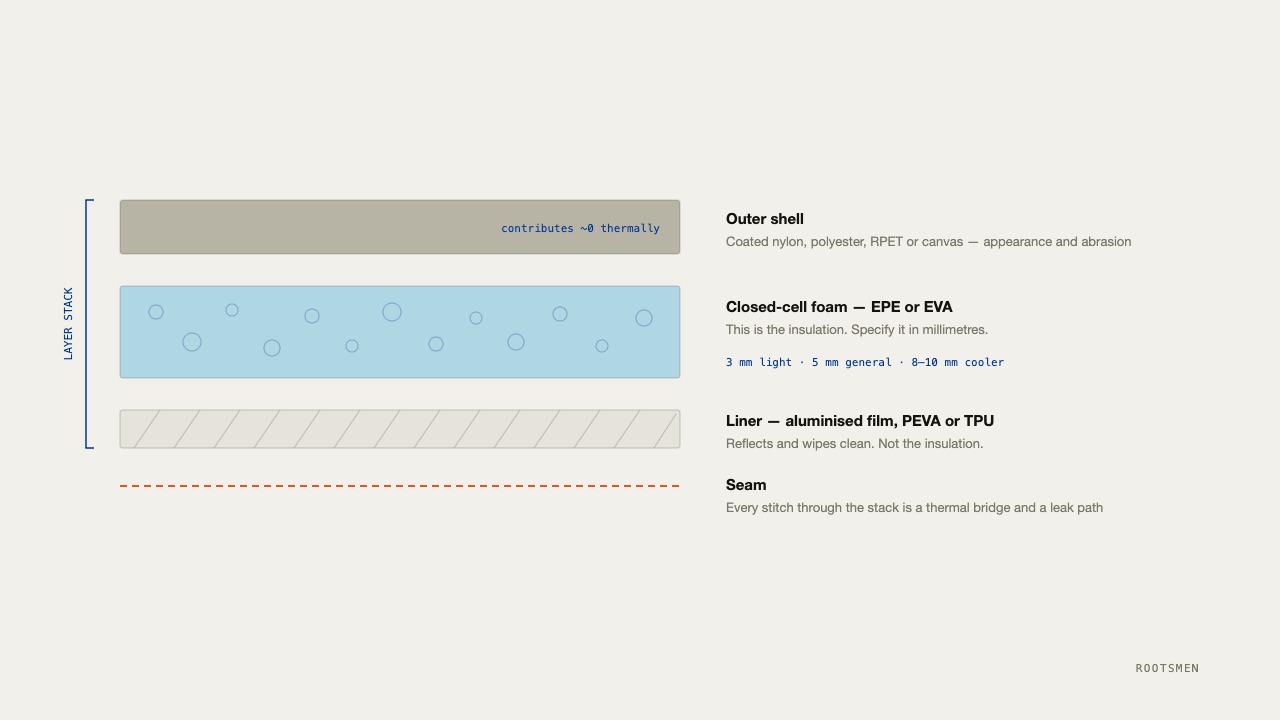
The outer shell is an ordinary bag material — coated nylon, polyester, RPET, canvas — chosen for appearance, abrasion and print. It contributes almost nothing to insulation.
The insulation is the middle layer and the one that does the work. Closed-cell foam — usually EPE or EVA sheet — is the common choice, specified by thickness. Around 3 mm is a light lunch bag, 5 mm is the general-purpose weight, 8–10 mm is a serious cooler. Each step adds bulk and cost.
The liner is what touches the food. Aluminised film (often called foil) is the standard: it reflects radiant heat, wipes clean and resists moisture. PEVA and TPU liners are used where a foil look is not wanted or where a softer hand is preferred.
The common misunderstanding is that the foil is the insulation. It is not — it is a reflective, wipeable surface. Without foam behind it, a foil-lined bag holds temperature for a very short time.
Seams are where the cold goes#
Insulation performance is decided as much by construction as by the foam. Every stitched seam through the layer stack is a thermal bridge and a potential leak path, and a bag with excellent foam and ordinary sewn seams will under-perform.
Heat-sealed or welded liner seams keep the inner skin continuous, which is both better thermally and far better when something spills. It costs more and it limits the shapes available.
Taped seams are a middle answer: sewn, then covered with a sealing tape on the inside.
If the brief asks for a bag that holds temperature for a stated number of hours, the seam method has to be specified too, or the number is not achievable regardless of the foam.
What you can honestly claim#
"Keeps food cold for X hours" is a performance claim, and it depends on the starting temperature, the ambient temperature, whether an ice pack is used, how full the bag is and how often it is opened. A number quoted without those conditions is not a specification; it is marketing.
If a number has to appear on packaging, it should come from a test under stated conditions, and that test should be agreed before the claim is written. Our note on compliance documents covers how declarations and reports are normally handled.
A safer and more defensible claim describes construction rather than outcome: the insulation thickness, the liner material and the seam method. It is also more useful to a buyer who knows what they are comparing.
Food contact, which is a different question#
The liner touches food, and that brings food-contact requirements that an ordinary bag never faces. Both the EU and the US regulate materials intended to contact food, and the relevant declaration covers the specific liner compound rather than the bag.
This is the single most common gap in cooler-bag briefs. Ask for the food-contact declaration for the liner material at quotation stage, and state the destination market — the requirement differs and the paperwork is specific to it.
If the bag is explicitly sold as not for direct food contact — food goes in containers inside it — say that in the copy, because it changes what is required.
Condensation, smell and cleaning#
Three complaints account for most cooler-bag returns and all three are construction decisions.
Condensation collects at the base. A bag with a sewn base seam leaks it; one with a welded base holds it. A removable liner tray solves it completely at a cost.
Smell comes from moisture trapped in the foam after a leak, and it is permanent once it is there. This is the argument for a sealed liner rather than a sewn one on any bag that will carry liquids or ice.
Cleaning is why foil and PEVA dominate over fabric liners: they wipe. A fabric-lined insulated bag cannot be properly cleaned, and buyers discover that in week two.
Shape, closure and what it does to performance#
A bag with a wide top opening loses cold air every time it is opened; one with a smaller opening keeps it. That is a real trade-off against usability rather than a fault.
Zips are the common closure and are a thermal weak point unless the bag has a flap over them. A roll-top closure performs better thermally and reads as outdoor rather than lunch. A lid with hook-and-loop sits between them.
Rigid or semi-rigid walls hold shape and protect contents but cannot be flattened, which affects both shelf presence and freight — the same calculation as any structured bag, covered in sea, air or express freight.
What to send with the brief#
What goes inside, for how long, and in what ambient conditions. Those three decide the insulation thickness, and without them the factory is guessing at the layer that costs the most.
Then: whether food touches the liner, the destination market, and whether a performance claim will appear on packaging. Each changes the specification and the documentation.
ROOTSMEN builds insulated bags as part of the lifestyle range, with the liner declaration supplied per programme. Send the use case and we will quote the layer stack rather than a bag.
| Layer | What it is | What it does | What to specify |
|---|---|---|---|
| Outer shell | Coated nylon, polyester, RPET, canvas | Appearance, abrasion, print | Material and weight |
| Insulation | Closed-cell EPE or EVA foam | Holds temperature | Thickness in mm |
| Liner | Aluminised film, PEVA or TPU | Reflects, wipes clean, resists moisture | Material and food-contact status |
| Seams | Sewn, taped or welded | Thermal bridging and leak path | Seam method, if a holding time is claimed |