"Where are your bags made?" is asked early in most sourcing conversations and answered badly in most of them, because the honest answer is that country matters less than people expect and differently than they expect.
The things a country decides are the supply chain around the factory, the tariff position into your market, and the practical realities of visiting and communicating. The things it does not decide are workmanship, quality systems and whether a specific factory can build your product. Those are factory-level, and the range within any one country is wider than the average difference between countries.
This note is about which questions belong to the country and which belong to the supplier — not about which country is best, because for soft goods that question has no general answer.
What the supply chain around the factory decides#
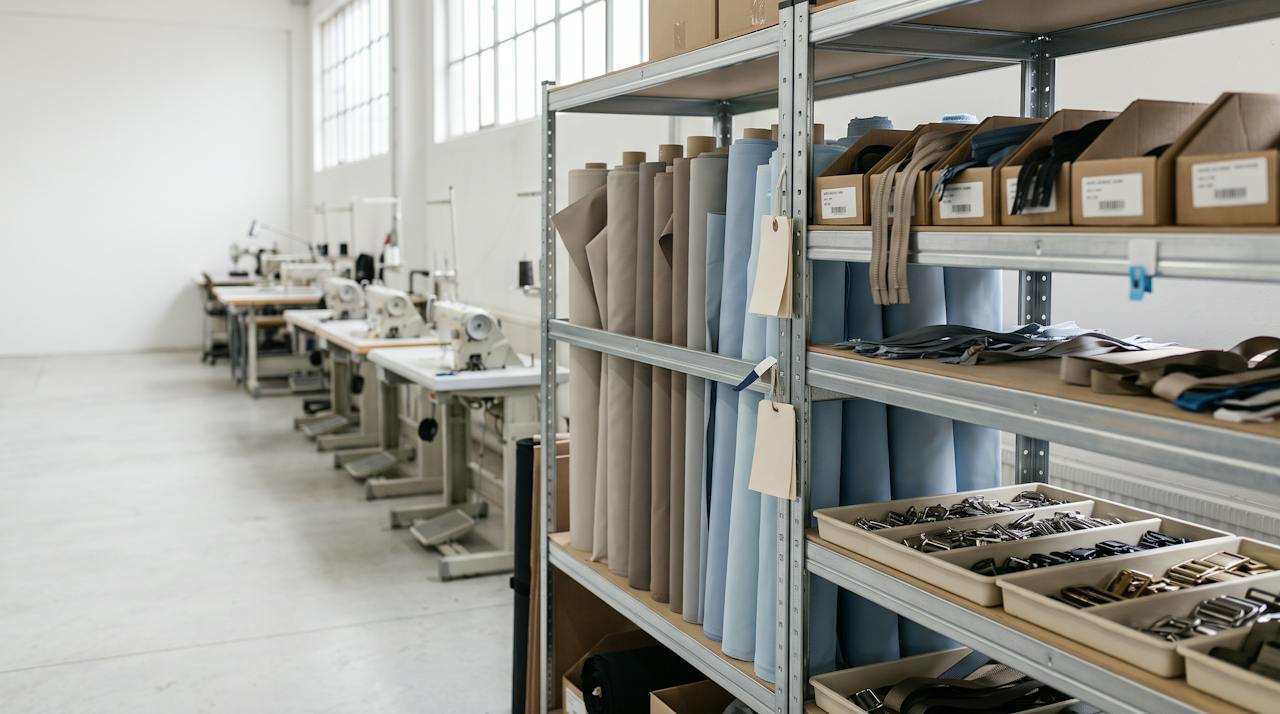
Bag manufacturing depends on components: zips, webbing, buckles, sliders, linings, coated fabrics, hardware. A factory sitting inside a dense component cluster can source a specific zip in a specific colour in days; one outside it orders and waits.
This is the most consistent real difference between sourcing locations, and it shows up as material lead time rather than as price. Guangdong in southern China has the deepest soft-goods component base of the three, developed over decades, and for a build with unusual hardware or a specific shell that depth is the thing that moves a schedule.
Vietnam's soft-goods base has grown substantially and is strong for volume production, but a share of components is still imported, which can add a step for a build that needs something specific. Taiwan's strength is different again: material engineering and technical fabrics, with a manufacturing base that has largely moved upstream.
The practical question is not which country but: for this build, with these components, what is the material lead time? Our note on how long a custom bag order takes explains why that figure usually dominates the schedule.
Tariffs and origin, which change and must be checked#
Country of manufacture sets the country of origin, and origin sets the duty rate into your market. For bags this is a live variable: rates on textile and leather goods have moved repeatedly in recent years, and additional duties apply to some origins in some markets.
Nothing in this note should be used as a duty figure. Rates change, they differ by tariff line, and the tariff line for a bag depends on the outer material rather than on the product name — our note on which HS code applies covers why. Check current rates in the official tariff for your market at costing and again before shipment, with your customs broker.
What is worth knowing structurally: origin is determined by where substantial transformation happens, not by where the fabric came from. A bag cut and sewn in one country from fabric woven in another normally originates where it was made. Where a trade agreement is involved, the rules of origin may be stricter, and they are the broker's question rather than the factory's.
ROOTSMEN does not classify goods or act as customs broker. The specification we supply describes materials, construction and dimensions; the code and any binding ruling are the importer's responsibility.
Cost, and why country is the wrong first lever#
Labour cost differences between soft-goods locations are real but narrower than they were, and they are only one input into a bag's price. Material is usually the largest component, and material is traded internationally — the same coated nylon costs broadly what it costs wherever it is sewn.
Meanwhile the things that genuinely move a unit price are construction, material choice, decoration count and quantity, and those are decisions rather than geography. A simplified construction saves more than a country change does on most builds. Our note on what drives the unit price puts them in order.
The cost differences that do follow location are freight and duty, and those are calculable rather than negotiable. Work them out before treating a lower ex-factory price as a saving — a cheaper bag landed at a higher duty rate is not cheaper.
Compliance and audits are factory-level, not country-level#
A social audit or a management-system certificate says something about a specific site on a specific date. It says nothing about the country, and treating a country as a proxy for standards is how buyers end up surprised in both directions.
Ask for the site's own reports: what scope, what date, what corrective actions, and whether they are closed. Our note on what SMETA, BSCI and ISO 9001 actually prove explains what each covers and how to verify it, because each proves something narrower than it is usually asked to.
The same applies to product compliance. Restricted substances, labelling and documentation are set by the market you sell into, not by where the bag was made — see compliance documents for the US and EU and PFAS rules.
Communication, time zones and visiting#
The unglamorous differences are often the ones that decide how a programme runs. Who writes your specification in your language, how quickly a question gets answered, and whether the person answering understands what you are asking.
A development conversation that takes one exchange per day because of a time zone and a translation step will cost more rounds than one that takes three exchanges in a morning. This is a supplier characteristic, not a country characteristic, but it correlates with how a supplier is organised.
Visiting still matters for a first programme of any size. Ask what you would actually see: the line running your product, or a showroom. Those are different visits.
Splitting production across locations#
Larger programmes sometimes run in more than one location — for tariff exposure, for capacity, or for continuity. It is a legitimate structure and it has a specific cost: every location is its own approval.
A pre-production sample approved at one site is not an approval at another. Patterns, material lots, operators and finishing all differ, and a second site needs its own PPS and its own inspection plan. Programmes that skip this step are the ones where two shipments of the same SKU do not match.
It also doubles the documentation. Origin marking, care labels and compliance files are per site, and a label printed for one origin cannot ship from the other.
How ROOTSMEN is set up#
ROOTSMEN is a Taiwanese company with production in Guangdong. In practice that means specification, development and programme management run from Taiwan, and manufacturing sits inside the southern China soft-goods component base — which is the part of the chain where material lead time is usually won or lost.
What that arrangement is good for: builds that need specific components sourced quickly, and buyers who want the development conversation to happen in one place with one person accountable for it. What it does not change: the tariff position, which depends on origin and on your market, and which your broker should confirm.
If sourcing location is part of your decision, say so in the enquiry along with the destination market. It changes what is worth quoting.
The questions to ask instead#
Replace "which country" with four questions that have answers. What is the material lead time for this specific build? What is the origin, and what duty does my broker calculate on it into my market? What audits does this site hold, in what scope, and when? And who writes my specification, in what language, with what turnaround?
Those four settle almost everything the country question was reaching for, and they are answerable by any supplier worth shortlisting. Our note on how to choose an OEM/ODM bag manufacturer covers the rest of the vetting.
| Question | Decided by |
|---|---|
| Component availability and material lead time | Location — the cluster around the factory |
| Country of origin and the duty rate | Location, plus your market's tariff, which changes |
| Freight cost and transit time | Location and your chosen mode |
| Workmanship on your build | The factory, not the country |
| Audits, certifications, corrective actions | The site, on a stated date and scope |
| Product compliance and labelling | The market you sell into |
| Specification quality and response time | The supplier's organisation |