
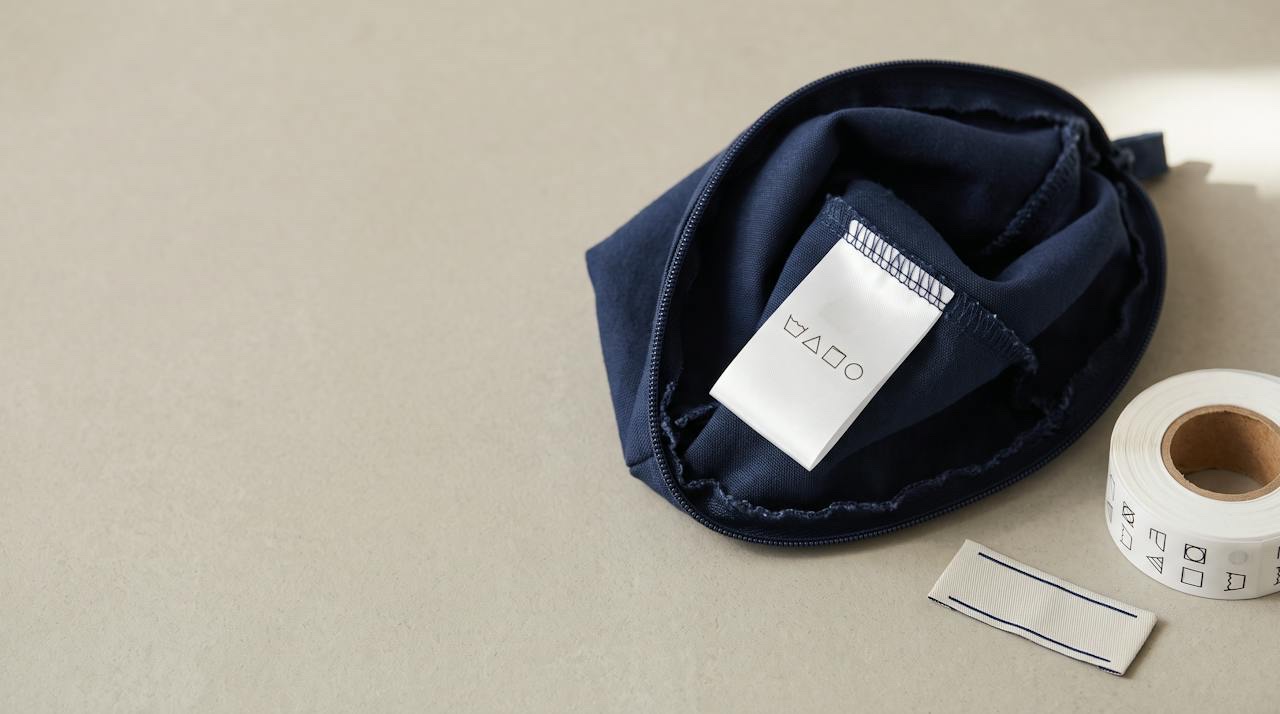
Care Labels for Bags and Pouches: What You Must Put on Them
Country of origin, fibre content, care symbols and language rules for soft goods sold in the US, EU/UK and Japan
A bag or pouch sold in the US must carry a country of origin marking; fibre content and care wording are only mandatory once you make a fibre claim, because handbags and luggage are exempt under the Textile Act. The EU and UK exempt travel goods from fibre labelling but still require traceability details. Japan regulates bags as sundry goods.
Most buyer briefings treat the care label as an afterthought, added once the artwork is signed off. It is the last thing decided and the first thing a customs officer or a market surveillance authority looks at. The rules are also less intuitive than people expect: a cosmetic pouch is not a garment, so obligations that apply to a T-shirt often do not apply to it. Here is what a soft-goods label must carry in the United States, the EU and UK, and Japan, tied to the official text behind each rule.
Stop treating "the care label" as one object: origin marking says where it was made, fibre content says what it is made of, and care instructions say how to clean it. They come from different statutes, and a market may require all three, one, or none.
United States: origin marking is the one you cannot skip
Under section 304 of the Tariff Act, imported articles must be marked with the English name of the country of origin for the ultimate purchaser, in a conspicuous place, as legibly, indelibly and permanently as the nature of the article permits. US Customs and Border Protection explains how it reads that duty in Marking of Country of Origin on U.S. Imports.
For a pouch that normally means a sewn-in fabric label rather than a hangtag or sticker, because the marking must survive until the product reaches the buyer.
The US fibre-content exemption — and how brands lose it
The Textile Fiber Products Identification Act requires generic fibre names and percentages by weight, the manufacturer's name or RN, and country of origin — but handbags and luggage, and the textile fibre products incorporated in them, are exempt. The FTC lists them alongside shoes and hats in Threading Your Way Through the Labeling Requirements.
The catch: the exemption falls away the moment any representation about fibre content is made in an advertisement, on a label or in any other means of identification. Print "100% recycled polyester" on a hangtag, a webshop page or an insert and full disclosure applies — correct generic names, percentages by weight in descending order of predominance, marketer identity. Sustainability copy triggers this constantly, and the label is rarely updated to match.
So decide early whether your copy will lean on materials, and verify the claim before artwork: see how to verify a recycled material claim and nylon versus rPET for cosmetic pouches.
Care wording in the US: covered, or voluntary?
The FTC Care Labeling Rule applies to textile wearing apparel — items worn to cover or protect the body — plus certain piece goods, and Clothes Captioning further excludes shoes, gloves, hats, handkerchiefs, belts and neckties. A cosmetic bag is not wearing apparel, so the rule does not force care wording onto it.
Care copy is still worth having: retail vendor manuals routinely demand it, and anything you print must be truthful. Where the rule does apply it requires the label to stay legible for the useful life of the product, and permits ASTM care symbols in place of words, naming ASTM D5489.
Care symbols: ISO 3758, GINETEX and the Japanese set
Outside the US the vocabulary comes from ISO 3758, a fixed sequence of five treatments: washing (tub), bleaching (triangle), drying (square), ironing (iron) and professional textile care (circle). GINETEX, which created the symbols, licenses them and publishes their meanings.
Japan's JIS L 0001 was harmonized with ISO 3758 and took full effect on 1 December 2016, expanding the symbol set and dropping most explanatory Japanese wording; it was revised again as JIS L 0001:2024, announced by METI. An ISO plate and a Japanese plate now look nearly identical, but the symbols are licensed marks — check your rights before reusing a supplier's file.
EU and UK: travel goods are exempt, traceability is not
Regulation (EU) No 1007/2011 covers textile products and articles containing at least 80% by weight of textile fibres. Its Annex V lists products for which labelling is not mandatory, and that list includes travel goods, along with fancy goods and spectacle and cigarette cases. The UK retained the instrument, and the same Annex V list sits on legislation.gov.uk.
There is therefore no fibre-composition duty of the apparel kind, and no EU care-labelling law at all — GINETEX symbols are used voluntarily and by contract. Where composition is given it must use the approved fibre names, in the official language or languages of the state of sale.
What has hardened is traceability. The General Product Safety Regulation (EU) 2023/988 requires a type, batch or model identifier plus the manufacturer's name, postal address and electronic address, with importer details too; where the product cannot carry them they go on the packaging or an accompanying document. That is a label change, and it is catching gift-with-purchase programmes out.
Japan: bags are sundry goods, not textiles
Japan's Household Goods Quality Labelling Act, administered by the Consumer Affairs Agency, sorts products into textile products, plastic products, electrical appliances and miscellaneous manufactured goods. Bags sit in the last family, under the labelling schedule for bags, not the textile schedule.
That schedule asks for the type of leather to be stated properly where leather is used, and for handling precautions on three points: cleaning with a cleaner, cream or neutral detergent suited to the material; drying in the shade when wet; and avoiding storage in humid places. It also requires the labelling party's name with an address or telephone number, shown on each bag where the consumer can easily see it — in Japanese. A Japanese programme needs its own label content, not a translated Western plate.
Placement, durability and one label programme that ships everywhere
Physically, woven or printed satin labels sewn into a side or lining seam survive best; loop labels hide the raw edge and stop the label curling into the zip track. Heat transfers can lift after abrasion on coated nylon — a compliance risk when they carry the origin marking. Keep the mandatory block stitched rather than adhered, clear of the fill area, and approve the real label on the real fabric at pre-production sample stage, with label defects named in your AQL inspection plan.
The workable pattern is a common mandatory block — origin, responsible-party identity, batch or style code — plus market-specific inserts: EU and UK contact details, a Japanese handling panel, and fibre content only where you have chosen to make a claim you can support.
ROOTSMEN has made cosmetic bags, pouches, travel organizers and promotional and gift-with-purchase soft goods since 1981, with our own factory in Guangdong since 1993; our audits and certifications include FAMA (Disney), ISO 9001, SMETA, GMP and BSCI. If you are mapping label content across markets, talk to us or look through our cosmetic bags.
| Requirement | United States | EU / UK | Japan |
|---|---|---|---|
| Country of origin marking | Required: English country name, conspicuous, legible, indelible and as permanent as the article permits | Not harmonized as a textile label duty; commonly applied by contract and customs practice | Not set by the bags labelling schedule; check import and retailer requirements |
| Fibre content | Exempt for handbags and luggage — unless any fibre claim is made anywhere, which reinstates full disclosure | Travel goods listed in Annex V, so fibre labelling is not mandatory | Bags fall under the sundry goods schedule, not the textile schedule |
| Care instructions | Care Labeling Rule covers wearing apparel, not bags; voluntary but must be truthful | No EU care-labelling law; GINETEX / ISO 3758 symbols used voluntarily | Handling precautions are required: suitable cleaner, shade drying, avoid humid storage |
| Symbol standard | ASTM D5489 symbols permitted in place of words where the rule applies | ISO 3758 / GINETEX | JIS L 0001, aligned with ISO 3758 |
| Language | English country name required | Fibre composition, where given, in the official language(s) of the selling state | Japanese |
| Party identity on product | Manufacturer name or RN where textile disclosure applies | GPSR: manufacturer and importer name, postal and electronic address, plus a product identifier | Name of labelling party with address or telephone number |
Event Details
From the Stand
Frequently Asked Questions
The questions this topic actually raises when a program is being scoped.
No, not in the sense apparel does. The US Care Labeling Rule covers textile wearing apparel, and the EU has no care-labelling law at all. Care symbols on a pouch are voluntary or contractual. What is genuinely mandatory is origin marking in the US and party identification in the EU and UK.
Only if you make a fibre claim. Handbags and luggage are exempt from the Textile Act's disclosure requirements, but the exemption is lost if any representation about fibre content appears in advertising, on a label or in any other identification. Then full generic names and percentages by weight apply.
Yes, in the US it can. A fibre-content representation anywhere — hangtag, webshop, insert — removes the handbag and luggage exemption and triggers full disclosure on the label. It also needs substantiation. Settle the material claim and its evidence before artwork is released, not afterwards.
Visually they are close, because JIS L 0001 was harmonized with ISO 3758 and both use the same five-treatment sequence. But the symbols are licensed by GINETEX, so confirm your usage rights, and Japan's bags schedule asks for written handling precautions in Japanese rather than symbols alone.
It means traceability information must travel with the product: a type, batch or model identifier, plus the manufacturer's name, postal address and electronic address, and the importer's details. Put it on the product where possible, otherwise on the packaging or an accompanying document. Gift-with-purchase programmes are not excused.
Into a side or lining seam, clear of the fill area and the zip track, so contents do not abrade it. Stitch the mandatory block rather than heat-transferring it, especially on coated nylon. Approve the real label on the real fabric at pre-production sample stage. ROOTSMEN handles this at that gate as standard.
Related Products
Builds where this decision applies.

Have a product requirement of your own?
Tell us the product, the quantity and the timeline — we'll scope a development plan.