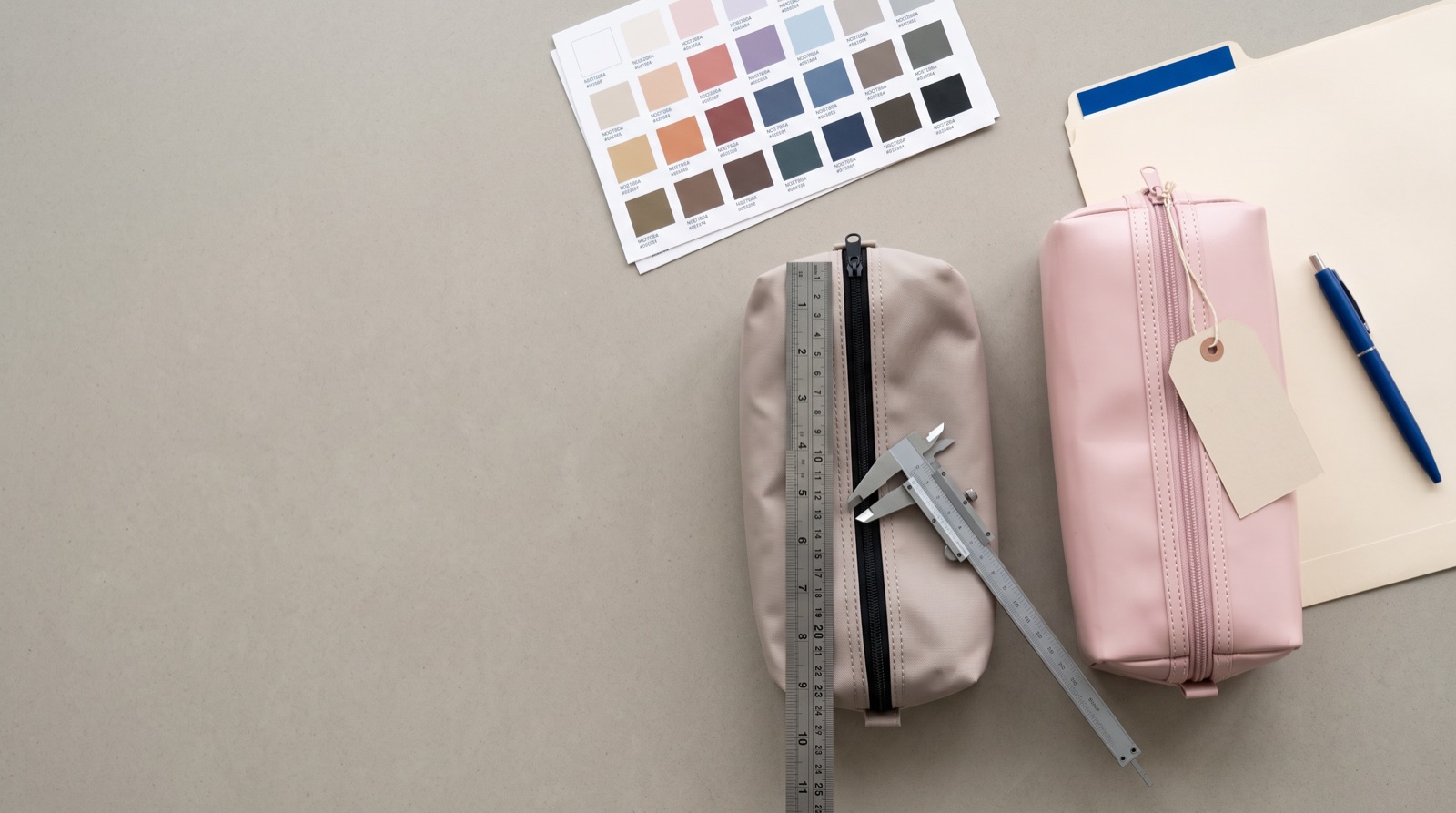
Nylon and RPET both work as cosmetic pouch shells, and on paper they look interchangeable. In development they behave differently enough that picking one late usually costs a revision round — and the revision is a pattern change, not an adjustment.

The short version: nylon is the more forgiving material to build a structured shape from; RPET is the material that lets you make a sustainability claim you can actually document. Which matters more is a positioning decision, not a technical one, and it is worth making before the first sample rather than after.
- Print: RPET takes transfer and sublimation well; screen printing needs a test on the specific lot
- Hand: RPET is slightly drier and less fluid at the same weight
- Colour: recycled yarn dyes with more lot-to-lot variance
- Cost: comparable at volume; the gap widens on short runs
What they are, and what the names leave out#
Nylon is a polyamide. In this category it usually arrives as a woven fabric in 210D, 420D or 600D, frequently coated on the reverse with PU for body and water resistance, and sometimes woven as a ripstop for tear resistance.
RPET is polyester made from recycled PET — the name describes the feedstock, not the weave or the weight. That is the first thing to pin down, because a quotation comparing 210D nylon to 600D RPET is comparing weights, not materials. Fix the denier or the target finished weight, then compare. Our note on denier explained covers where the common weights sit.
Both are commonly specified alongside a coating and a lining, and both of those change the hand more than the shell fibre does. A soft RPET with a firm interlining feels more structured than a nylon with none.
How they behave in construction#
Nylon holds a crease and takes a structured, boxed shape with less internal reinforcement. If the brief calls for a pouch that stands up on shelf empty, nylon gets there with fewer added panels, which keeps both the weight and the unit cost down.
RPET is generally softer in hand and slightly less consistent lot to lot, because the input is recycled feedstock. That is not a defect — it is the nature of the material — but it means a structured silhouette usually needs either a heavier weight or an added base panel, and both of those change the costing. Our note on lining and interlining covers which layer does what.
At the seams the two differ in how they take a needle. Coated fabrics show needle holes more readily, which matters on a bound edge or a topstitched corner, and the stitch density that looks right on one can perforate the other. This is set on the sample, per material, and is one of the reasons a late shell change means re-cutting rather than re-sewing.
Colour and print#
Nylon takes saturated colour predictably and holds fine print detail well. RPET can shift slightly between dye lots, which matters most for pale and mid-tone colours where a small shift is visible side by side.
The practical implication for a range: if several SKUs in the same colourway must sit together on shelf, either lock them to a single dye lot at order stage or choose a colour with more tolerance for variation. This is worth deciding at material selection, not at final inspection — the approval discipline is set out in lab dips and why colours shift.
For printing, RPET takes transfer and sublimation well; screen printing needs a test on the specific lot, because the coating affects ink adhesion. On darker shells of either material an underbase is usually needed, which is an extra colour in the setup — see choosing a print method.
Water, cleaning and how the piece ages#
Polyester absorbs less moisture than nylon, so an RPET pouch dries faster and is less prone to holding a damp smell — a genuine advantage on a wash bag that gets packed wet. Nylon is the tougher of the two for abrasion at comparable weight, which shows on a piece that lives loose in a handbag.
Neither is waterproof by virtue of the fibre. Water resistance comes from the coating, the seams and the zip, and the honest limit of what can be claimed is set out in waterproof versus water repellent.
If a repellent finish is wanted, decide it at brief stage: some fluorinated treatments are restricted in a growing number of markets, and cosmetic bags are named in several of them. Our note on PFAS rules for fabric bags covers which.
Whichever is chosen, the piece needs a care instruction that matches what it can actually survive — see care labels and washing instructions.
The parts that are not the shell#
On a cosmetic pouch the zip is the component most likely to be blamed when the product feels cheap, and it is chosen independently of the shell. Chain type, slider, pull and tape width all matter more to the perceived quality than the difference between these two fabrics — our note on how to choose a zipper works through it.
The lining is the other one. An unlined pouch shows its seam allowances and the back of any embroidery; a lined one hides both and adds cost. On a piece that will hold glass, the lining is also what protects the contents from the inside of the shell.
It is worth separating "this shell feels flimsy" from "this piece has no structure", because the fixes are different and only one of them is a material change.
Cost, and where the difference actually sits#
At comparable weight and construction the two shells are usually close enough that the material is not what decides the unit price. What decides it is construction: the number of panels, whether there is a lining, whether there is a base, how many zips, and how the mark is applied.
RPET at a heavier weight or with an added base panel to reach the same structure as a lighter nylon can end up more expensive overall — which is the specific case where a sustainability position carries a real cost, and is worth knowing in advance rather than discovering in a quotation.
Our note on what drives the unit price of a custom cosmetic bag sets out the full list, in the order the numbers actually move.
The sustainability claim, and what it rests on#
RPET supports a recycled-content position; it does not create one. The claim rests on documentation for the specific material — transaction certificates and a chain of custody — requested at material selection rather than after the hangtag is printed.
Recycled nylon exists and is worth asking about where the construction genuinely needs nylon's behaviour but the programme still needs a recycled position. It is less widely stocked and usually carries a longer material lead time, which is a schedule question rather than a technical one.
What to ask for, and in what order, is set out in verifying a recycled material claim. For programmes selling into the EU, the direction of travel is towards product-level documentation as standard — see what ESPR and the Digital Product Passport mean.
Making the call#
If the piece is structural, retail-facing and colour-critical, nylon is the lower-risk route. If the programme carries a sustainability message that has to survive scrutiny, RPET is the route — and the claim should be confirmed against documentation for the specific material before it appears in any copy.
Either way, the decision belongs at the brief stage. Changing shell material after the first sample means re-cutting the pattern, because the two materials do not behave the same at the seams, and it usually costs a full round.
Put the shell, the weight, the lining and the intended structure in the tech pack together. The cosmetic bag range shows where each shell is typically used.
| Nylon | RPET | |
|---|---|---|
| Structure | Holds a boxed shape with less reinforcement | Softer; usually needs heavier weight or a base panel |
| Colour consistency | Predictable between lots | Can shift between lots on pale and mid tones |
| Print detail | Holds fine detail well | Good; underbase may be needed on darker shells |
| Recycled position | No | Yes, subject to documentation |
| Typical use | Structured retail pouches | Programs carrying a sustainability message |