
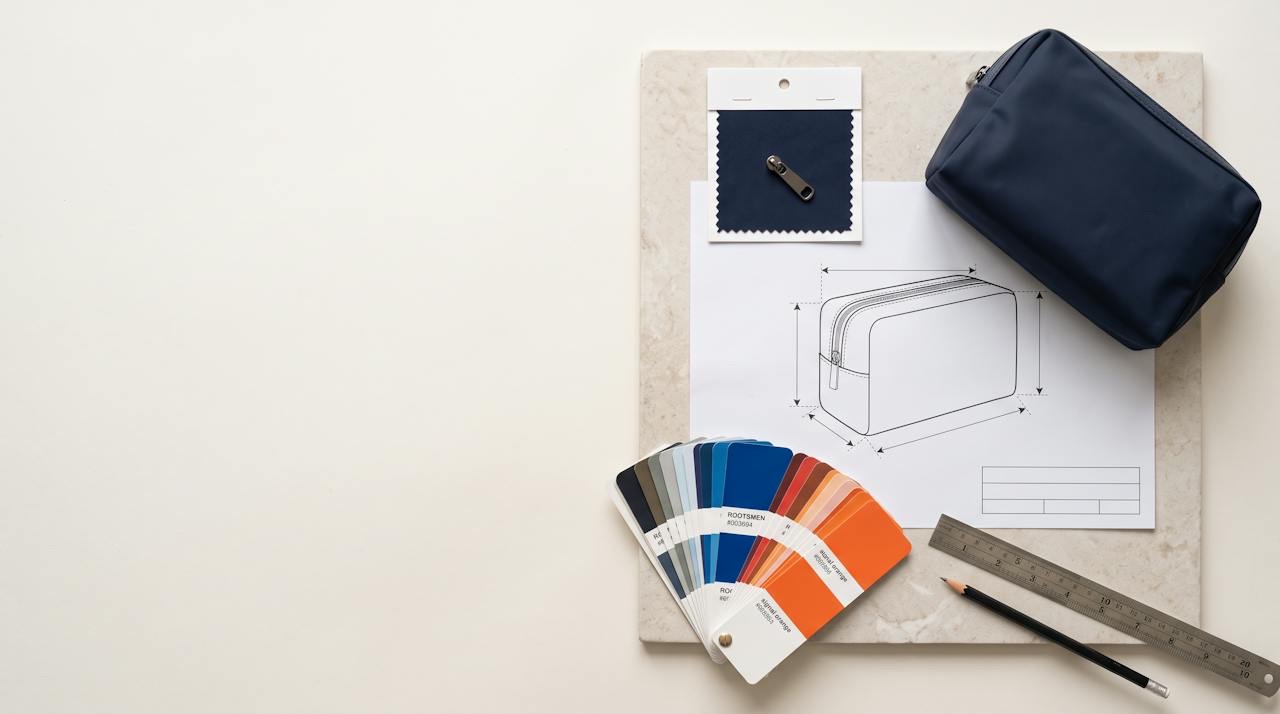
How to Write a Tech Pack for a Cosmetic Bag
What each page of a pouch tech pack must control, from sketches and tolerances to colour, labelling and sampling.
A cosmetic bag tech pack should include flat sketches of every view, a measurement spec with points of measure and tolerances, a full bill of materials covering shell, lining, interlining, zipper, puller and trims, physical colour standards, artwork placement with the logo method, construction and seam notes, and packaging and labelling instructions. Version-control it so samples and bulk are checked against it.
A tech pack is the written and drawn instruction set a factory uses to make your product. For a cosmetic bag, it turns a mood board or a competitor sample into something measurable: exact dimensions, named materials, colour references and construction rules. Search interest in "tech pack templates" keeps rising, but a template only helps if you know what each page must control.
This guide walks through each section a pouch or cosmetic bag tech pack should include, and explains how the document governs sampling and bulk production.
Flat sketches and views
Start with clean, flat technical drawings rather than lifestyle renders. Show the front, back, side gussets, base and top, plus an open view of the interior with pockets, elastic loops or dividers. Add close-up callouts for the zipper end, handle attachment and any piping, so nothing is left to interpretation.
Draw sketches to scale where possible and label every component with the same name used in the bill of materials. Consistent naming lets the factory cross-check drawings against materials and quickly spot anything that has been left out or described twice.
Measurement spec: points of measure and tolerances
List every point of measure (POM) with a code, a plain description and how it is measured: for example width at base, height at centre, gusset depth, zipper opening length and handle drop. Give each POM a plus/minus tolerance. Without tolerances, a factory cannot tell whether a sample passes, and your inspector has nothing objective to check.
State whether measurements are taken flat or filled, with the zipper open or closed, and in which unit. Soft pouches can change shape noticeably depending on how they are laid out, so a clear method keeps factory, brand and inspector reading the same numbers.
Bill of materials
The bill of materials (BOM) names every component: shell fabric, lining, interlining or foam, zipper tape and teeth, puller, webbing, trims, thread and labels. For each, state the material, weight or thickness, finish, colour and where it is used. If you are still deciding on a shell fabric, our note on nylon versus RPET covers the trade-offs.
Be specific about hardware. "Metal zipper" is not enough; state the zipper type and size, the puller style and finish, and whether the zipper closes left-to-right or right-to-left.
Colour standards
Reference each colour to a physical standard, not a screen. For textiles, many brands use the Pantone Fashion, Home + Interiors system, whose TCX references are cotton swatches; Pantone also offers TPG paper standards that correspond to TCX colours. Specify which standard applies to which component, and note that the same reference can look different on nylon, PU and cotton.
Also state the light source for colour approval, and whether you will approve lab dips before sampling.
Artwork placement and logo method
Supply vector artwork and a placement drawing with the logo size and its distance from fixed reference points such as the top seam or the centre line. Name the decoration method (screen print, heat transfer, embroidery or debossing, woven or rubber patch) and the colours used in the artwork.
For each logo, note the thread or ink colours against your colour standards, the minimum line thickness the method can hold, and whether the decoration is applied before or after the panel is sewn. Placement often shifts once a panel is stitched, so state which stage the measurement refers to.
Construction and seam notes
Describe how the bag is built: seam type, stitches per inch or per centimetre, thread type, seam allowance, whether seams are bound, turned or piped, and where bartacks reinforce stress points. Note any water-resistant requirement for the lining and how the lining attaches to the zipper. Mark critical areas so they are checked first during the AQL inspection plan.
Where a detail is hard to describe, attach a photo of a reference product with arrows and notes. A clear image of the finish you want, such as a turned edge or a bound seam, often avoids a full extra sample round.
Packaging and labelling
Specify labels (brand, care, fibre content, country of origin), hangtags, polybag type and warnings, folding or stuffing, inner and outer carton marking, and barcode placement. If you sell in the EU, Regulation (EU) No 1007/2011 governs textile fibre names and composition labelling; the EUR-Lex summary notes that fabric bags with non-textile parts of animal origin must say so. Our guide to compliance documents covers the wider picture.
If your product carries an environmental claim, such as recycled content, list the supporting documents you expect alongside the labelling artwork so the claim can be checked before anything is printed.
How the tech pack controls sampling and bulk
Treat the tech pack as a version-controlled contract. Every sample round should be measured against it, with comments recorded on a revision page and the file re-issued with a new version number. The approved pre-production sample and the final tech pack together become the reference for bulk production and inspection.
When a detail is missing, the factory has to guess, and guesses show up as rework, delays or disputes. A complete tech pack also makes quotes comparable, because every supplier is pricing the same product.
Working with ROOTSMEN
ROOTSMEN has made custom cosmetic bags, pouches and travel organizers since 1981, with its own factory in Guangdong since 1993. If you have a draft tech pack, a sketch or a reference cosmetic bag, send us your draft and we can review it with you before sampling begins.
| Section | What to include | What it prevents |
|---|---|---|
| Flat sketches | Front, back, gussets, base, interior, detail callouts | Misread shape or missing pockets |
| Measurement spec | Coded POMs, method, plus/minus tolerances | Size disputes at inspection |
| Bill of materials | Shell, lining, interlining, zipper, puller, trims, thread, labels | Material substitutions |
| Colour standards | Physical references per component, light source | Shade mismatch between parts |
| Artwork and logo | Vector files, size, position, decoration method | Off-centre or wrong-size logos |
| Construction notes | Seam type, stitch density, reinforcements | Weak seams and early failure |
| Packaging and labelling | Labels, hangtags, polybags, carton marks, barcodes | Relabelling and customs or retail rejections |
Event Details
From the Stand
Frequently Asked Questions
The questions this topic actually raises when a program is being scoped.
It should include flat sketches, a measurement spec with tolerances, a bill of materials, colour standards, artwork placement, construction notes, and packaging and labelling instructions. Together these let a factory quote, sample and produce the bag without guessing, and give your inspector an objective reference.
Yes, a template is a good starting point, but most are built for apparel. Adapt it for bags by adding gusset and handle measurements, zipper and puller details, lining and interlining, and interior layout views. What matters is that every section is filled in completely.
Specify colours with physical references, such as Pantone TCX cotton swatches for textiles, rather than screen values. State which reference applies to each component, the light source for approval, and whether lab dips must be approved first, since the same colour can shift across materials.
Set a plus/minus tolerance for every point of measure, tighter where fit matters, such as a pouch that must hold a set palette, and looser where it does not. Agree the values with your supplier during sampling so they are realistic for the materials used.
No, the two work together. The tech pack defines the product in writing, while the approved pre-production sample shows the physical result. Bulk production and inspection should be checked against both, and any difference between them should be resolved and recorded before production starts.
Yes, many OEM/ODM factories will review or complete a draft with you. ROOTSMEN can review sketches, reference samples or partial tech packs with you before sampling, so construction and material choices are clarified early rather than corrected later.
Related Products
Builds where this decision applies.

Have a product requirement of your own?
Tell us the product, the quantity and the timeline — we'll scope a development plan.