Most cosmetic bag briefs arrive with a picture and no dimensions, or with dimensions copied from a competitor's listing. Both produce the same outcome: a first sample that is nearly right and a revision round spent on millimetres.
Size is not a finishing detail. It decides what the bag holds, how it photographs, what it costs to ship and whether it fits the retail fixture it has to sit in. It is worth deciding before the first pattern is cut, not after the first sample is seen.
How a bag is measured, and where briefs go wrong#
Soft goods are quoted as W × H × D — width, height, depth — in millimetres, measured flat and empty unless stated otherwise. That last clause is where most misunderstandings live.
A boxed pouch measured flat and the same pouch measured filled are different numbers, because the gusset opens. If your brief says 250 mm wide and the factory measures flat while you pictured it packed, the sample will look small and nobody will be wrong.
Say which state you mean, and give a tolerance. Soft goods do not hold a dimension the way an injection-moulded part does; ±5 mm is a common working tolerance on a mid-size pouch, tighter on something that must fit a fixture. Putting the tolerance in the tech pack converts an argument into a measurement.
The sizes the category actually uses#
There is no standard, but the category clusters, because the contents cluster. Working bands, flat-measured, that most briefs land inside:
Small flat pouch, roughly 180–200 mm wide and 120–130 mm high, with little or no depth: lipsticks, a compact, a sample set. This is the usual gift-with-purchase size, because it is cheap to make and cheap to ship.
Everyday makeup bag, roughly 200–240 × 130–150 × 60–80 mm: a daily routine, a few brushes lying flat. The most-ordered band, and the one where depth does the most work.
Wash bag or large cosmetic bag, roughly 250–280 × 150–180 × 90–110 mm: a full routine including bottles, which is why depth and a stable base matter more than width.
Brush roll or long pouch, roughly 300–350 mm in one dimension: set by the longest brush, not by aesthetics.
Treat these as a starting point to argue with, not a specification. The right number comes from the contents, which is the next section.
Size the bag from its contents, not from a photograph#
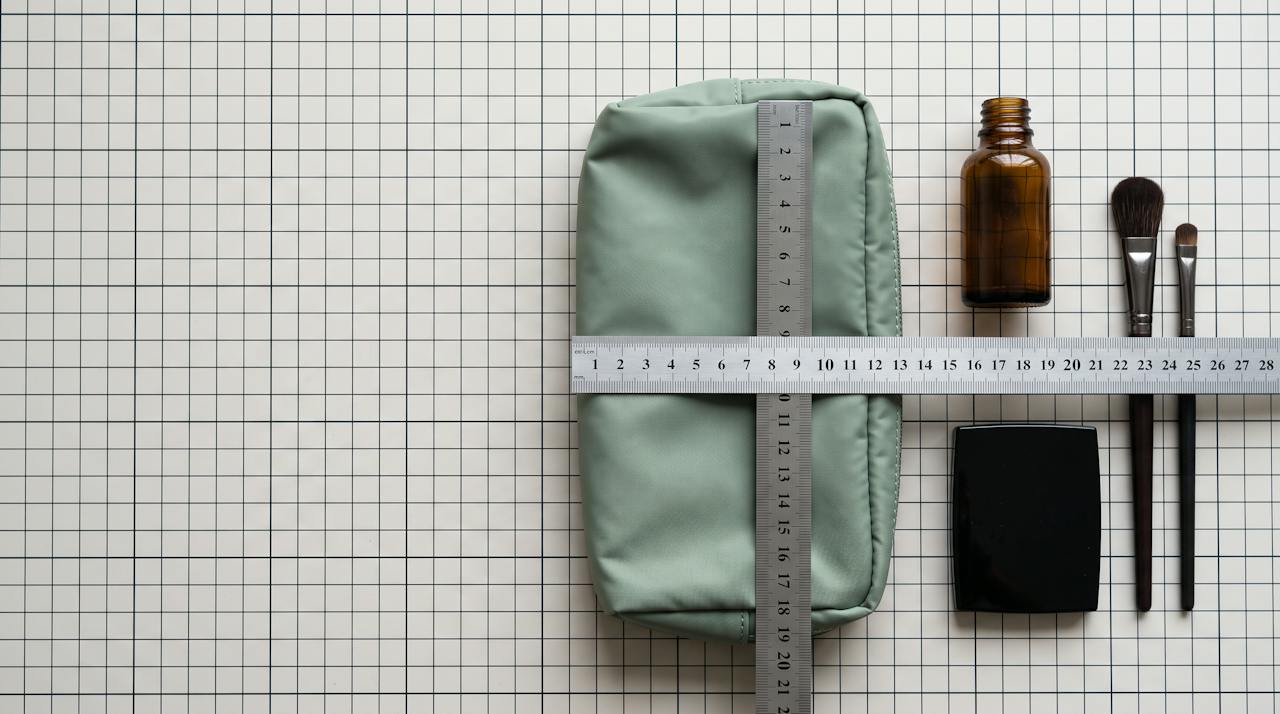
The reliable method takes an afternoon and removes most of the risk. Put the actual items the bag is meant to hold on a table — the real bottles, the real compact, the real brushes — and measure the footprint they occupy when arranged as a user would arrange them.
Add clearance. A bag sized exactly to its contents cannot be closed without a fight, and the zip is where that fight shows. Roughly 10–15 mm on each dimension is a usual allowance, more if the contents are rigid.
Then check the tallest item against the height, and the widest rigid item against the base. A 150 ml bottle standing up is the constraint on most wash bags, and it is the measurement most often missed because the brief was written from a flat-lay photograph.
If the bag ships as part of a set, do this for the set: five pieces that each fit their contents but do not nest inside the outer bag is a common and expensive discovery.
What size does to the unit price#
Material consumption rises with surface area, not with any single dimension, so a bag 20 per cent larger in every direction is not 20 per cent more expensive in material — it is considerably more. This is the single biggest reason a size decision belongs before costing.
Cutting yield matters as much as area. Fabric comes in fixed widths, and a pattern that nearly fits two pieces across a roll wastes the remainder on every metre. A small change in one dimension can move yield to the next step and take real cost out, which is a conversation worth having with the factory rather than guessing at.
Sewing time does not scale as steeply as material, but a deeper bag usually means a gusset, a base panel or a stiffener, and those are operations rather than centimetres. Our note on what drives the unit price puts the components in order.
Size, cartons and what it costs to ship#
Freight for soft goods is usually decided by volume rather than weight, so the packed size of the bag is a direct cost. A pouch that folds flat and one with a structured base occupy very different space in a carton even when they measure the same.
Work out how many pieces fit a standard export carton before the size is frozen. A bag whose dimensions leave 30 mm of dead space across a carton wastes that space on every carton in the shipment, and the loss compounds at container scale. Our note on sea, air or express freight explains how the space is charged.
Retail adds its own constraint. If the product has to hang on a peg, sit in a fixture or fit a shelf depth, that is a hard limit and should be in the brief as one — it is not something a factory can infer from a drawing.
When the size has to change after sampling#
A dimension change after the first sample is a new pattern, not an adjustment. The pieces are re-drawn, the gusset re-calculated and the sample re-made, which is a round and a schedule.
It is still worth doing if the sample proves the size wrong. The expensive version of this mistake is accepting a size that does not hold its contents because the launch date is close — that ships a product that fails in the customer's hands rather than in the sample room.
What makes this cheap is catching it early, which means loading the first sample with real contents the day it arrives. Our note on what to check when your first samples arrive sets out the sequence, and what a pre-production sample confirms covers the gate after it.
What to send with the brief#
Three things settle the size question in one exchange: the contents the bag must hold, the flat W × H × D you are aiming at with a tolerance, and any hard limit from retail, packaging or freight.
If you have a reference bag, send its measurements rather than its photograph, and say which parts of it you want to keep. "Like this but slightly bigger" is the single most expensive sentence in a bag brief.
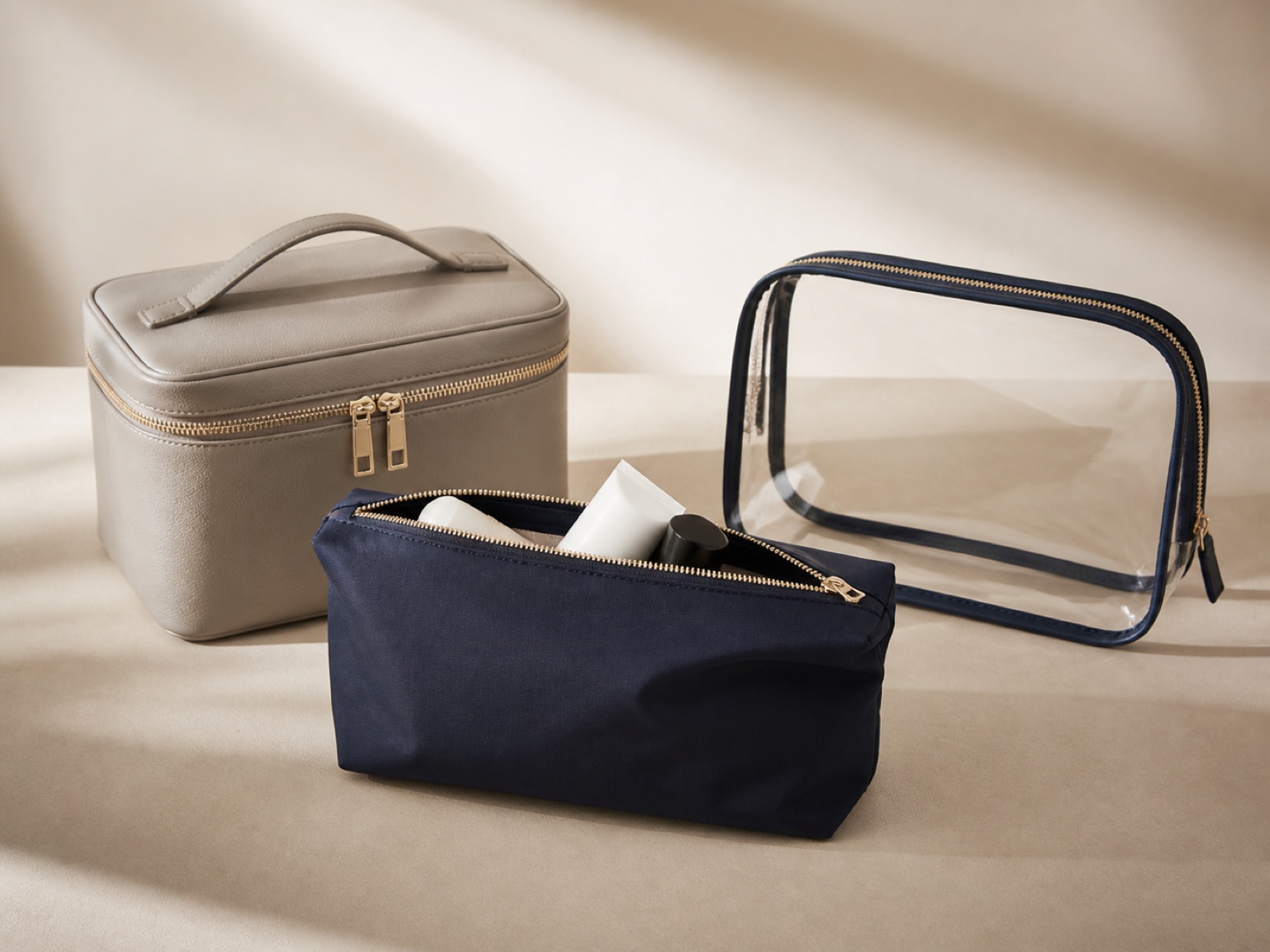
The cosmetic bag range shows where the common sizes sit in practice, and dimensions are listed on each build.
| Format | Typical W × H × D (mm) | What it holds | Usual use |
|---|---|---|---|
| Small flat pouch | 180–200 × 120–130 × 0–20 | Lipsticks, a compact, samples | Gift with purchase |
| Everyday makeup bag | 200–240 × 130–150 × 60–80 | A daily routine, brushes flat | Retail, the most-ordered band |
| Wash bag / large cosmetic bag | 250–280 × 150–180 × 90–110 | Full routine including bottles | Travel, retail |
| Brush roll / long pouch | 300–350 in one dimension | Brushes at full length | Professional, sets |