
Sea, Air or Express: Choosing Freight for a Bag Order
How volume, weight, launch dates and Incoterms decide whether your cosmetic bags travel by ocean container, by air or by courier
Choose sea freight when the goods are bulky, low in value density and the launch date is comfortable; choose air when the volume is modest or the date is fixed; choose express courier for samples and small top-up runs. Soft goods are volume-heavy, so the decision usually turns on cubic metres and volumetric weight rather than on actual kilograms.
Cosmetic bags, pouches and travel organizers are the classic awkward freight: light enough that nobody worries about weight limits, bulky enough that they fill a container long before they get heavy. That is why two buyers with identical products end up with very different landed costs — one planned the cartons, the other did not.
Freight is also the last point at which a launch can slip. Here is how buyers of soft goods choose between sea, air and express, what volumetric weight does to a pouch programme, and what the ICC Incoterms rules do and do not settle.
What actually drives the choice
Four variables decide the mode, and only one is the freight quote itself.
Volume. Soft goods are measured in cubic metres before kilos, and air pricing punishes low-density cargo.
Launch date. If the goods must be on a retailer's floor on a fixed date, the date sets the mode and the budget follows. Working backwards through clearance, port handling, sailing and the factory's inspection window is the only reliable way to know whether ocean is still viable.
Cashflow. Sea ties up money in stock for longer but keeps the freight line small; air trades a bigger freight line for a shorter cash cycle.
Value density. A decorated faux-leather organizer carries far more value per cubic metre than a flat pouch, so air freight is a smaller share of its landed cost — which is why freight belongs in the same conversation as unit price.
Sea freight: FCL and LCL
FCL (full container load) means you buy the container, not the space inside it. The box is sealed at the factory and opened at destination, so handling is minimal. For programmes that fill most of a container it is usually both the cheapest per unit and the gentlest on the cartons.
LCL (less than container load) means your pallets share a container with other shippers' cargo, consolidated at origin and deconsolidated at destination. That adds two handling events, extra terminal charges and more chances of crushed cartons. LCL is billed on the greater of weight or volume, so a light, bulky pouch shipment is charged on its cubic metres.
The surprises with LCL live in the destination charges, which are levied locally and rarely appear in the origin quotation. Ask your forwarder to quote both legs before comparing it against air.
Air freight and volumetric weight
Air cargo is charged on chargeable weight: the higher of actual gross weight and volumetric weight. The standard volumetric factor across air cargo tariffs is 6,000 cm³ per kilogram, the default applied in IATA's air cargo tariff system.
For cosmetic bags this is the whole story. A carton of foam-structured train cases can be charged at several times its real weight, while flat-packed nylon pouches of the same outer dimensions sit much closer to their actual kilos. That is the argument for deciding the mode before the cartons are specified: compression, flat packing and a tighter carton fill change the chargeable weight far more than negotiating the rate does. Fabric choice feeds in too, alongside the trade-offs in nylon versus rPET for cosmetic pouches.
Express courier: the small, urgent lane
Express courier is door-to-door, with the carrier normally handling the customs entry — the right tool for samples, salesman sets, photography units and replacement pieces.
It is the wrong tool for bulk soft goods. Couriers apply their own volumetric divisors, often harsher than the air cargo standard; charges scale close to linearly with volume, so there is no consolidation benefit; and simplified clearance gives you less control over classification and valuation. If you would need a pallet, express no longer makes commercial sense.
Carton and pallet planning starts at the factory
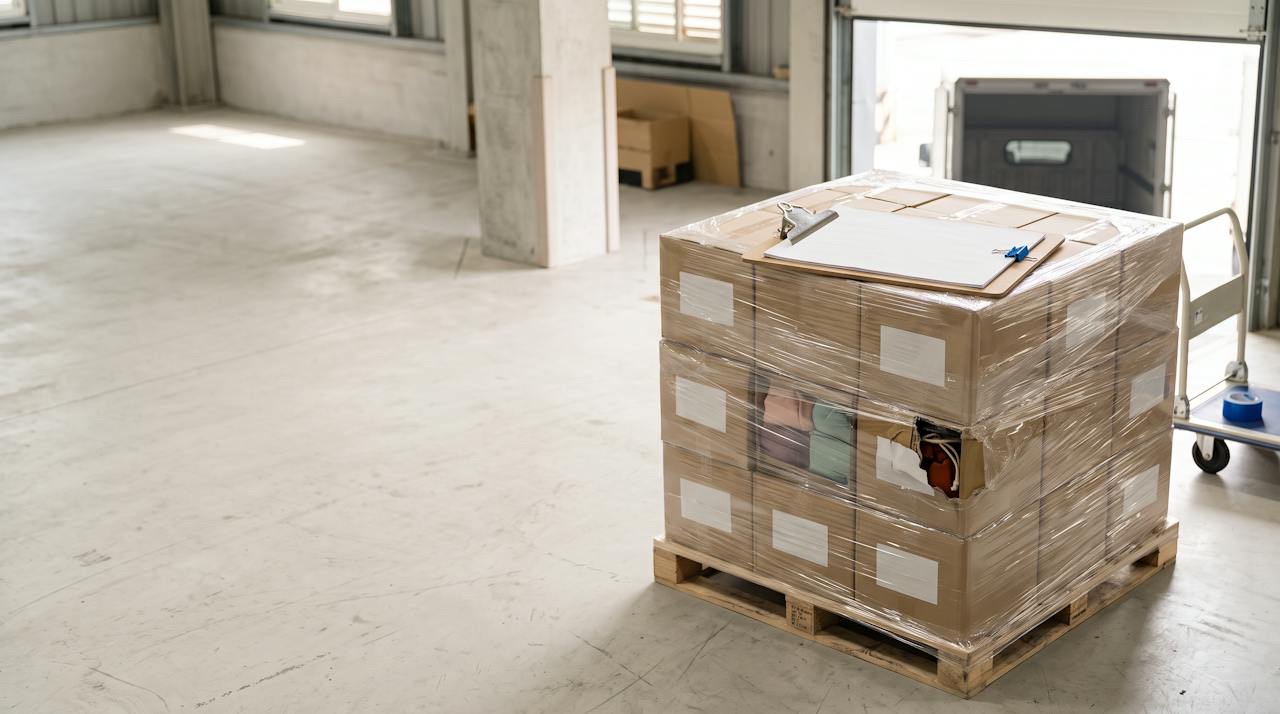
Freight efficiency is designed into the packing specification, not negotiated afterwards. Settle the same questions every time: pieces per inner and inners per carton (a carton 80 per cent full wastes 20 per cent of the freight on every unit); outer carton dimensions, so cartons tessellate on a pallet without overhang; and whether goods are compressed, which cuts cube on unstructured pouches but risks creasing on structured cases.
Wooden pallets and crates must comply with ISPM 15, the IPPC standard for wood packaging material in international trade, which requires an approved treatment and the recognized mark. Non-compliant wood is a real border risk; plastic and pressed-composite pallets fall outside the standard.
Lock carton marking, barcode placement and retailer packaging rules alongside the pre-production sample — a packaging change after approval means another sample round.
Incoterms 2020: who does what, and where risk passes
The Incoterms 2020 rules published by the International Chamber of Commerce are eleven three-letter trade terms that allocate tasks, costs and risks between seller and buyer. They entered into force on 1 January 2020 and do not decide payment terms, title or governing law.
EXW puts the goods at the buyer's disposal at the seller's premises, with the buyer organizing everything from there. FOB, a sea and inland waterway rule, has the seller deliver on board the vessel at the named port and clear the goods for export, with risk passing there; it suits buyers with their own forwarder. CIF, also sea-only, adds carriage and minimum insurance to the destination port — but risk still passes on board at origin, which surprises buyers more than any other point in the rules.
DAP has the seller deliver at a named place in the destination country ready for unloading, with the buyer handling import clearance and duties; DDP goes furthest, with the seller bearing those too. Always name the exact place after the term — "FOB Shenzhen" and "DAP Rotterdam warehouse" mean different things to different desks.
Documents and customs
Whoever acts as importer of record is responsible for the entry being correct. For imports into the United States, CBP's guidance for commercial importers sets out that entry documents include an invoice and, where available, a packing list and shipping documents, and that the commercial invoice must carry an adequate description of the merchandise, the quantities, the values and the appropriate tariff subheading. The bill of lading or air waybill sits alongside it as receipt, evidence of the contract of carriage and, where negotiable, a document of title.
Two details cause most delays with bags: the material description must be precise enough to support the tariff classification, and any recycled-content, origin or certification claim printed on the product must be substantiated. Assemble market paperwork before the goods sail — see compliance documents for the US and EU.
Making the call with your supplier
The most useful thing a factory can give you is not a freight opinion — it is an accurate packing list, early. Carton dimensions, gross and net weights, cubic metres and pallet configuration let a forwarder price all three modes against each other honestly.
ROOTSMEN has been developing custom cosmetic bags, pouches, travel organizers and promotional soft goods since 1981, with its own factory in Guangdong since 1993, working to FAMA (Disney), ISO 9001, SMETA, GMP and BSCI standards. Packing specifications are treated as part of development, so buyers can plan freight alongside the product. Get in touch to discuss a programme.
| Factor | Sea (FCL) | Sea (LCL) | Air freight | Express courier |
|---|---|---|---|---|
| Best suited to | Volume that fills most of a container | Part-container volume | Modest volume or a fixed launch date | Samples and small top-ups |
| Charged on | The container | Greater of weight or volume | Chargeable weight (6,000 cm³/kg factor) | Carrier's own volumetric divisor |
| Handling events | Fewest — sealed at origin | Consolidation and deconsolidation added | Terminal handling both ends | Door to door |
| Customs entry | Your broker | Your broker | Your broker | Usually handled by the carrier |
| Cube discipline matters | Yes, for container fill | Critically | Critically | Critically |
| Typical Incoterms fit | FOB, CIF, DAP | FOB, DAP | FOB, DAP | DAP or DDP |
Event Details
From the Stand
Frequently Asked Questions
The questions this topic actually raises when a program is being scoped.
FOB gives you control and visibility of freight costs, which suits buyers with an established forwarder. DDP shifts clearance and duties to the seller and gives you one landed figure, which suits buyers without a customs broker. Neither is cheaper by nature — DDP simply moves the cost inside the quotation.
Because air cargo is charged on chargeable weight, the higher of actual and volumetric weight. The standard air cargo volumetric factor is 6,000 cm³ per kilogram, so bulky, light goods such as structured cosmetic cases are billed on their cube. Reducing carton size lowers this more than negotiating the rate.
When destination charges close the gap. LCL adds consolidation, deconsolidation, terminal handling and documentation fees at destination that origin quotes often omit. Ask your forwarder for an all-in door figure for both, then compare. For part-pallet volumes with a tight date, air frequently wins once those charges are counted.
Wooden pallets and crates must comply with ISPM 15, the IPPC standard for wood packaging material in international trade, which requires an approved treatment and the recognized mark. Plastic and pressed-composite pallets fall outside the standard. Confirm the pallet type in the packing specification rather than assuming.
It depends on the Incoterms rule and where risk passed. Under FOB and CIF, risk passes to the buyer once the goods are on board at the port of shipment — including under CIF, where the seller pays for carriage and insurance but does not carry the risk. Under DAP and DDP, risk stays with the seller until delivery.
During development, before the packing specification is fixed. Carton dimensions, pieces per carton and whether goods are compressed change freight cost far more than choosing the mode at the end. Ask your supplier for carton dimensions, gross weight and cubic metres as part of pre-production sample approval.
Related Products
Builds where this decision applies.

Have a product requirement of your own?
Tell us the product, the quantity and the timeline — we'll scope a development plan.