Most cost questions arrive in the same shape: how much is a custom cosmetic bag? There is no useful single answer, because a bag is not a commodity with a market price — it is a set of decisions, and each one adds or removes minutes and material. What is answerable, and more useful when you are building a landed-cost model, is which lines in a quote you control. Once two quotations are in hand, the harder question is whether they are even describing the same product — how to read and compare two bag factory quotations works through that.
What follows is the logic behind a quote, not a price list: every number specific to your programme is confirmed at quotation. If you want that quote to come back quickly and accurately, start with what to send us so the first quote is accurate.
What is actually inside a unit price?#
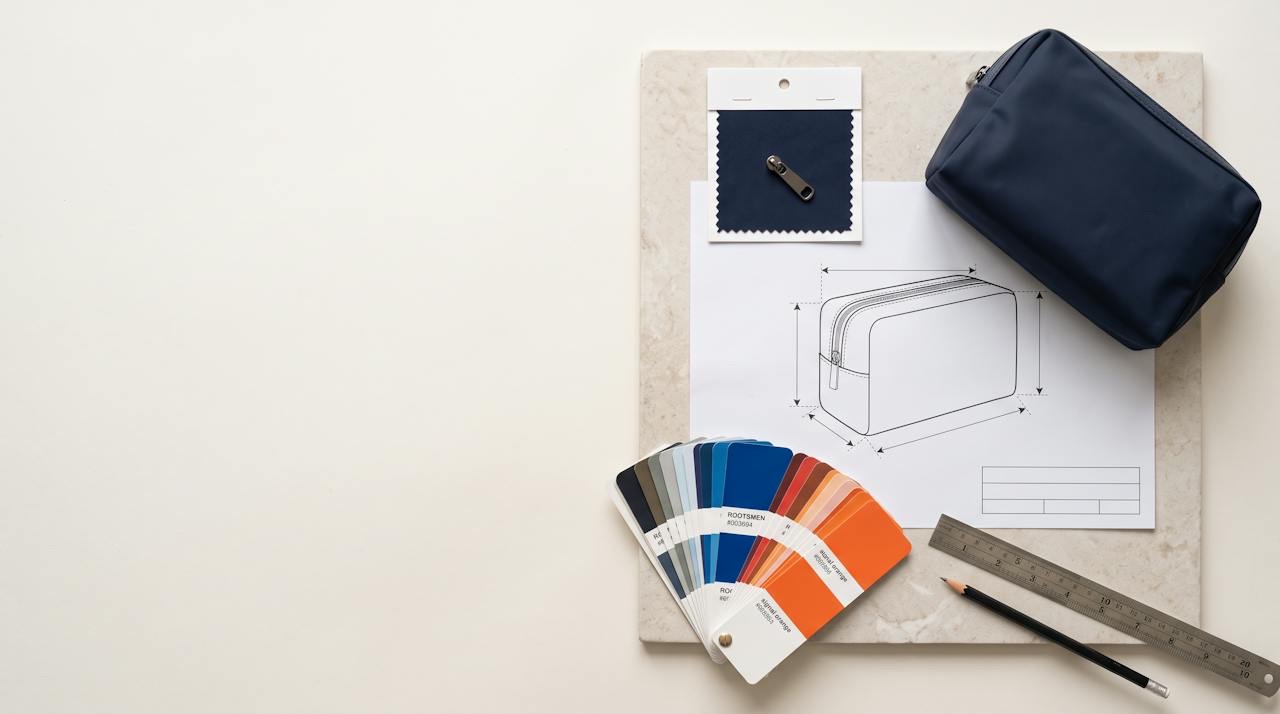
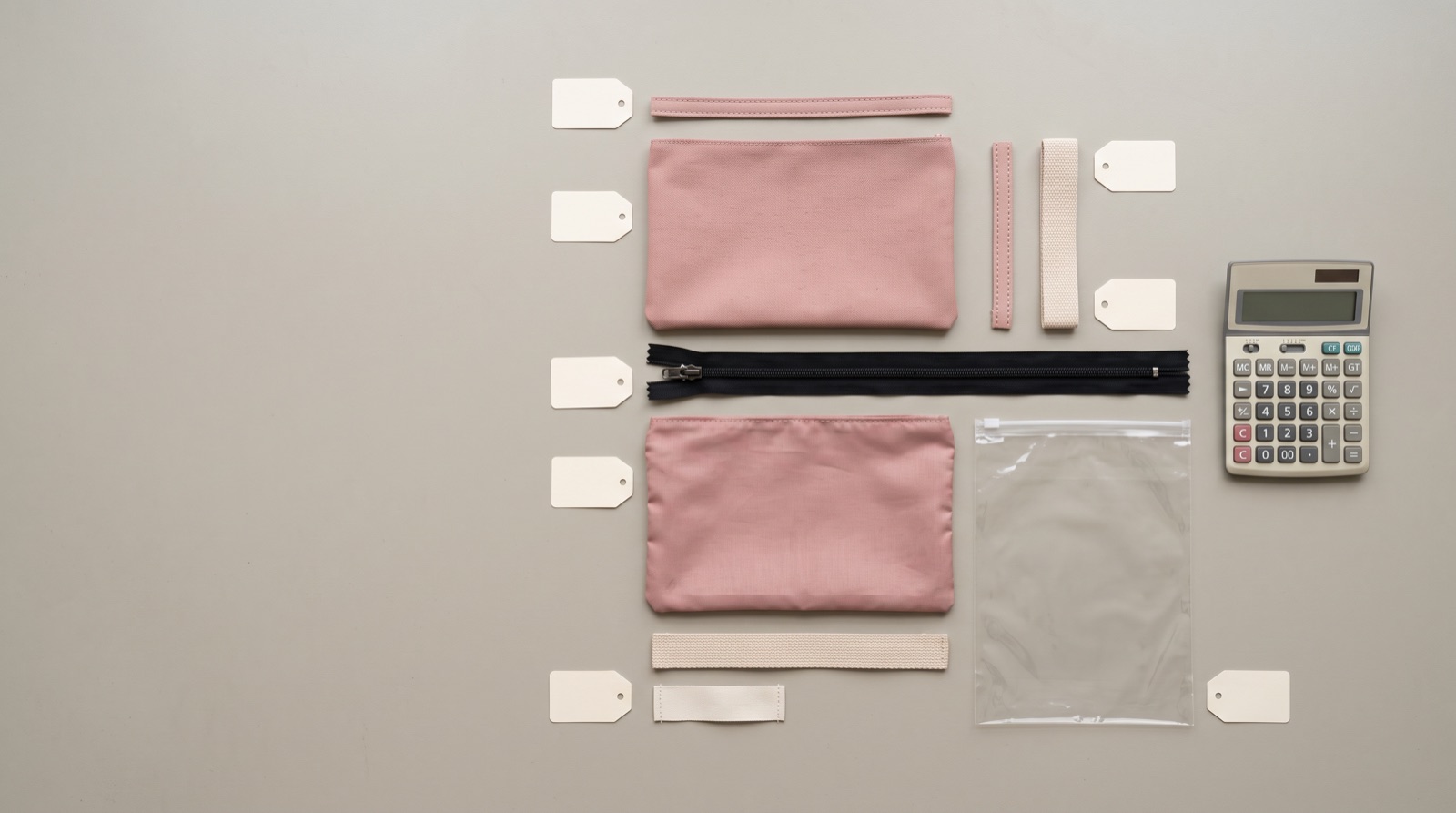
A quoted unit price is normally built from four groups. Material is the shell, lining, interlining and reinforcement, costed by consumption rather than by the price on the roll. Labour is cutting, preparation and sewing, measured in minutes per piece. Trim and hardware covers zippers, pulls, webbing, sliders, feet, labels and packaging. One-off costs are charges incurred once for the style regardless of how many pieces you buy: pattern making, sample rounds, screens or plates, embroidery digitising, and moulds for custom hardware.
Two terms are worth defining. Nesting is the arrangement of pattern pieces across the fabric width so the waste between them is minimised; fabric utilisation is the percentage of the roll that ends up in the product. A design that nests badly — long diagonal panels, curved gussets, a directional print that forbids rotating pieces — consumes more fabric per unit at exactly the same fabric price. That is one reason two bags in the same material quote differently.
Why does panel count matter more than fabric price?#
Fabric cost per unit is usually a smaller share of a pouch than buyers expect. Input prices do drift with the market, but stepping from one mid-weight shell to another rarely changes a quote the way buyers imagine.
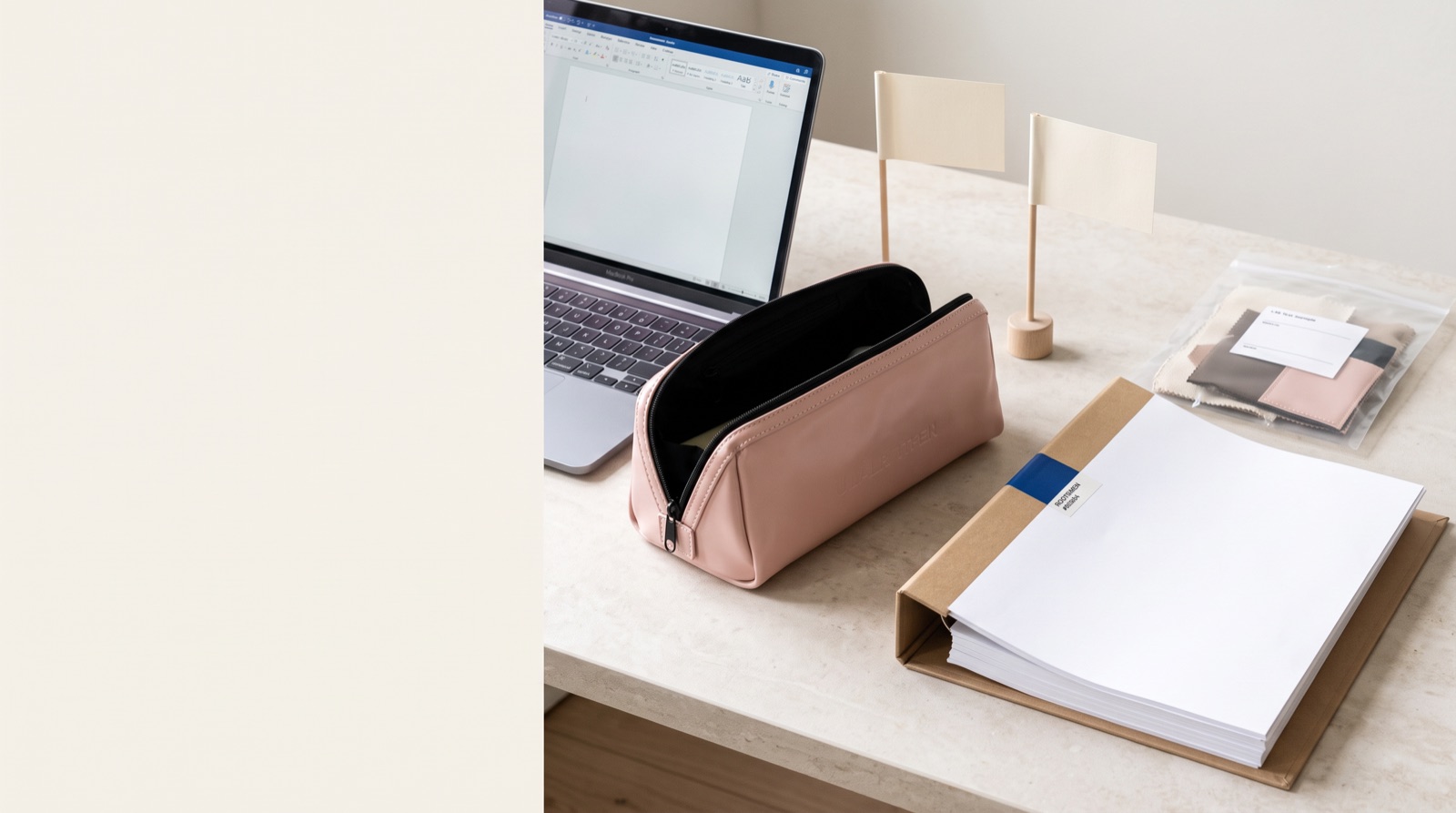
Construction does. Every seam is operator time, and that time repeats on every unit in the run. A flat two-panel pouch with a top zip and no lining is a handful of operations. Add a full lining and you have effectively built a second bag inside the first. Add piping and you introduce a bias-cut trim, a preparation step and a slower, more skilled sewing pass. Add a boxed gusset and the piece stops being flat — corners must be aligned, eased and topstitched.
So the honest cost conversation is a construction conversation, not a materials one: the reliable route to a target price is to remove a panel, simplify an edge finish or drop an interior feature the end user will not miss. You can see the range of builds we work from on the custom cosmetic bags pages; each listed style is a starting point to be respecified, not a fixed catalogue item.
Why is there an MOQ at all, and why is it 300 to 500 pieces?#
MOQ — minimum order quantity — is not a sales tactic. It is the point below which the one-off costs of a style stop being recoverable at a sane unit price. A line has to be set up for your pattern: fabric ordered to a mill minimum, the cutting table laid, operators trained on the sequence, the line balanced. That cost is the same whether the run is 300 pieces or 5,000.
The arithmetic is blunt: a fixed setup and tooling package divided by 300 pieces produces a per-unit contribution several times larger than the same package divided by 3,000. Nothing about the bag has changed; the amortisation has. Our stated minimum is 300–500 pcs per style and colourway, and the split matters — each colourway is a separate fabric order, a separate cutting lay and a separate line changeover.
For procurement, the implication is that a 300-piece quote and a 3,000-piece quote say nothing about which supplier is cheaper. Ask everyone for the same quantity break, and ask which charges are one-off.
How much do zippers, pulls and hardware change the price?#
More than most buyers assume, because trim is bought per piece and multiplies straight through the run. A zipper is three decisions: chain type (coil, moulded plastic, metal), length, and whether the slider and pull are stock or custom. Moulded and metal chains cost more than coil and sew more slowly on curves. A branded pull adds a mould or engraving step — a one-off charge on the first order, and a per-piece cost thereafter.
Webbing, D-rings, sliders and feet follow the same pattern: finish drives cost. An electroplated or antique finish is a separate process with its own minimum, and matching it across pull, slider and rivet is a sourcing job rather than a catalogue pick. None of this argues against good trim — on a piece meant to be kept, trim is where perceived quality lives. It argues for deciding trim early, since late substitutions are a common cause of a quote moving after approval.
How does decoration affect the unit cost?#
Decoration is the clearest case of one-off versus recurring cost. Screen printing is charged per colour for setup and then per impression, so a two-colour mark at volume is inexpensive and a six-colour mark is not; digital printing has little setup but a higher per-piece cost, so the crossover depends on colour count and quantity together — set out in choosing a print method for gift-with-purchase runs.
Applied branding behaves differently again. Embroidery carries a one-off digitising charge plus a per-piece cost driven by stitch count, so a dense logo is meaningfully dearer than an outlined one; debossing carries a plate or die charge and then very little per piece — see embroidery vs. debossing on soft goods. The rule across all of them: setup is amortised, execution is not.
What sits outside the unit price — and why does it surprise people?#
The unit price is a factory-gate number. Your cost model also carries freight, insurance, duty, brokerage and inland delivery, and who pays which is set by the Incoterm on the order. The ICC Incoterms 2020 rules give a clear allocation of cost, risk and obligations between seller and buyer, consolidating each rule's costs at articles A9/B9. An EXW price and a DDP price for the identical bag are not comparable figures.
Duty depends on classification. Goods are classified under the Harmonized System, which the World Customs Organization describes as a six-digit international nomenclature used by more than 200 countries and economies and covering over 98% of merchandise in international trade; the US extends it to ten digits, with Schedule B for exports and the HTS for imports sharing the first six. Classification for bags of this kind is normally settled with your customs broker — the outer surface material is one of the attributes it can turn on — and the Census Bureau's Schedule B search tool is a reasonable starting point. Quotes are issued in a stated currency; whether and how long that rate holds is agreed in the quotation.
Which changes actually lower the cost, and which only look cheaper?#
Five changes reliably reduce unit cost without cheapening the product: reduce panel count, simplify the edge finish, drop the lining where the piece does not need one, standardise trim across the programme so volumes consolidate, and increase run size so one-off charges amortise further. Consolidating colourways belongs on the same list.
Three only look cheaper. Shaving fabric weight often costs more than it saves, because a lighter shell needs reinforcement to hold the same shape — see nylon vs. RPET for cosmetic pouches. Downgrading trim on a piece meant to be reused moves the cost to returns. And splitting an order across two suppliers duplicates every one-off charge on both sides.
What should you send us to get a real number?#
Send us: the silhouette and approximate dimensions, with a reference sample or sketch; the intended shell and lining, or the performance you need if the material is still open; construction detail such as lining, gussets, pockets and edge finishes; the trim, including zipper type and whether the pull is custom; decoration method, colour count and artwork; quantity and number of colourways; target landed cost and Incoterm; and the in-market date.
If any of that is unsettled, say so rather than guessing — an honest "undecided" gets you a quote with the options priced separately, which is more useful than a single number built on assumptions. Tell us what you have on the contact page, or see solutions for how programmes of this kind are scoped. Everything numeric is confirmed at quotation against your specification.
Sources#
Incoterms 2020 rules — International Chamber of Commerce
What is the Harmonized System? — World Customs Organization
Harmonized System (HS) Codes — International Trade Administration, U.S. Department of Commerce
Schedule B commodity classification and search tool — U.S. Census Bureau
| Lever | Effect on unit cost | Effect on lead time | Risk to the look |
|---|---|---|---|
| Increase run size | Falls — one-off charges amortise further | Slightly longer production window | None |
| Remove a panel or gusset | Falls — fewer sewing minutes per piece | Neutral to shorter | Changes the silhouette; confirm on sample |
| Drop the lining | Falls noticeably | Shorter | Interior seams become visible |
| Simplify the edge finish (binding instead of piping) | Falls | Shorter | Low if detailing is consistent |
| Standardise trim across styles | Falls — trim volumes consolidate | Neutral | None if the finish is matched |
| Reduce print colours | Falls — fewer screens, fewer passes | Shorter | Artwork may need redrawing |
| Custom zip pull or hardware mould | Rises — one-off mould plus per-piece cost | Longer | Improves perceived quality |
| Add colourways at the same total quantity | Rises — each colourway is a separate minimum | Longer | None |
| Lighter shell weight | Often rises once reinforcement is added | Neutral | Structure can soften |