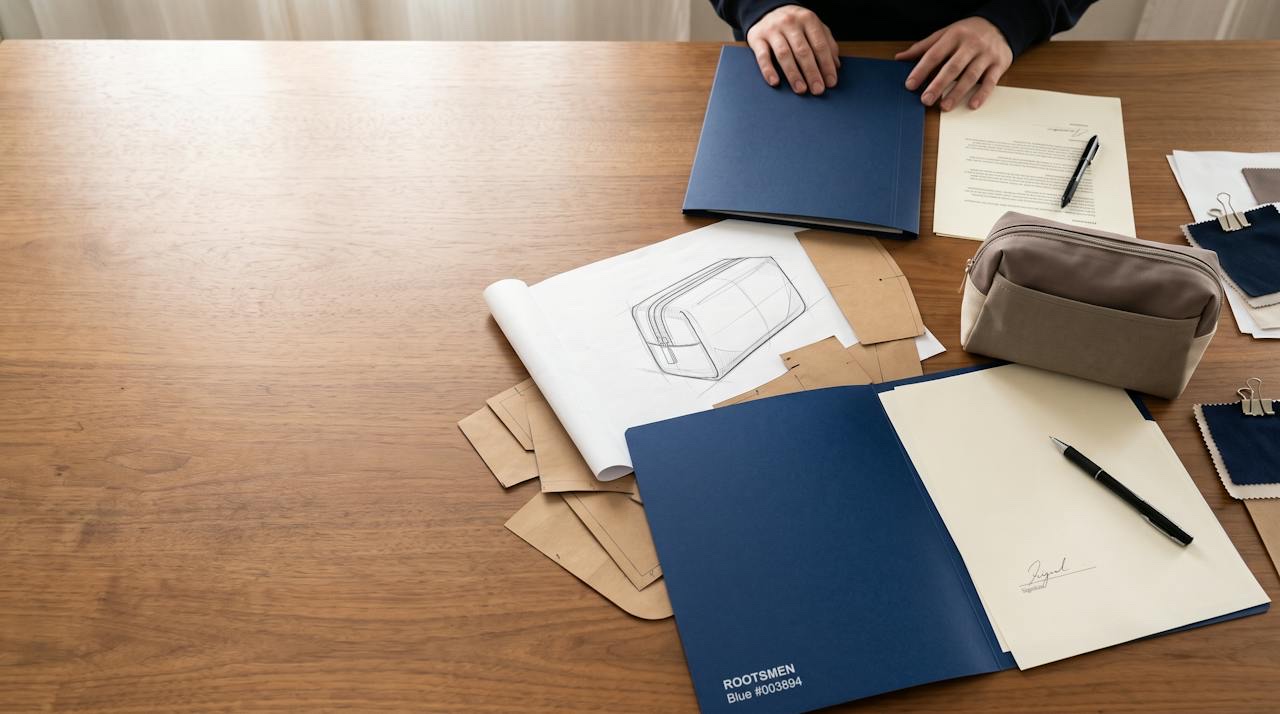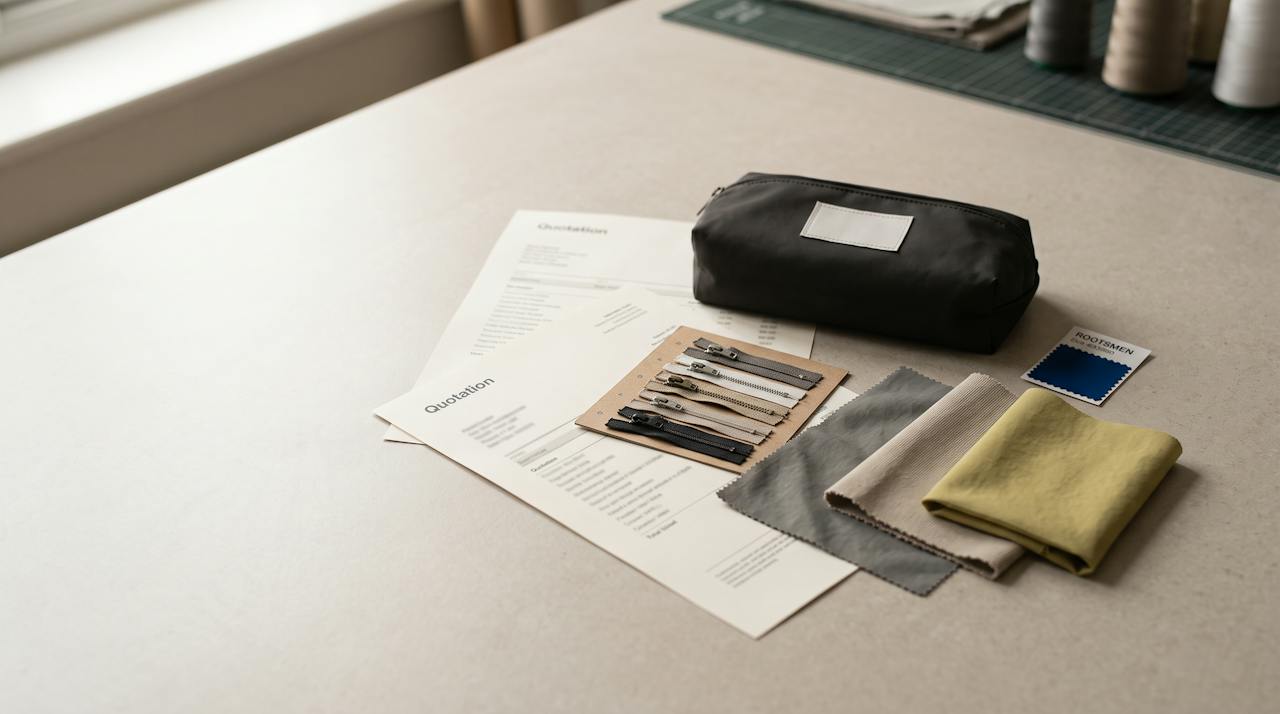
A buyer sends one brief to three factories and gets back three numbers that do not agree. The instinct is to assume the cheapest is aggressive and the dearest is padded. More often, all three are quoting honestly against different readings of an incomplete brief.
Comparing them is not an exercise in negotiation. It is an exercise in making the three quotations describe the same product — and the gaps you find doing that are usually more valuable than the price difference.
First, check they are quoting the same build#
Before comparing any number, line up the specification each quotation assumed. Shell material and weight, lining or none, interlining or none, base panel, zip type and size, puller, branding method and position, and packing.
One quotation with an unlined pouch and one with a lined pouch are not comparable, and the unlined one will win on price every time. The same is true of a coil zip against a moulded one, or a printed mark against an embroidered one.
Where a quotation is silent on a line, it has assumed something. Ask what. A supplier who answers precisely is telling you as much about how the programme will run as about the price.
Separate one-off costs from the unit price#
A bag quotation has two layers, and mixing them is the most common comparison error. One-off costs are pattern making, sample charges, screens or dies for decoration, and any custom hardware tooling. Unit cost is material, cutting, sewing, trims, decoration run cost, inspection and packing.
A factory that folds its setup into the unit price looks expensive at low quantity and cheap at high quantity; one that charges setup separately looks the reverse. Neither is hiding anything, but only one arrangement suits your volume.
Ask for both layers separately, and ask for the unit price at two or three quantities. The shape of that curve tells you where the setup sits without anyone having to disclose their costing.
Find the lines that are missing rather than the ones that are high#
The expensive surprises in bag programmes are almost never in the quoted lines. They are in the ones nobody quoted.
Things commonly left out: the polybag and the carton, the hangtag and its string, the care label and the origin label, barcode application, inner packing for retail, inspection, and any testing the destination market requires. Each is small. Together they are a meaningful percentage, and they arrive after the price is agreed.
Ask directly whether the price is for the bag or for the packed, labelled, inspection-ready product. Our notes on care labels, packaging and AQL inspection cover what each involves.
Read the Incoterm before you read the price#
A price is meaningless without the term attached to it. EXW means the goods leave the factory door and everything after that is yours. FOB means the supplier gets them onto the vessel. CIF adds sea freight and insurance. DDP means delivered, duty paid.
An EXW price and a DDP price for the same bag can differ enormously and both be correct. Comparing them directly is the single most common way a buyer picks the wrong supplier.
Convert everything to one term before comparing — usually FOB, because it is the point most suppliers can quote and it excludes freight you will arrange yourself. Our note on freight and Incoterms sets out what each covers.
Check the lead time is measured from the same point#
"Forty days" is not a lead time until you know what it is counted from. Production days from approved pre-production sample and materials in house is a different figure from days from your first enquiry, and the gap between them is usually weeks.
Ask for the schedule in stages rather than as one number: development and sampling, material lead time, sample approval, production, inspection and packing. A supplier who can break it down is quoting from a plan; one who gives a single number may be quoting from hope.
Our note on how long a custom bag order takes covers the five stages and which of them belong to you rather than to the factory.
Ask what the price depends on#
A quotation is valid against assumptions, and those assumptions have dates. Material prices move, currency moves, and a quotation held for three months while a brand decides may no longer stand.
Ask how long the price holds and what would change it. A supplier naming specific dependencies — this fabric, this quantity, this decoration count, quoted this month — is easier to work with than one who holds a number that later moves for reasons nobody explained.
Ask what happens if quantity drops. Programmes are cut more often than they are increased, and the cost of a reduced run is better known before the order than after it.
What the quotation tells you about the supplier#
Read the document as evidence, not just as arithmetic. A quotation that restates your specification line by line shows the brief was read. One that returns a single number against a product name shows it was skimmed.
Questions asked before quoting are a good sign, not a delay. A factory that asks about the contents, the market and the launch date is scoping the programme; one that quotes immediately from a photograph is guessing, and the guess is what you will be holding when the sample arrives.
Our note on how to choose an OEM/ODM bag manufacturer covers the rest of the vetting, and what SMETA, BSCI and ISO 9001 prove covers what the audit list does and does not evidence.
A comparison that takes twenty minutes#
Put the quotations in one table with a row for each of: shell and weight, lining, interlining or base, zip and puller, decoration method and positions, labels, polybag and carton, inspection, Incoterm, quantity, unit price, one-off costs, and lead time with its starting point.
Every empty cell is a question to send back, and those questions cost nothing. When the table is full, the quotations are comparable — and in most cases the range has narrowed to something much smaller than the number you started with.
If you would like a quotation in that form, send the brief and say so. ROOTSMEN quotes the build line by line rather than as a single figure, which makes it straightforward to compare against anyone else's.
| Line | Why it moves the number |
|---|---|
| Shell, weight, lining, interlining | An unlined pouch always wins on price and is not the same product |
| Zip type, size and puller | Coil against moulded is a visible cost and quality difference |
| Decoration method and positions | Charged per colour and per position, not per logo |
| Labels, polybag, carton, hangtag | Small each, meaningful together, and usually unquoted |
| Inspection | Either included or a separate line; rarely stated unless asked |
| Incoterm | EXW against DDP can differ enormously and both be correct |
| Lead time, and its starting point | Production days and days from enquiry are weeks apart |
| One-off costs, separated | Setup folded into the unit price hides the volume breakpoint |