
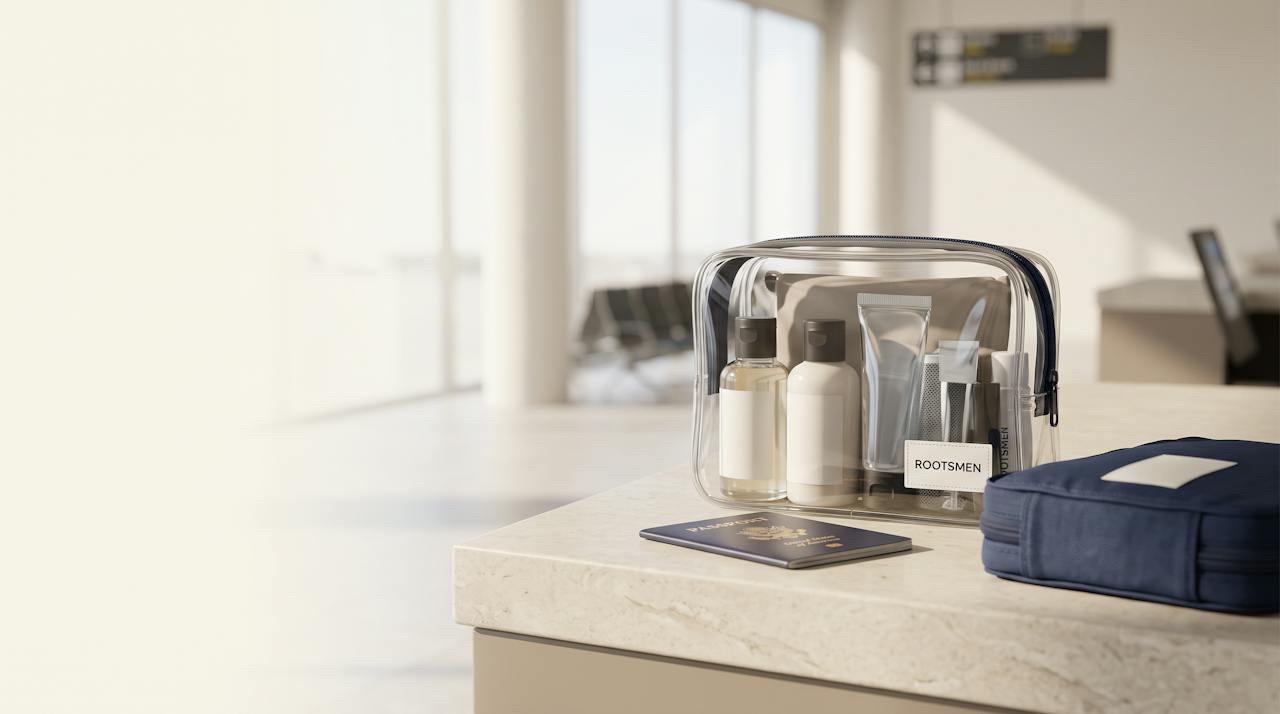
Clear Toiletry Bags and Airline Liquid Rules: What to Design For
Size, closure and material decisions that decide whether your transparent toiletry bag clears security
A clear toiletry bag sold as airport-ready should hold one litre or less, be transparent, and be resealable, because that is what the TSA, the European Commission and IATA all describe. Individual containers stay at 100 ml or 3.4 oz, and passengers are limited to one bag. Some airports with newer scanners now apply looser limits, so wording matters.
A transparent toiletry bag looks like the simplest product in a beauty or travel range: a flat pouch with a zip. In practice it is one of the few soft goods whose specification is set by regulators rather than by your designer, and where a wrong dimension turns a gift-with-purchase into something abandoned at a security tray.
The rules are not identical across markets, they are being loosened at some airports and not others, and the film that looks best on a shelf is not always the one that survives a year of travel.
What the published rules require, and where they diverge
Three requirements recur in every official text: limited container volume, a bag that is transparent and resealable, and one bag per passenger. The TSA liquids rule describes a quart-sized bag for liquids, aerosols, gels, creams and pastes in containers of 3.4 ounces (100 ml) or less. The European Commission sets out 100 ml containers packed in one transparent one-litre re-sealable plastic bag, one bag per passenger.
The IATA summary is the same shape, and IATA notes that governments are increasingly aligning with ICAO guidelines, which is why the specification has converged internationally even though enforcement has not.
Medicines, baby food and special dietary liquids sit outside the limit in both texts, and EU duty-free purchases travel in security tamper-evident bags with proof of purchase. None of that changes what you design: one litre, transparent, resealable is the safe target.
The divergence is in how the bag is described. A US quart is roughly 0.95 litres, so a quart bag and a one-litre bag are close but not identical. The UK publishes a dimension: GOV.UK requires a single, transparent, resealable plastic bag holding no more than a litre and measuring approximately 20cm x 20cm, one per person.
That 20 x 20 cm figure is the most useful single number a buyer has, because a pouch meeting it will almost always satisfy the volume wording used elsewhere. It is also the number most often missed: a 24 cm wide pouch photographs beautifully and fails the only measurable test anyone applies.
Scanner upgrades are changing the rule unevenly
Newer computed-tomography cabin baggage scanners can resolve liquids without removing them, and where certified the volume limit can be relaxed. ACI EUROPE has tracked how changes to EU regulation affected these new-generation scanners at European airports, including a period in 2024 when airports operating them had to return to the 100 ml limit.
GOV.UK now states plainly that the rules depend on the airport, that some airports allow containers up to two litres, and that travellers should check both departure and transit airports. That is the honest position for your own product copy.
Sizing the pouch so it passes everywhere
Design to a finished flat size at or just under 20 x 20 cm and keep the gusset modest. A generous gusset raises internal volume above a litre while the flat dimensions still look compliant, and it is volume that is judged when the bag is full.
Build the sample around real contents rather than a drawing. A 100 ml bottle is taller than most people assume, so internal height decides whether the zip closes. Fit testing with the bottles a brand intends to bundle is the most valuable thing done at sampling, and it belongs in the brief long before the pre-production sample is approved.
Transparency, closure and what resealable means
Transparent means contents are visible without opening the bag. Heavy frosting, dense all-over prints and dark tints work against that, and a panel covering most of one face can prompt a manual check. Keep branding to a border or corner.
Resealable means the passenger can open and close it repeatedly: a zip slider, press-seal track or hook-and-loop flap all qualify, a one-time heat seal does not. Zip quality matters more here than on an opaque pouch, and binding the zip edges with fabric tape prevents the most common early failure.
Material trade-offs: PVC, TPU, EVA and PEVA
PVC gives high clarity and low cost, welds easily and prints well, but it can yellow under UV, stiffens in cold conditions and carries the regulatory baggage discussed below. TPU is the premium option: excellent clarity, far better cold flexibility and tear strength, and specifiable without phthalate plasticizers, at higher cost and with a tighter welding window.
EVA is softer and more matt, usually frosted rather than water-clear: comfortable in the hand, forgiving on tooling, but the reduced clarity works against the product's purpose. PEVA sits between them and is often specified simply as the chlorine-free alternative for brands that have removed PVC from their material policy.
Specify gauge as well as film type. A pouch that feels flimsy reads as cheap regardless of brand, and gauge is where a quotation is most often quietly reduced. The same discipline applies to the fabric versions of these products.
Compliance points buyers should not skip
Plasticized films attract chemical restrictions. Under REACH Annex XVII, DEHP, BBP, DBP and DIBP are restricted in plasticized material in articles at or above 0.1% by weight, individually or combined. If you buy PVC, ask for test reports against that threshold rather than a general assurance; retailer chemical policies often go further.
Decide early whether the pouch is an accessory or is sold containing product, because that changes the labelling you owe. Our overview of compliance documents for cosmetic bags in the US and EU sets out the usual file.
Set the inspection plan before production, not after. Clarity, weld strength, zip cycling and finished dimensions are all measurable, and an AQL inspection plan is where those checks become contractual rather than aspirational.
What to put on the specification sheet
Write the finished flat dimensions and the maximum internal volume, not just a size name. State film type and gauge, the plasticizer restriction, zip type and pull, the decoration method and its coverage limit, and the fit test against the bottles the bag must hold. Add the dimensional tolerance you will accept, because here a tolerance is a compliance question.
For promotional and gift-with-purchase programmes, decide how the pouch is presented and shipped, since folding creases show on clear film in a way they do not on fabric. Our guide to print methods for gift-with-purchase runs covers the decoration trade-offs.
Finally, be careful in your copy. "Meets the one-litre carry-on limit" is defensible. "TSA approved" is not a status any authority grants to a bag, and airport-by-airport variation means absolute promises will eventually be wrong.
Developing the product with a manufacturer
The gap between a compliant drawing and a compliant shipment is closed at sampling. A maker who has run clear films before will raise gusset volume, zip binding and weld width before you do.
ROOTSMEN has made cosmetic bags, pouches and travel organizers as an OEM/ODM supplier since 1981, with its own factory in Guangdong since 1993, and works to FAMA (Disney), ISO 9001, SMETA, GMP and BSCI requirements. If you are developing a transparent toiletry bag for retail or for a promotional or GWP programme, or a wider travel accessories range, our team can work from your dimensions and material policy. Talk to us about your programme.
| Film | Clarity | Cold flexibility | Typical strengths | Watch-outs |
|---|---|---|---|---|
| PVC | Water-clear, highest | Stiffens when cold | Easy welding, strong print results, widely available | Phthalate restrictions apply to plasticized material; can yellow under UV; excluded by some retailer policies |
| TPU | Water-clear, high | Very good | Tear strength, repeated folding, available phthalate-free | Higher cost; tighter welding window |
| EVA | Frosted, limited | Good | Soft hand feel, forgiving to tool | Reduced visibility of contents works against the product's purpose |
| PEVA | Semi-clear to clear | Good | Chlorine-free alternative where PVC is off the material list | Clarity and stiffness vary by grade, so approve a physical swatch |
Event Details
From the Stand
Frequently Asked Questions
The questions this topic actually raises when a program is being scoped.
Design to one litre or less. The European Commission and IATA both describe a one-litre transparent resealable bag, the TSA describes a quart-sized bag, and GOV.UK publishes an approximate 20cm x 20cm dimension. A pouch built to the UK figure will satisfy the volume wording used elsewhere.
No authority certifies or approves toiletry bags. The TSA publishes a rule about container size and a quart-sized bag, not an approval scheme for products. Marketing copy should describe the bag's capacity and features rather than claim an approval that does not exist.
No. Both the European Commission and GOV.UK state a limit of one bag per passenger, and the TSA rule is written in the singular. Selling a two-pouch set is fine, but present the second pouch as checked-luggage storage rather than a second security bag.
In some places only. Newer certified cabin baggage scanners allow relaxed limits at particular airports, and GOV.UK now states that rules depend on the airport and that some allow containers up to two litres. The relaxation is not universal and has been reversed before, so design to one litre.
TPU where durability, cold flexibility and chemical policy matter; PVC where cost and print results lead and the restrictions are verified. Under REACH Annex XVII, four phthalates are restricted in plasticized material at or above 0.1% by weight, so ask for test reports against that threshold.
Keep decoration to a border, corner or small panel so the contents stay visible without opening the bag. Dense all-over prints and heavy frosting defeat the purpose of a transparent pouch and can invite a manual check even when the film itself is clear.
Related Products
Builds where this decision applies.

Have a product requirement of your own?
Tell us the product, the quantity and the timeline — we'll scope a development plan.