
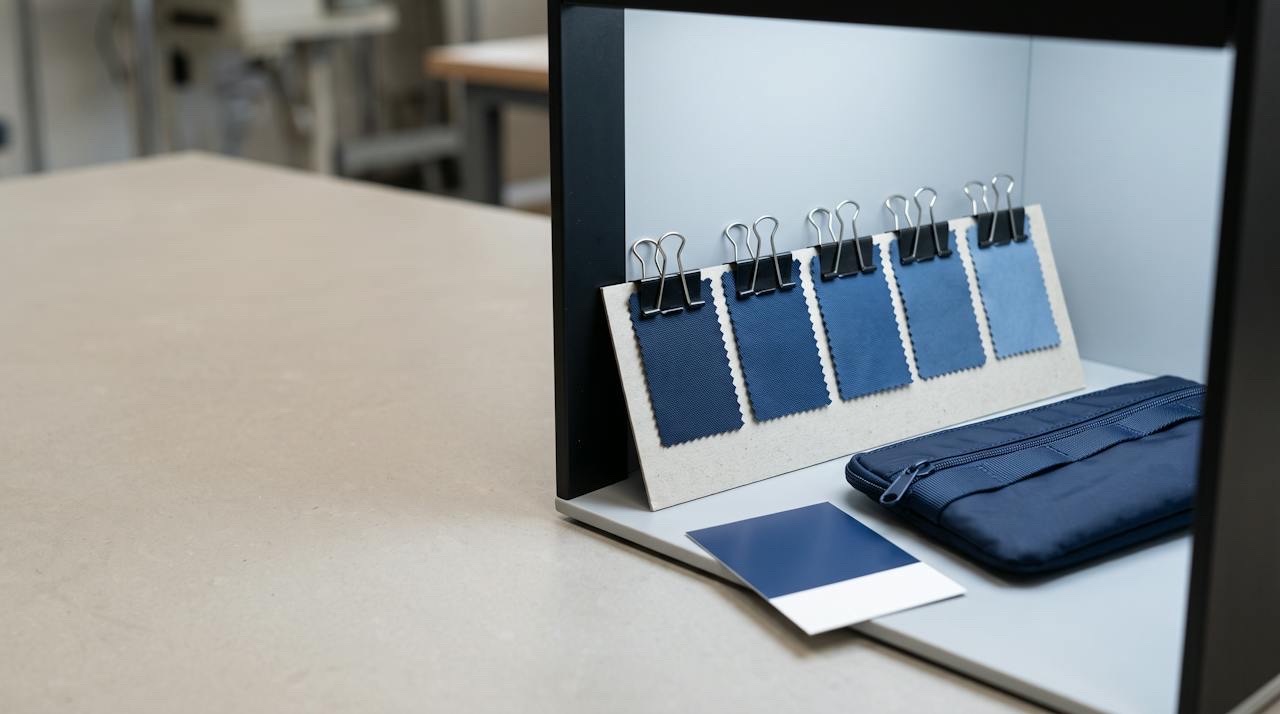
Colour Matching for Bags: Lab Dips, Pantone and Why Colours Shift
How colour standards, lab dips and lighting conditions decide whether your bulk bags match the colour you approved
Colour matching starts with one physical standard, usually a Pantone TCX cotton swatch. Your factory dyes lab dips and prints strike-offs against it, and you approve under an agreed light source such as D65. Colours shift because dye chemistry, substrate and illuminant interact: the same recipe reads differently on nylon, PU and canvas, and again under store lighting.
Almost every colour complaint on a soft goods programme traces back to the same root cause: the approval was never anchored to a physical standard that both sides could hold under the same light. A colour code travels by email in seconds; the dye recipe that reproduces it on coated nylon does not.
This guide covers how colour is controlled on a custom bag or pouch programme — how Pantone TCX and TPG differ, what lab dips and strike-offs do, why metamerism causes arguments, and how approvals are recorded so bulk matches what you signed off.
What a colour standard actually is
A colour standard is a physical reference, not a number. It is the object a dyer, a printer and an inspector can place beside a production sample under controlled light. Lab values and spectral data describe that object; they are not the thing being matched.
Dyeing is a chemical process with tolerances and printing is a mechanical one, so neither reproduces a target exactly. The question is never is it identical but is it inside the agreed tolerance against the physical standard. Without a physical standard, every review becomes an opinion.
Pantone TCX and TPG: which one should you specify?
Pantone's Fashion, Home + Interiors system exists because textile colour cannot be specified on paper alone. TCX is the cotton format: dyed cotton swatches supplied as cotton swatch cards and libraries, each carrying spectral data. TPG is the paper format, a coating on paper that Pantone states matches back to the TCX cotton colours.
The practical rule for bags: specify TCX for dyed fabric and trims, and use TPG for reference and hard components such as moulded zip pullers or rigid cases. Handing a dyehouse a paper chip to match in fabric asks it to bridge two materials by eye, which is where disputes start. If a brand palette exists only in TPG, convert it to a TCX equivalent in writing before development begins.
Lab dips and strike-offs: the approval chain
A lab dip is a piece of your actual fabric dyed to your standard in a laboratory-scale bath — the first honest answer to whether the colour is achievable on that substrate. Dyehouses commonly submit several options per round, because the closest visual match is not always the recipe that repeats well in bulk.
A strike-off is the printed equivalent: your artwork, ink system and fabric, produced before bulk so colour, registration and hand feel can be judged together. Settle the print method first, since a pigment print, a sublimation print and a solid dyed ground have different colour ranges.
Approve both before the pre-production sample. That sample confirms construction against an already-fixed colour; it is not the place to still be arguing about shade, as what a PPS actually confirms sets out.
Metamerism: why the colour changes when you move
Metamerism is the effect where two samples match under one light source and visibly differ under another. It occurs when they are made with different colourants: their spectral reflectance curves cross rather than coincide, so changing the illuminant changes which one looks darker, warmer or duller. That is a physical consequence of matching one colourant system with another, and it becomes a defect only when nobody agreed which light decides.
So agree it. ASTM D1729, the practice for visual appraisal of colours and colour differences of diffusely-illuminated opaque materials, sets out equipment and procedure for this judgement and notes that simulated average daylight D65 is the illuminant recommended by the CIE; ISO 3664 governs viewing conditions in graphic technology and photography. Nominate your primary illuminant in writing and add the secondaries you care about — a shop-floor fluorescent such as TL84, an incandescent source, and the retail lighting your product will sit under.
Substrate: the same recipe on nylon, PU and canvas
Fibre chemistry decides which dye class can be used, and the dye class decides the colour space available. Polyamide and polyester take different dyes; a coated nylon puts a layer between the eye and the dyed yarn; PU is pigmented rather than dyed; cotton canvas absorbs and scatters light differently again.
The consequences are predictable once you expect them. A gloss PU trim reads darker and more chromatic than the same nominal colour in a matt woven, because surface reflection changes what reaches the eye, and textured weaves such as ripstop break up light and can read lighter. Recycled feedstock matters too: rPET can carry a slight base cast that shifts pale and neutral shades, so whites and soft greys need particular attention.
Review colour in the material mix the product will actually use, not one fabric at a time. If you are still weighing substrates, nylon versus rPET for cosmetic pouches is a useful starting point, because the substrate decision quietly sets your colour ceiling.
Lot-to-lot variation and setting a tolerance
Dyeing is a batch process. Bath temperature, liquor ratio, dwell time and the incoming yarn lot all vary slightly, so consecutive dye lots vary too. A large order may be dyed in several lots, and pieces of a single bag may come from more than one.
Two things follow. Shading within a roll, side to side and end to end, should be checked rather than only the average shade of the lot. More importantly, components must be cut so a visible seam does not join two different lots — a body and gusset reading differently is far more damaging than a whole order sitting slightly off standard.
Set the tolerance explicitly: the approved standard, the illuminant, an acceptable direction and magnitude of deviation, and, where justified, physical tolerance swatches showing the limit each way. Then tie it to an AQL inspection plan so a shade defect has a defined severity and outcome.
Recording approvals so bulk matches the standard
An approval that lives in an email thread is not an approval. Make it an object and a record: the signed lab dip or strike-off is cut, dated, signed by both parties and retained by both, with one copy travelling in the production file to the dyehouse and the sewing floor.
The record beside it should carry the standard reference, the substrate and finish it was approved on, the nominated illuminant and secondaries, the tolerance, the approver's name and the date. Colour approval is component-level: a shade approved on matt woven nylon has not been approved on gloss PU, webbing, zip tape or thread, and an embroidery thread, a pigment print and a debossed surface each render the same nominal colour differently.
Getting this right with your manufacturer
Good colour control is a procedure, not a talent, and it is visible early. A manufacturer that asks which illuminant you will approve under, submits multiple lab dips on your actual substrate and keeps signed physical references on file is telling you how bulk will be controlled long before bulk exists.
ROOTSMEN has produced custom cosmetic bags, pouches, travel organizers and promotional and licensed soft goods since 1981, working from its own factory in Guangdong since 1993, with FAMA (Disney), ISO 9001, SMETA, GMP and BSCI among its certifications. To scope a colour-critical programme, see our cosmetic bags and travel accessories capabilities, or get in touch to talk through your palette and substrates.
| Pantone TCX | Pantone TPG | |
|---|---|---|
| Format | Dyed cotton fabric swatch | Coating printed on paper |
| Relationship | The textile colour system | Formulated to match back to TCX colours |
| Best used for | Dyed fabric, webbing, trims and thread | Design reference and hard components |
| Strength as a standard | Same medium as the product, so the dyehouse matches fabric to fabric | Portable, easy to duplicate and distribute |
| Weakness | Fabric references age and soil with handling | Paper and coating differ from fabric, adding a translation step |
| Use in approvals | Suitable as the standard of record for dyeing | Best converted to a TCX equivalent before development |
Event Details
From the Stand
Frequently Asked Questions
The questions this topic actually raises when a program is being scoped.
TCX is Pantone's dyed cotton fabric format and TPG is a coating printed on paper, formulated to match back to the TCX cotton colours. For dyed fabric, specify TCX so the dyehouse matches fabric to fabric. Use TPG as a design reference or for hard, non-textile components.
Usually metamerism. Your sample and the standard were made with different colourants, so they match under one illuminant and diverge under another. Approve under an agreed light source such as D65, then check the same pair under store lighting and any other source that matters before signing off.
Dyehouses commonly submit several options in a round, because the closest visual match is not always the recipe that repeats reliably in bulk. More than one round is normal for difficult shades. Deep saturated colours and pale neutrals are the least forgiving and usually take the most work.
No. Colour approval is component-level. A shade approved on matt woven nylon has not been approved on gloss PU, webbing, zip tape or thread, because each substrate takes colourant differently and reflects light differently. Submit and approve each material and finish separately, then review them together as an assembled set.
Nominate a primary illuminant and your secondaries in writing. ASTM D1729 covers visual appraisal of colours and colour differences of diffusely-illuminated opaque materials and notes D65 simulated daylight as the CIE recommendation; ISO 3664 governs graphic technology viewing conditions. Add a fluorescent source and the retail lighting your product will sit under.
Large orders are dyed in multiple lots, and lots vary. The damaging case is mixed lots within one finished bag, so cutting should keep a visible seam from joining two lots. Ask how lot control and shade sorting are handled, and put a shade defect into your inspection plan with a defined severity.
Related Products
Builds where this decision applies.

Have a product requirement of your own?
Tell us the product, the quantity and the timeline — we'll scope a development plan.