Most inspection clauses in a purchase order start with a number — "inspected to AQL 2.5" — and stop there. On a sewn product that sentence decides very little. It sets how many faults a sample may contain before the lot is rejected, but says nothing about what counts as a fault on a zipped cosmetic bag, which is where nearly every dispute starts.
The useful order of work is the reverse: write the defect definition first, agree the reference standard the inspector measures against, choose the inspection level and the AQL, and only then decide who books the inspection and when.
What do AQL, lot and inspection level actually mean?#
AQL — acceptance quality limit — is the worst process average still considered acceptable for the purpose of the sampling plan. It is not a permitted defect rate for your shipment, and not a promise that a passed lot contains that percentage of faults. The US NIST/SEMATECH Engineering Statistics Handbook puts it plainly: acceptance sampling decides whether a lot is likely to be acceptable, not the quality of the lot.
A lot is the quantity presented for inspection as one unit of decision — normally one style, one colourway, one production run, packed and ready. A single sampling plan means one sample is drawn, and the lot is accepted if the number of defective pieces is at or below the accept number and rejected if it reaches the reject number. The general inspection level (I, II or III) sets how much sampling effort you buy: level II is the normal default, level I gives a smaller sample and less discrimination, level III a larger sample and more.
Defects are then sorted into classes. A critical defect could make the product unsafe or unsaleable outright; a major defect is one a normal customer would likely notice and return; a minor defect departs from the standard but would rarely trigger a return. Each class gets its own AQL, agreed with the buyer and written into the purchase order.
How does ISO 2859-1 turn a lot size into a sample size?#
The mechanism is a two-table lookup. ISO 2859-1, Sampling procedures for inspection by attributes (current edition BS ISO 2859-1:2026) gives single, double and multiple sampling plans indexed by AQL for lot-by-lot inspection, with switching rules between normal, tightened and reduced inspection. Its stated aim is to encourage a producer to hold the process average at or better than the agreed AQL while limiting the consumer's risk of accepting a bad lot.
First table: lot size plus inspection level gives a sample size code letter. Second table: the code letter plus the AQL gives the sample size and the accept and reject numbers. Both tables sit inside the standard itself, which is why the purchase order should name the standard and its edition rather than a bare number.
Two consequences matter for a bag programme. The sample size grows much more slowly than the order, so a 3,000-piece run and a 10,000-piece run are not inspected in proportion — which is why the defect definition carries more weight than the number. And because sampling makes a one-off decision about one lot, it is not a substitute for process control during the run, a distinction the NIST handbook draws explicitly. Our in-line checkpoints are described on the manufacturing page.
What counts as a major defect on a cosmetic bag?#
This is the part worth your drafting time, because "AQL 2.5" applied to an undefined fault list means whatever the inspector on the day thinks it means. A workable soft-goods defect list covers seven areas, each written so two people looking at the same pouch agree.
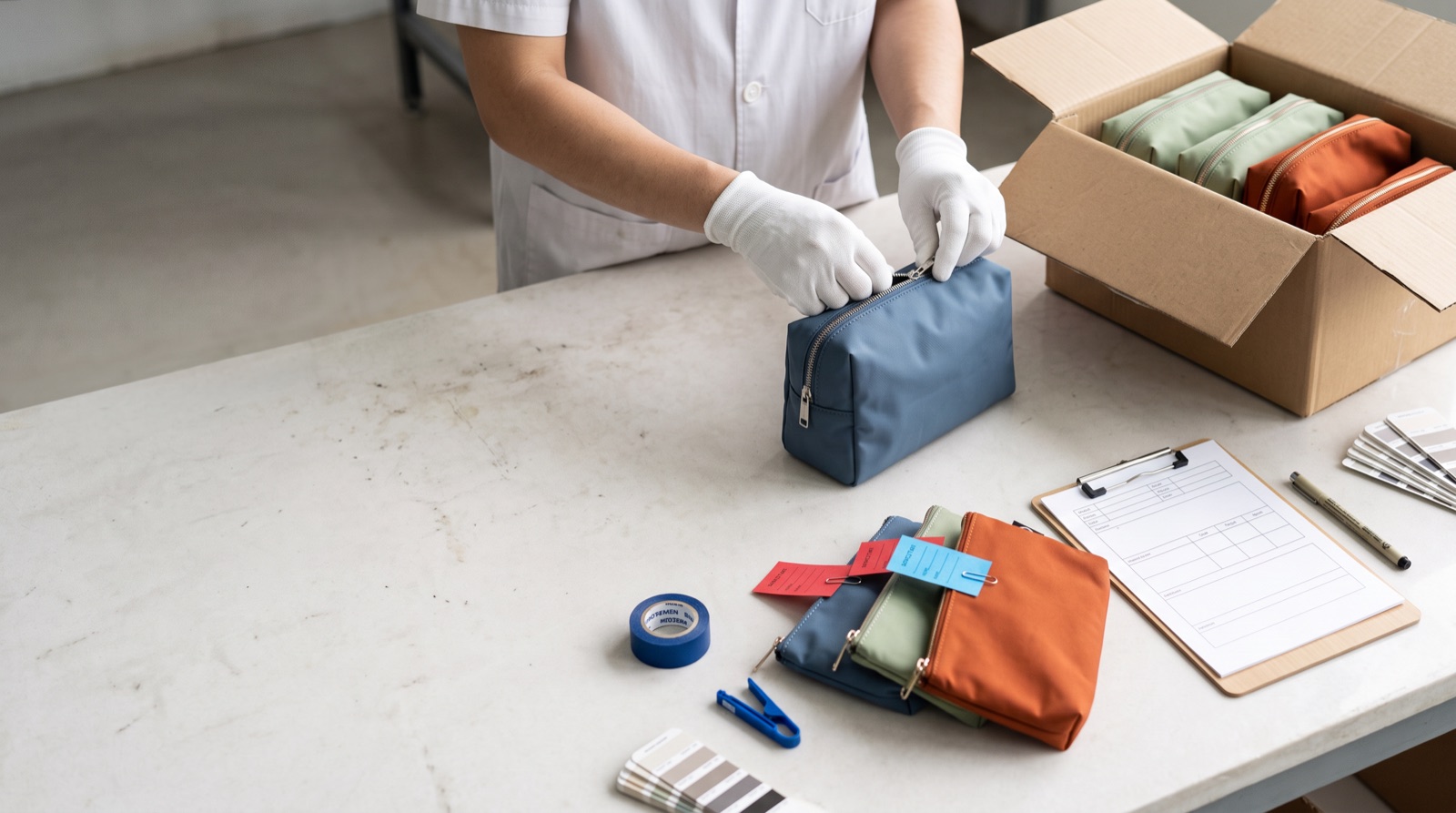
Seams and stitching: seam slippage, open or broken seams, skipped stitches, stitch density below the spec, raw edges not enclosed. Zipper function: the zip must run the full length in both directions with the bag loaded, not empty and flat, and the slider must not separate under normal use — the strength properties behind that are the subject of ASTM D2061-07(2021), Standard Test Methods for Strength Tests for Zippers, covering chain strength, stop holding strength, slider lock holding strength and pull-off resistance.
Puller and hardware finish: plating scratches, colour mismatch between pullers and other trims, burrs or sharp edges. Colour against the approved standard: assessed against the approved swatch under an agreed light source and graded with grey scales rather than by opinion — AATCC's own guidance on grey scales points out that the reference chips are affected by fingerprints and light exposure and should be replaced yearly. Dimensions: each measurement point with a stated tolerance, typically ±3–5% or an absolute figure in millimetres.
Labelling: for goods sold in the US, the FTC's guide to the Textile and Wool Acts requires fibre content, country of origin and the identity of the manufacturer or responsible dealer, clearly legible and securely attached until the product reaches the consumer — so a wrong or missing label is a compliance failure, not a cosmetic one. Packing and barcode: polybag and carton marking, quantity per carton, and a scan test on the retail barcode.
Why should the approved PPS be the reference standard?#
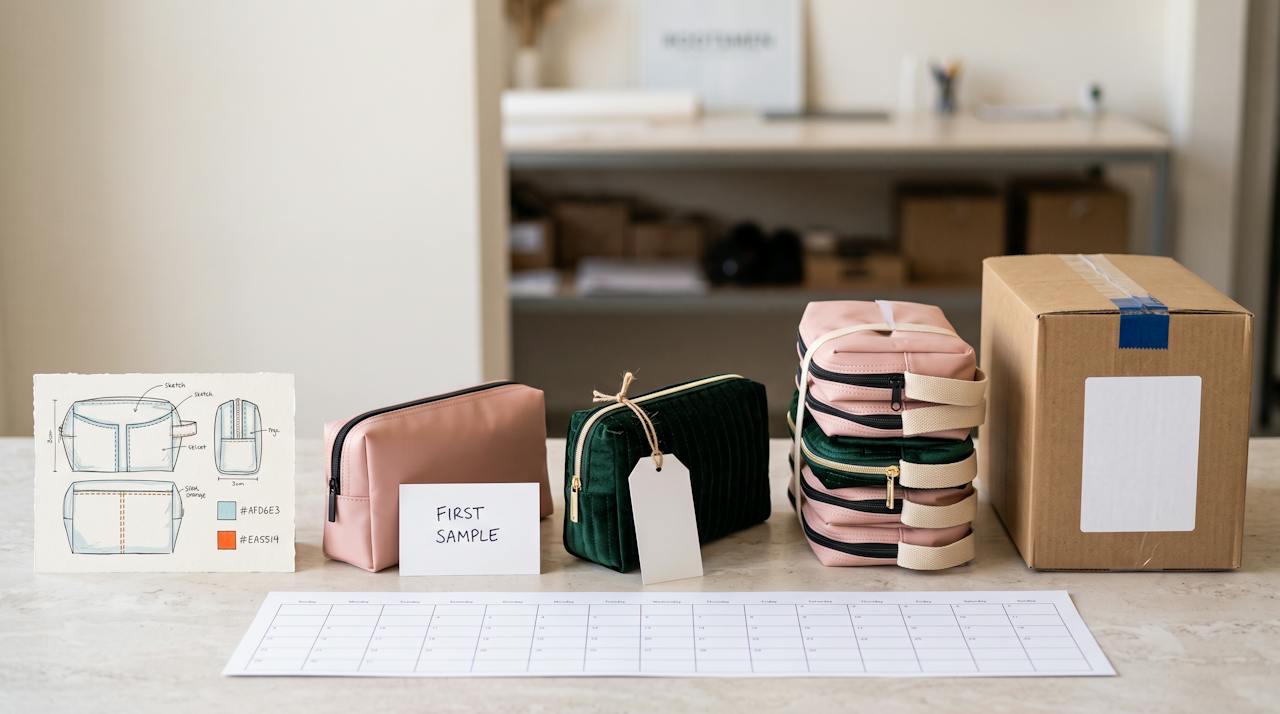
An inspector needs something to inspect against. If the clause says "as per buyer's requirements", the inspection is an opinion. If it says "against the approved pre-production sample and signed spec sheet, both sealed and held at the factory and at the buyer", it is a measurement.
That is the whole reason the pre-production sample exists. As set out in what a PPS actually confirms before bulk production, once approved it becomes the reference every production unit is measured against. Name it in the purchase order by date and seal number, and state that colour is judged against the approved lab dip or swatch, not against the PPS shell, which may have been handled and faded.
Should you inspect during production or pre-shipment?#
Both, for different reasons. A during-production inspection is commonly booked once roughly 20% of the order is finished and packed — early enough that a systemic fault, a mis-set stitch density or a wrong puller finish, can still be corrected on the remaining work. It buys you time, not a shipping decision.
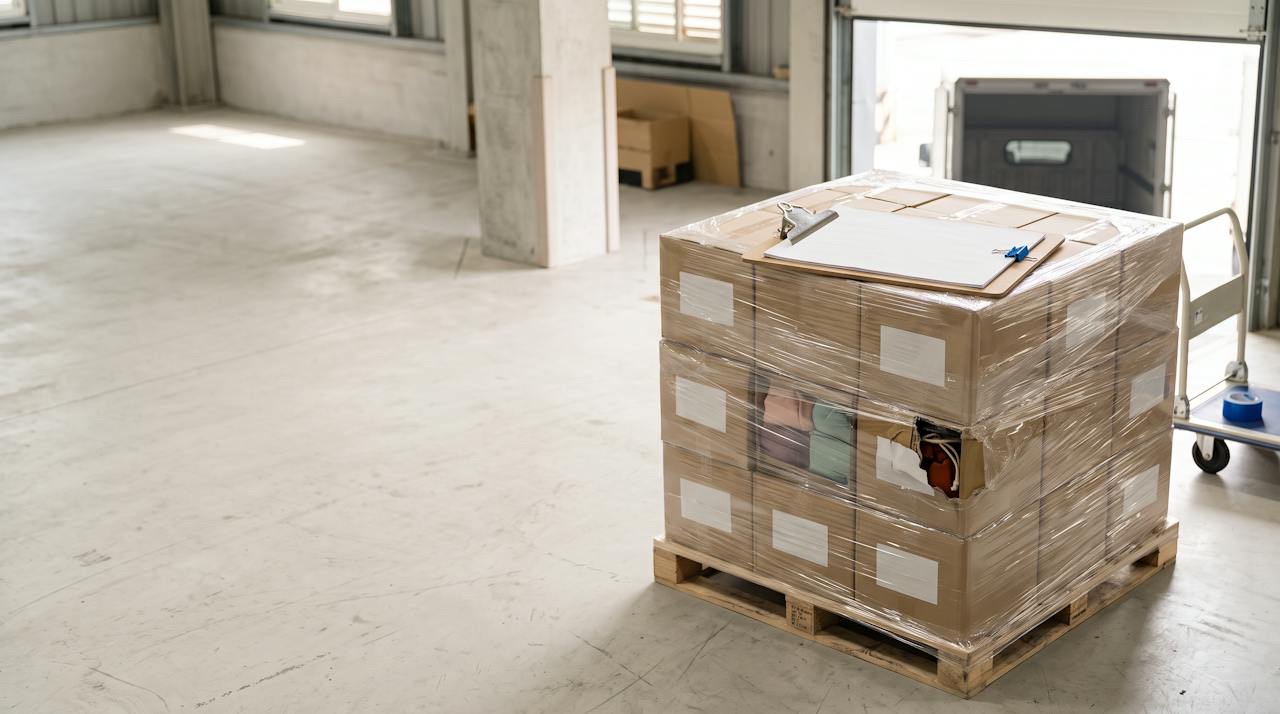
The pre-shipment inspection is the acceptance decision, and it is usually conditioned on the widely used packed-goods condition — typically at least 80% of the order produced and 100% packed — which you should write into the purchase order rather than assume. Inspecting earlier means the inspector samples from what happens to be ready, which is not a random draw from the lot. If your order is split across styles, state whether each style is its own lot; mixed-style lots produce arguments nobody wins.
Who books the inspection and what must the report contain?#
For a first order with a new supplier, the buyer books and pays for a third-party inspection body and instructs it directly. That is not distrust; it is what makes the result usable as a basis for holding a shipment. At ROOTSMEN, AQL inspection can be arranged where the programme requires it, and the inspection level and acceptance criteria are agreed with the buyer before production. Where the buyer books the inspection, the inspection location, packing status and sample presentation are confirmed with the order.
For the report to support a hold, it must state at minimum: the standard applied and its edition, the lot size and how the lot was defined, the inspection level and the AQL for each defect class, the sample size and accept/reject numbers, the actual defect count by class with photographs, the measurement results against the spec sheet's points, carton and barcode checks, and a signed accept or reject conclusion. A report that gives a verdict without the sample size and accept numbers cannot be argued with — or from.
Agree in the purchase order what a rejection triggers: sorting and re-inspection at the supplier's cost, rework, or a discount — and who pays for the re-inspection.
What should you send us to set the plan?#
Send the order quantity per style and colourway, your intended lot definition, the destination market, the approved PPS and spec sheet references, your defect classification list if you have one, and the inspection body you intend to use. If you do not have a defect list, say so — we will work from the spec sheet and propose one for your review.
If you are still scoping the programme, what to send us so the first quote is accurate covers the development end of the same conversation, and the travel accessories range shows the constructions these checks are written against. When the inspection plan is part of the order, send it with the brief through contact.
Sources#
Engineering Statistics Handbook, 6.2.1 What is acceptance sampling? — NIST/SEMATECH
Engineering Statistics Handbook, 6.2.2 Single sampling plans — NIST/SEMATECH
BS ISO 2859-1:2026 Sampling procedures for inspection by attributes — Part 1: Sampling schemes indexed by acceptance quality limit (AQL) for lot-by-lot inspection — BSI Knowledge (British Standards Institution)
ASTM D2061-07(2021) Standard Test Methods for Strength Tests for Zippers — ASTM International
Test Methods and Evaluation Procedures (grey scale guidance) — AATCC
Threading Your Way Through the Labeling Requirements Under the Textile and Wool Acts — US Federal Trade Commission
| Defect class | Example on a cosmetic bag | Typical AQL treatment | If found |
|---|---|---|---|
| Critical | Sharp burr on a slider or exposed needle fragment; missing or wrong country-of-origin label on goods bound for the US | Zero accepted in the sample | Hold the lot; 100% sort and correct, then re-inspect before any release |
| Major | Open or slipped seam, zip that jams or separates when the bag is loaded, colour outside the agreed grade against the approved swatch, measurement outside tolerance | Tighter class AQL, agreed with the buyer | Reject at the accept number; rework or sort at supplier cost, then re-inspect the full lot |
| Minor | Loose thread ends, slight plating mark on hardware, minor carton marking error that does not affect identification | Looser class AQL, agreed with the buyer | Accept within the number; log the finding and correct the cause on the next run |