Transparent bags are specified more often than almost anything else in this category — stadium bags, airport pouches, cosmetic kits, gift-with-purchase sets, retail display pieces — and the brief almost always says the same thing: clear PVC. Half the time what arrives would have been better in something else.
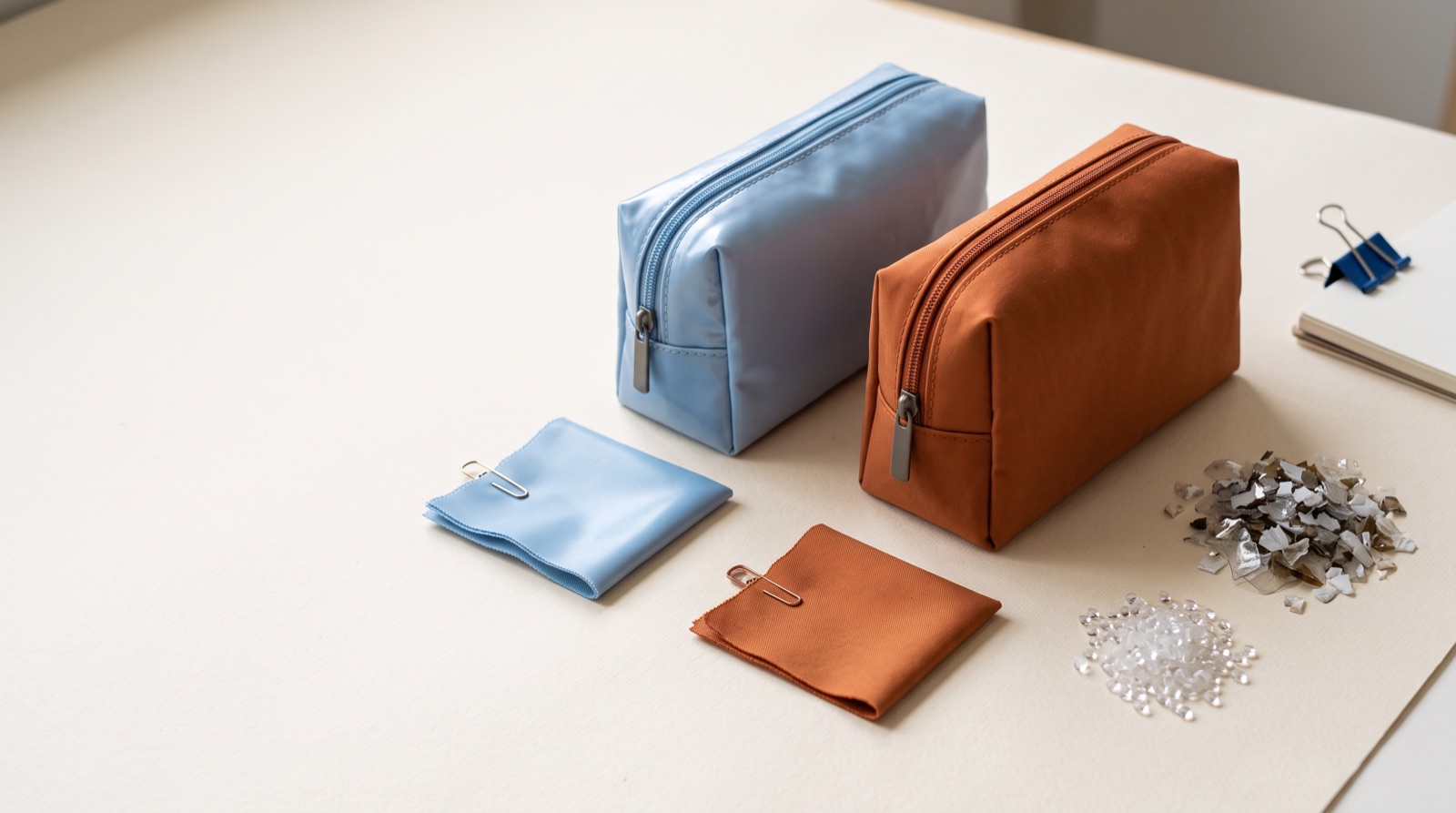
Four films cover nearly all of this work: PVC, TPU, EVA and PEVA. They are not grades of one material. They are different polymers with different clarity, different behaviour in the cold, different welding, different smell and different regulatory exposure, and the one that suits a stadium bag is not the one that suits a cosmetic pouch.
What the four materials actually are#
PVC (polyvinyl chloride) is the default. It is the cheapest, the easiest to weld, available in the widest range of thicknesses and the most forgiving to work with. Flexible PVC needs plasticisers to be soft, and that is where its compliance exposure comes from.
TPU (thermoplastic polyurethane) is the premium film. It is clearer, noticeably stronger for its thickness, stays flexible when cold, and is usually specified without the plasticisers PVC needs. It costs considerably more and is less forgiving in production.
EVA (ethylene-vinyl acetate) sits between them: softer and more rubbery in hand, slightly hazier than PVC, free of the plasticiser question, and commonly used where a soft touch matters more than optical clarity.
PEVA (polyethylene-vinyl acetate) is the budget non-PVC option. It is the softest and haziest of the four, the least durable, and it is specified mostly because a brand wants to say "PVC-free" on a low-cost item.
Thickness, and the number that actually matters#
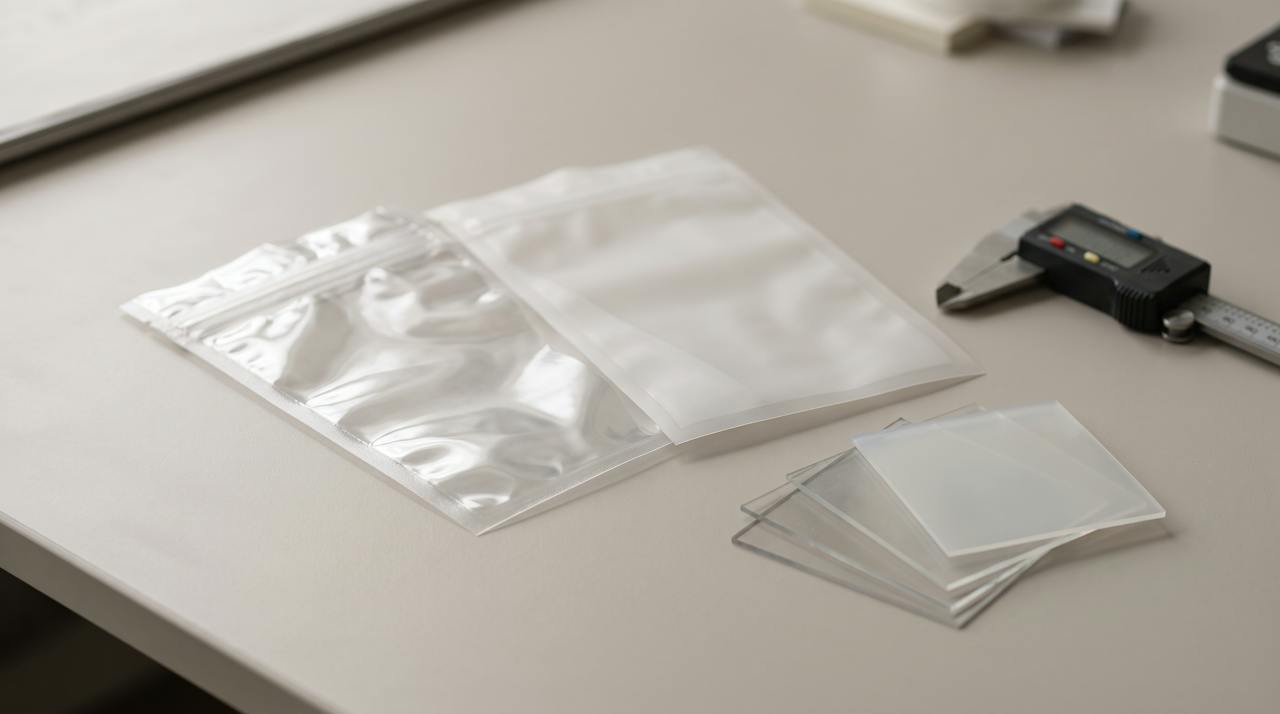
Clear film is specified in gauge or in millimetres. The common working range for bags is roughly 0.3 mm to 0.8 mm; below that the piece feels like packaging, and above it the material stops folding cleanly and starts fighting the sewing machine.
Around 0.3–0.4 mm suits a flat pouch with no structure — an airport liquids bag, a sample kit. 0.5 mm is the general-purpose weight for a cosmetic pouch that should stand up to daily use. 0.6–0.8 mm is for pieces that must hold a shape or carry weight, and for anything that will be handled hard.
Thickness is also where a cheap quotation hides. The same bag in 0.35 mm and in 0.5 mm looks identical in a photograph and feels completely different in the hand, so the number belongs in the tech pack rather than in a conversation.
Clarity, haze and yellowing#
All four are described as clear and none is optically perfect. TPU is the clearest and stays that way longest. PVC is clear when new and ambers with age and light exposure — slowly indoors, visibly faster in a shop window or a sunny shipping container. EVA and PEVA both start slightly hazy, which reads as milky rather than dirty.
If the product has to show a brand's packaging through it — a cosmetic set where the bottles are the point — that yellowing matters, because it ages the product the brand put inside. For a stadium bag or a travel pouch, almost nobody notices.
Where the film carries a printed or welded logo, clarity also affects how the mark reads. A white print on hazy PEVA loses contrast in a way it does not on TPU, which is worth seeing on a sample before the decoration method is fixed.
Cold weather is where they separate#
This is the single most useful distinction and the one briefs most often miss. Flexible PVC stiffens as temperature drops and becomes brittle; a PVC bag that is supple in a warehouse can crack along a fold after a winter flight in an unheated hold, or in a cold shop doorway.
TPU stays flexible far lower and is the reason it dominates outdoor and travel applications. EVA sits in between. PEVA is the weakest of the four here.
So the question to ask is not "which is better" but "where does this product live". A GWP pouch shipping to Southeast Asia and a travel organiser sold in northern Europe are not the same specification, and a product that will cross a winter supply chain should be quoted in TPU or in a heavier PVC with the risk understood.
How they are joined, and why it changes the design#
Clear film is usually high-frequency welded rather than sewn. An RF machine fuses the layers with a heated die, which gives a sealed, clean edge with no stitch holes — the reason a welded clear pouch can be genuinely water-resistant where a sewn one cannot.
PVC welds easily and is the reason it is the default. TPU welds well but needs tighter control. EVA welds. PEVA and polyethylene-based films weld poorly or not at all with standard RF equipment, which is a real constraint rather than a detail: it limits what shapes are possible and often forces a sewn or taped construction instead.
Welding also means tooling. Each welded shape needs its own die, which is a one-off cost per size and one of the reasons a four-size set costs more to start than one size does.
Where the piece is sewn instead, the needle perforates the film, and the seam becomes the weak line. A sewn clear bag needs either a bound edge or a reinforcing tape, and it should not be described as waterproof — see waterproof versus water repellent.
Smell, and why samples arrive in a sealed bag#
Flexible PVC has a characteristic smell, strongest when new and in a sealed container. It fades with airing, but it is the most common complaint on a first clear-bag sample and it surprises buyers who have never handled the material in volume.
TPU and EVA are substantially lower odour; PEVA is usually the lowest. For a cosmetic or amenity programme, where the bag sits next to fragranced product, this is worth weighing — the smell of the bag can be read as a fault in the contents.
If a sample arrives sealed, open it and leave it out for a day before judging. If it still smells after that, say so: it is information about the compound, not about the sample.
Compliance: where the real difference is#
This is where "clear PVC" becomes a decision rather than a default. Flexible PVC is softened with plasticisers, and several phthalate plasticisers are restricted. In the EU, REACH restricts certain phthalates in articles, with tighter rules again for anything classed as a toy or childcare article. US states operate their own lists, and California's Proposition 65 warning regime reaches this material directly.
Nothing here is a limit value to design against; limits change and depend on the article and the market. What is actionable is the sequence: name the market in the brief, ask the supplier for the plasticiser declaration and any test report for the specific compound, and keep that paperwork with the programme file. Our note on compliance documents for the US and EU covers what is normally requested.
TPU, EVA and PEVA avoid the phthalate question by construction, which is most of why a brand moves off PVC. "PVC-free" is also a claim, and like any claim it should rest on a declaration for the material actually used rather than on the material's name.
If the product is for children, or will be sold alongside a children's product, raise it at brief stage. The requirements tighten considerably and they change which film is viable.
The airport-liquids case#
A large share of clear-bag briefs are for airport liquid pouches, and that application has its own constraints: a size limit, a transparent body and a resealable closure. The material question is secondary to those, but it interacts with them — a film that cracks in a cold hold fails the product regardless of how well it was specified.
Our note on clear toiletry bags and airline liquid rules covers the sizing and closure requirements in detail.
Choosing, in one pass#
PVC when cost and weldability lead, the market is warm, and the plasticiser declaration is in hand. TPU when the piece must stay clear, stay flexible in the cold, or carry a premium position — and when the budget can take it. EVA when a soft hand matters and PVC is off the table. PEVA only for low-cost, light-duty items where "PVC-free" is the point and the construction does not need welding.
Send four things with the brief and the quotation will come back right the first time: the market it sells into, the lowest temperature it will see, the thickness or the feel you are targeting, and whether anything is printed on it.
ROOTSMEN manufactures clear and translucent pouches in PVC, TPU, EVA and PEVA, welded or sewn, with the material declaration supplied per programme. See the cosmetic bag range and travel accessories, or send the brief and we will quote the construction line by line.
| PVC | TPU | EVA | PEVA | |
|---|---|---|---|---|
| Relative cost | Lowest | Highest | Middle | Low |
| Clarity | Good when new, ambers | Clearest, stays clear | Slightly hazy | Haziest |
| Cold flexibility | Stiffens, can crack | Stays flexible | Moderate | Weakest |
| RF welding | Easiest | Good, tighter control | Weldable | Poor or not at all |
| Odour when new | Noticeable | Low | Low | Lowest |
| Plasticiser question | Yes | No | No | No |
| Best for | Cost-led, warm markets | Premium, cold, outdoor | Soft hand, PVC-free | Low-cost PVC-free |