
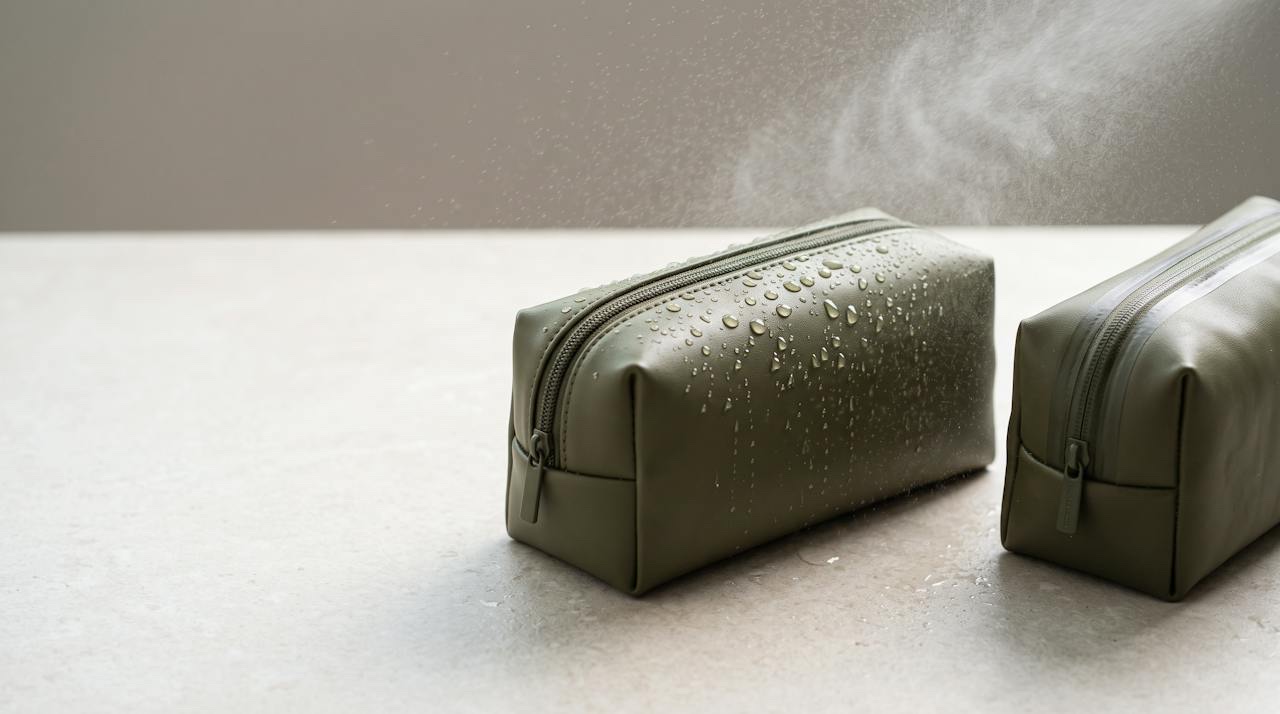
Waterproof vs Water-Repellent: What a Wash Bag Can Really Promise
How coatings, seams and zippers decide whether your wash bag is genuinely waterproof, and how to word the claim so it survives scrutiny.
Water-repellent means the outer fabric sheds surface water thanks to a finish, tested by spray methods such as ISO 4920 and AATCC TM22. Waterproof means water cannot pass through under pressure, which needs a coating or laminate plus sealed seams, and is measured by hydrostatic head to ISO 811. Most wash bags are water-resistant, not waterproof.
"Waterproof toiletry bag" is one of the highest-intent searches in the category, and the phrase most likely to land a brand in a customer-service queue. A shopper who reads waterproof expects a bag that can sit in a wet shower cubicle, hold a leaking bottle of shampoo or go into a swim kit without consequence. A bag that merely beads off a splash will disappoint within a week.
The gap is not a marketing problem but a construction one. Repellency lives on the surface of the fabric; waterproofness lives in the barrier layer, the seams and the closure. Knowing which you have specified is what keeps the product page, the packaging and the returns rate aligned.
Repellent, resistant, waterproof: three different promises
Water-repellent describes a surface behaviour: a finish makes droplets bead and roll rather than soak in. The fabric underneath is still porous, and the effect wears off with abrasion and laundering.
Water-resistant has no single technical definition. It usually signals a repellent finish plus a tight weave, or a light coating, and it is the honest label for most wash bags on the market.
Waterproof should mean the material stops liquid water under pressure — and that the assembled article does too. That second half is where most bags fail: a fully coated fabric with ordinary sewn seams is not a waterproof bag, because every needle penetration is a hole.
DWR finishes: what they do and what they do not
A durable water repellent finish is applied to the face of the fabric, normally by padding and curing. It changes how the surface interacts with water, not how permeable the textile is. On a wash bag that is genuinely useful: condensation, splashback and a wet hand all roll off, and the bag dries quickly.
Its limits matter for the claim. DWR degrades through folding, rubbing and contact with soaps and oils — exactly what a toiletry bag lives among. Treat it as a feature with a service life, not a permanent property, and put that on the care label rather than the front of the packaging.
PU, TPU and laminates: adding a real barrier
To stop water rather than shed it, you add a continuous layer. PU coating is applied wet to the back of the fabric and is the most common route for bags; a heavier coat weight gives a higher hydrostatic head but a stiffer hand. TPU is supplied as a film and bonded to the fabric, giving a more consistent barrier, better abrasion behaviour and — importantly — a surface that can be welded.
Fully laminated constructions sit at the top of the range and are what genuinely waterproof, dry-bag style wash bags are built from; the trade-offs are hand feel, printability and behaviour at folds. Our notes on nylon and rPET for cosmetic pouches cover how the substrate affects what a coating can achieve.
Seams decide the outcome
A sewn seam in a coated fabric leaks by design, and there are three routes to fixing it. Seam tape is heat-applied over the stitch line on the coated face; it depends on compatibility between tape and coating, so it must be trialled on the actual material. Welded seams, high frequency or hot air, fuse TPU-faced materials with no needle holes at all — the strongest construction, and the one used for roll-top wet bags. Bound or folded seams tidy the inside but seal nothing.
The seam is the item to police in production. Ask for a water-tightness check on the finished bag, not only a fabric report, and write the acceptance into the inspection scope — our guide to setting an AQL inspection plan explains how to attach a functional test to a sampling plan.
Zippers and closures
A standard coil zipper is an open channel and will pass water freely, whatever the fabric around it does. Water-resistant zippers carry a PU or TPU film laminated over the tape, closing tightly against the coil. They handle spray and splash well and are the sensible default for a premium wash bag, but they are not submersion-proof and are generally not claimed to be.
Roll-top closures with a buckle are the only common format genuinely close to waterproof, because there is no mechanism to leak through. Welded flap-over and hook-and-loop closures sit between the two.
The standards, and what each one actually proves
ISO 811 is the hydrostatic pressure test: a specimen faces steadily increasing water pressure until water appears in three places, and the pressure at the third is recorded in centimetres of water. This is what people mean by "hydrostatic head", and it is the only one of the three that speaks to waterproofness of the material.
ISO 4920 is the spray test: water is sprayed onto a specimen mounted on a ring at 45° and the wetted pattern is graded against photographs. ISO states explicitly that it is not intended to predict rain penetration, because it does not measure water passing through the fabric. AATCC TM22 is the comparable American spray method.
So a spray rating describes a finish and a hydrostatic head describes a barrier. Neither describes a bag. Only a test on the assembled article tells you what the customer will experience.
PFAS-free DWR and the regulatory backdrop
Historically the best-performing DWR chemistries were fluorinated. That option is narrowing sharply. In the EU, PFOS, PFOA and PFHxS and their related substances are restricted under the POPs Regulation (EU) 2019/1021, and a broad PFAS restriction has been under consideration through ECHA. In the US, California's AB 1817 prohibits textile articles containing intentionally added PFAS, on a total organic fluorine threshold that steps down over time, and handbags and accessories fall inside its definition of a textile article.
Practically, specify a non-fluorinated DWR — silicone, wax, polyurethane and dendrimer chemistries are the usual families — accepting that oil repellency is largely lost while water repellency can remain good. Then ask for documentation rather than an adjective: a substance declaration, and a total organic fluorine result where a market requires it. The same discipline applies to any environmental wording, as we set out in verifying a recycled material claim.
Wording the claim, and building it with a partner
Write the claim to match the construction. With a coated fabric, a water-resistant zipper and sewn seams, say water-resistant and describe the benefit: wipes clean, contains a splash, protects a suitcase from a leaking bottle. With a welded or taped body and a roll-top, waterproof is defensible — and you should still say what it is not. Where you can, name the method and the result, and keep the report on file.
Then lock it into the sample. A claim is only real if the pre-production sample is tested as a finished bag and the approved construction is written into the specification, seam by seam. ROOTSMEN has made custom cosmetic bags, pouches and travel organizers since 1981, with our own factory in Guangdong since 1993, and works with brand owners on exactly this — matching coating, seam treatment and closure to the claim a brand intends to print. Our travel accessories range and the contact page are the place to start.
| Construction | Typical barrier | Seams | Closure | Honest wording |
|---|---|---|---|---|
| Uncoated fabric with DWR | None — surface finish only | Sewn | Standard coil zipper | Water-repellent surface; wipes clean |
| PU-coated fabric | Coating, gives a measurable hydrostatic head | Sewn, unsealed | Standard or water-resistant zipper | Water-resistant lining; contains a splash |
| PU or TPU coated, seam-taped | Coating plus sealed stitch lines | Heat-taped | Water-resistant zipper | Highly water-resistant; not submersion-rated |
| TPU-faced, welded body | Film laminate, no needle holes | Welded (HF or hot air) | Roll-top with buckle | Waterproof body and seams |
| Lined wet pocket inside a dry bag | Coated inner compartment | Bound inner, sewn outer | Separate water-resistant zipper | Wet-dry separation; contains damp items |
Event Details
From the Stand
Frequently Asked Questions
The questions this topic actually raises when a program is being scoped.
Yes, but only when the body, seams and closure are all sealed — typically a TPU-faced welded construction with a roll-top. Anything with sewn, untaped seams or a standard zipper is water-resistant at best, because water enters through the needle holes and the zipper channel long before it passes through the fabric.
It tells you how much water pressure the fabric itself withstands before water penetrates, measured in centimetres of water under ISO 811. It says nothing about the finished bag. A high reading paired with unsealed seams and an open coil zipper will still produce a bag that leaks in normal use.
No. A spray rating under ISO 4920 or AATCC TM22 grades surface wetting only, and ISO 4920 states it is not intended to predict rain penetration. It supports a repellency claim. For a waterproof claim you need a barrier result plus evidence that the seams and closure are sealed.
For water, non-fluorinated finishes generally perform well and are the mainstream choice now. The clear loss is oil and stain repellency, which fluorochemistry provided and silicone, wax, polyurethane and dendrimer alternatives largely do not. For a wash bag that trade-off is usually acceptable, since the barrier does the real work.
Usually yes on a premium wash bag. A film-laminated zipper stops splash and spray that an ordinary coil zipper passes straight through, and it reads as quality in the hand. It is not submersion-proof, so pair it with honest wording rather than treating it as a waterproofing solution on its own.
Test the pre-production sample as a finished bag, not just the fabric, and write the approved coating, seam treatment and zipper into the specification by name. Then attach a water-tightness check to the inspection scope so the same construction is verified in bulk. ROOTSMEN builds this into the sample approval stage with brand owners.
Related Products
Builds where this decision applies.

Have a product requirement of your own?
Tell us the product, the quantity and the timeline — we'll scope a development plan.