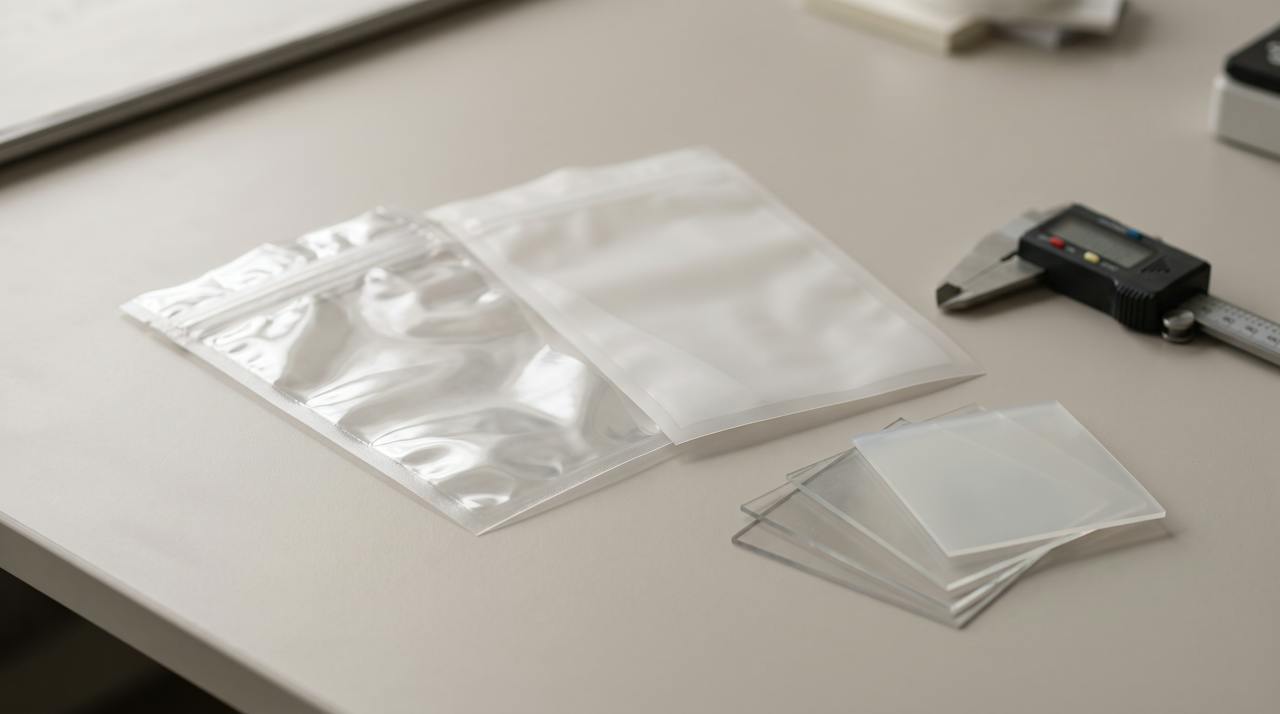
Clear windows let a buyer see the brushes, palette or travel bottles inside a cosmetic bag without opening it. On a fabric bag, the window is usually a panel of clear film framed by fabric, binding or piping, and it is the part of the bag most likely to look tired first.
Our overview of clear PVC, TPU, EVA and PEVA compares the films for whole clear bags. This article looks only at the window panel, where the demands are slightly different.
What a window panel has to do that a clear bag does not#
A window is joined to fabric on every edge. It flexes at the frame each time the bag is opened, it sits next to printed or coloured fabric that may stain or transfer onto it, and it is often the first thing a customer looks at in a shop.
That puts the weight of the decision on four things: how the film ages in light, how it behaves when folded in the cold, how it copes with humidity, and how it is joined to the fabric. Chemistry and paperwork follow from the choice of film.
Clarity and yellowing over time#
Yellowing is the most visible failure of a window. Thermoplastic polyurethane comes in two broad families, and they age differently. Lubrizol, a TPU manufacturer, describes aliphatic TPU as colour-stable and non-yellowing, and notes that aromatic TPU grades are used where non-yellowing performance is not essential, with strengths in chemical, abrasion and puncture resistance instead.
So "TPU" alone is not enough on a tech pack. An aromatic TPU window can yellow, while an aliphatic one is chosen precisely to stay clear. Flexible PVC can also discolour with age and light exposure, which is why a window on a bag sold under strong retail lighting deserves a sample left in the light before approval.
Cold, folds and cracking at the frame#
A window folds along its frame every time the bag is packed. In cold conditions, such as an unheated hold or a winter shop doorway, a film that is supple in the factory can stiffen and crack along that fold.
ASTM D1790 measures the brittleness temperature of plastic sheeting 1.00 mm thick or less, and was developed mainly for plasticised vinyl. ASTM notes that the result does not necessarily determine the lowest temperature at which the material can be used, so treat it as a comparison between films rather than a guarantee. Lubrizol lists low-temperature performance among the properties of polyether TPU. If the bag will cross a winter supply chain, ask for a cold-flex or brittleness result on the actual window film.
| Property | TPU | Flexible PVC | What to specify |
|---|---|---|---|
| Yellowing | Aliphatic grades are colour-stable; aromatic grades can yellow | Can discolour with age and light | Chemistry for TPU; light check on sample |
| Cold folding | Polyether grades keep low-temperature properties | Stiffens in the cold; brittleness tests developed for vinyl | Cold-flex or brittleness result |
| Humidity | Polyether resists hydrolysis and fungus; polyester resists oils | No polyether/polyester choice; test with the real contents | Polyether or polyester |
| Plasticisers | Usually specified without them, but polyurethanes are in REACH entry 51's scope | Needs plasticisers; DEHP, DBP, BBP and DIBP restricted at 0.1% | Entry 51 test report |
| Joining | Welds with closer process control; sews well with binding | Welds easily; sews well with binding | Sewn or welded, frame material |
Humidity and bathrooms: polyether or polyester TPU#
Makeup bags live in bathrooms, and some are used as wash bags. That matters for TPU, because its two chemistries respond differently to moisture.
Lubrizol describes polyether TPU as offering hydrolysis and fungus resistance along with low-temperature properties, while polyester TPU is chosen for oil and solvent resistance. For a window that will spend its life near a shower, polyether is the usual direction. For a window that will be in contact with cosmetic oils, ask the film supplier how both chemistries perform with the products the bag is meant to hold, and test a sample with them.
Plasticisers and the paperwork each film needs#
Flexible PVC is soft because it contains plasticisers. Under REACH Annex XVII entry 51, as amended by Regulation (EU) 2018/2005, articles placed on the EU market after 7 July 2020 must not contain DEHP, DBP, BBP or DIBP, individually or in combination, at 0.1% by weight or more of the plasticised material. The entry defines plasticised material as any of a list of homogeneous materials: PVC, PVDC, PVA and polyurethanes; any other polymer, including polymer foams and rubber, except silicone rubber and natural latex coatings; and surface coatings, finishes, decals, printed designs, adhesives, sealants, paints and inks.
That means a TPU window is not automatically outside the restriction. TPU is usually specified without the plasticisers PVC needs, but the test report should still cover the window film, the coating on the fabric frame and any print on the window. In California, DEHP is listed under Proposition 65 as a chemical known to cause cancer and reproductive toxicity, which is another reason buyers selling into the US ask which plasticiser a PVC film contains.
A "PVC-free" line on a hangtag is a claim like any other. Keep the material declaration behind it, and if it is presented as an environmental benefit, check it against the rules on environmental claims in each market. In the EU, from 27 September 2026, Directive (EU) 2024/825 prohibits generic environmental claims, such as "eco-friendly", unless the trader can demonstrate recognised excellent environmental performance. A claim whose specification is given clearly on the same medium is not generic.
Working on a programme like this? Send us the brief and we will come back with material and construction options. Contact Us →
Joining the window to the bag#
A window is usually either sewn in with a fabric binding or piping, or welded to a fabric frame. A sewn window is versatile and works with almost any outer fabric, but the needle holes form a line along which the film can tear if it is folded hard at the seam. Binding covers the cut edge and spreads the load.
Welding fuses the film to a compatible frame and avoids needle holes. PVC is generally easy to weld; TPU also welds but usually needs closer control of the process. Which method suits depends on the outer fabric and the bag's construction, so decide it with the factory at the sampling stage rather than in the artwork.
How to specify the window on a tech pack#
A window specification should give the factory enough to quote and test the same material every time:
- Film type, with chemistry for TPU (aliphatic or aromatic; polyether or polyester)
- Thickness in millimetres and surface finish (clear, matte or frosted)
- Whether the film arrives with a protective layer that is removed after sewing
- Joining method: sewn with binding or piping, or welded to a frame
- Required documents: an entry 51 phthalate test report covering the film, coatings and prints
- Any cold-flex or brittleness test, and any light-exposure check before approval
- The exact wording of any material claim on the hangtag
Our guide to what compliance documents you need to sell cosmetic bags in the US and EU covers the wider document set.
So, is TPU better?#
For a makeup-bag window that has to stay clear, fold in the cold and live in a bathroom, a correctly specified TPU, aliphatic and usually polyether, is generally the stronger choice. PVC remains a reasonable option for short-life or promotional pieces where welding ease and cost come first, as long as the plasticiser is known and documented.
The wrong answer is to write "clear TPU" or "clear PVC" on the tech pack and stop there. The grade, the thickness, the joining method and the test report decide how the window performs.
Sources#
- Lubrizol, TPU film and sheet (aliphatic and aromatic; polyether and polyester properties): https://www.lubrizol.com/solutions/technologies/tpu/film-and-sheet
- Lubrizol, colour-stable aliphatic TPU: https://www.lubrizol.com/solutions/technologies/tpu/color-stable-aliphatic-tpu
- ASTM International, D1790-21, Standard Test Method for Brittleness Temperature of Plastic Sheeting by Impact: https://store.astm.org/d1790-21.html
- EUR-Lex, Commission Regulation (EU) 2018/2005 amending REACH Annex XVII entry 51 (paragraphs 3 and 5(a)): https://eur-lex.europa.eu/eli/reg/2018/2005/oj/eng
- OEHHA, Di(2-ethylhexyl)phthalate (DEHP), Proposition 65 listing: https://oehha.ca.gov/proposition-65/chemicals/di2-ethylhexylphthalate-dehp
- EUR-Lex, Directive (EU) 2024/825: https://eur-lex.europa.eu/eli/dir/2024/825/oj/eng