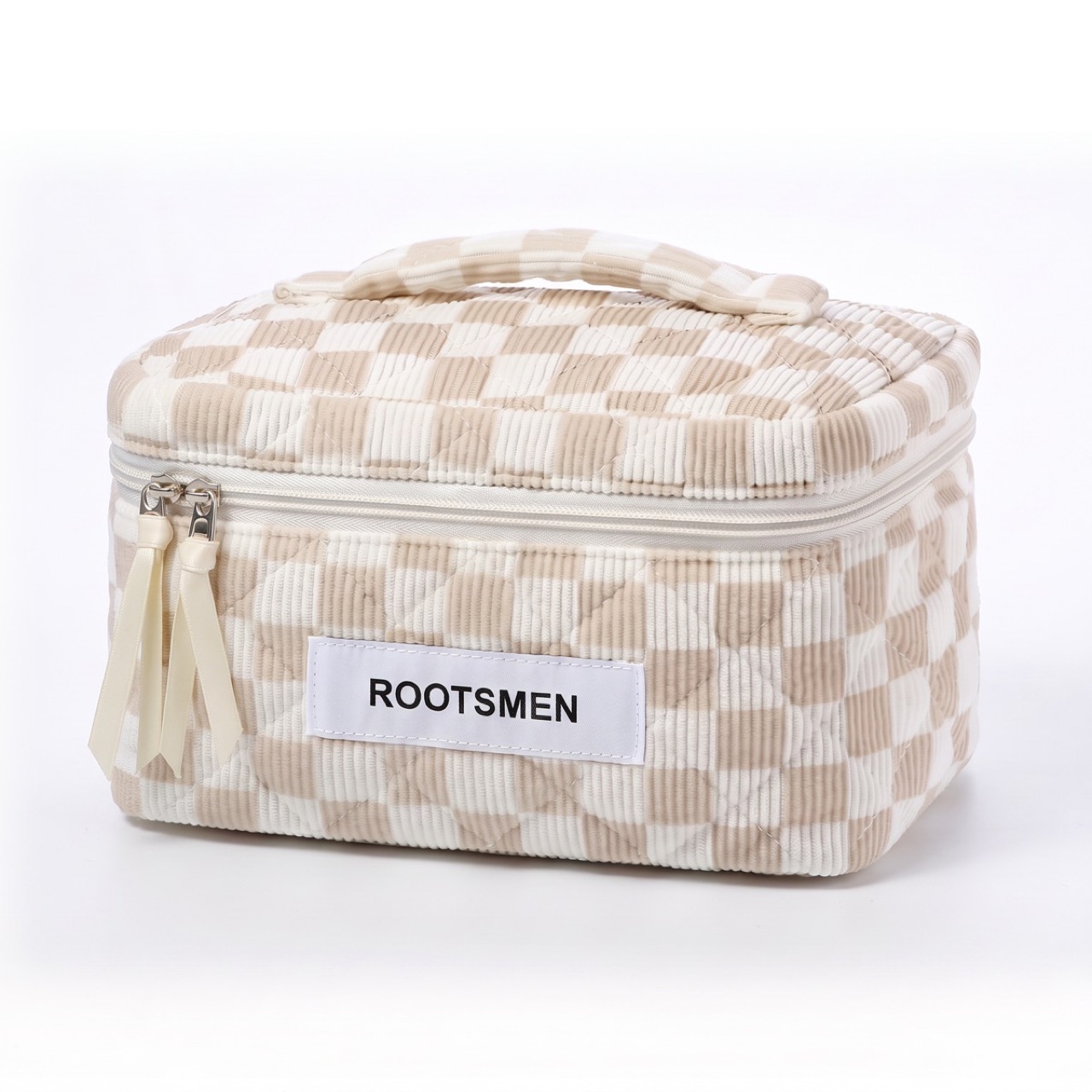
A vanity case is a cosmetic bag that stands up on its own, keeps its shape when empty, and usually opens flat or wide enough to work out of. It is the format brands reach for when the bag has to look like a product on a shelf rather than an accessory in a drawer.
It is also the construction where briefs most often under-budget, because the thing that makes it a vanity case is not the shell. It is the structure behind the shell, and that structure is panels, boards and operations that a soft pouch never needs.
What makes it structured#
Shape comes from one of three approaches, and they sit at very different prices.
Interlining — a fusible or sew-in layer behind the shell — gives firmness without rigidity. The bag holds a silhouette but still gives when squeezed. It is the cheapest route and the one most "structured" pouches actually use.
Foam, usually EVA or PE sheet, adds thickness and impact protection as well as shape. It is what makes a case feel protective, and it adds bulk to both the product and the carton.
Board — a rigid panel in the base, sometimes in the sides — is what makes a case genuinely hold a rectangle. It is the most convincing and the least forgiving: a board that is a millimetre oversize buckles the panel, and board does not tolerate being folded for shipping.
Most real vanity cases combine them: board in the base, foam or interlining in the walls. Our note on lining and interlining sets out what each layer does.
The base is the part that is judged#
Set a vanity case on a counter and the first thing a buyer notices is whether it sits flat and stays put. A soft base that rocks makes the whole piece feel cheap regardless of the shell.
That means a rigid or semi-rigid base panel, and usually base studs — small metal or plastic feet at the corners. Studs do two jobs: they keep the base off a wet surface and they stop it abrading. They also need a reinforced patch behind them, because a stud set through a single layer pulls out.
If the piece has no studs, the base material has to take the wear itself, which usually means a heavier or coated panel there than on the sides. Either answer is fine; not deciding is what produces a scuffed sample.
How it opens#
The opening is the second thing judged and the main cost variable after structure.
A wrap-around zip that runs down both sides lets the case open like a clam, which is what most users want and what photographs well. It is the longest zip and the hardest corner work.
A top-only zip is cheaper and makes the case a deep well — fine for storage, awkward for working out of.
A hinged lid, where the back panel is reinforced so the lid holds itself open, is the premium answer and needs the structure to be stiff enough to carry it. It is also the version that most often needs a second sample, because "holds itself open" is a property of the whole assembly rather than of any one part.
Specify the opening angle you expect, not just the zip path. Our note on choosing a zipper covers chain size and slider, which matter more on a long wrap than on a short top zip.
Interior fittings#
A vanity case is usually sold on what is inside it: elastic brush loops in the lid, a removable tray, a divider, a mirror.
Removable trays are the fitting that most changes the product and the cost. A tray needs its own structure, its own lining and a way of lifting out, and it reduces the usable depth below it.
Mirrors carry a safety consideration — a glass mirror in a bag that will be thrown into a case is a hazard, so acrylic is the normal specification, and it should be stated rather than assumed.
Dividers are cheap if they are sewn in and expensive if they are adjustable, because adjustable means hook-and-loop fields and extra panels.
Why it costs more to ship#
A structured case cannot be flattened. It occupies its full volume in the carton from the factory to the shelf, and soft-goods freight is charged by the space taken rather than the weight. That is a real and recurring cost that does not appear in the unit price.
Calculate the cartons before the dimensions are frozen. A case 10 mm narrower that lets one more piece fit across a standard carton can pay for itself over a container — see sea, air or express freight.
Structured cases also need more protection in transit, because a crushed corner on a rigid piece does not recover the way a soft pouch does. Inner cartons or dividers are usual and should be quoted rather than assumed.
Shell materials that suit structure#
Structure and shell interact. A shell with body — PU, microfibre, heavy canvas, coated nylon — works with the interlining and keeps panels flat. A soft, fluid shell fights it and shows every underlying edge.
Hard-surface shells also show their own faults differently: a flat panel in PU reveals any ripple in the interlining behind it, which is why a structured case needs a tighter lamination and a better sample check than a soft pouch.
Where the case must survive travel, consider what the surface does when scuffed. Some PU finishes mark permanently and some recover, and that is a sample test rather than a specification line.
What to send with the brief#
The contents, the external dimensions with a tolerance, how it should open, and whether it has to hold its shape empty or merely look structured. That last distinction is the one that moves the cost most, and it is usually left implicit.
Say whether it ships assembled. A case that can be shipped flat and assembled is a different and much cheaper product, and it is worth asking whether the programme can take it.
The cosmetic bag range includes structured builds with dimensions listed, and specifying dimensions covers measuring from the contents.
| Interlining | Foam | Rigid board | |
|---|---|---|---|
| Holds shape empty | Partly | Mostly | Fully |
| Impact protection | Little | Good | Good at the base |
| Added bulk | Least | Noticeable | Least for the rigidity |
| Tolerance to error | Forgiving | Forgiving | A millimetre oversize buckles the panel |
| Relative cost | Lowest | Middle | Highest |
| Typical use | Soft structured pouches | Protective cases | Base panel of a true vanity case |