
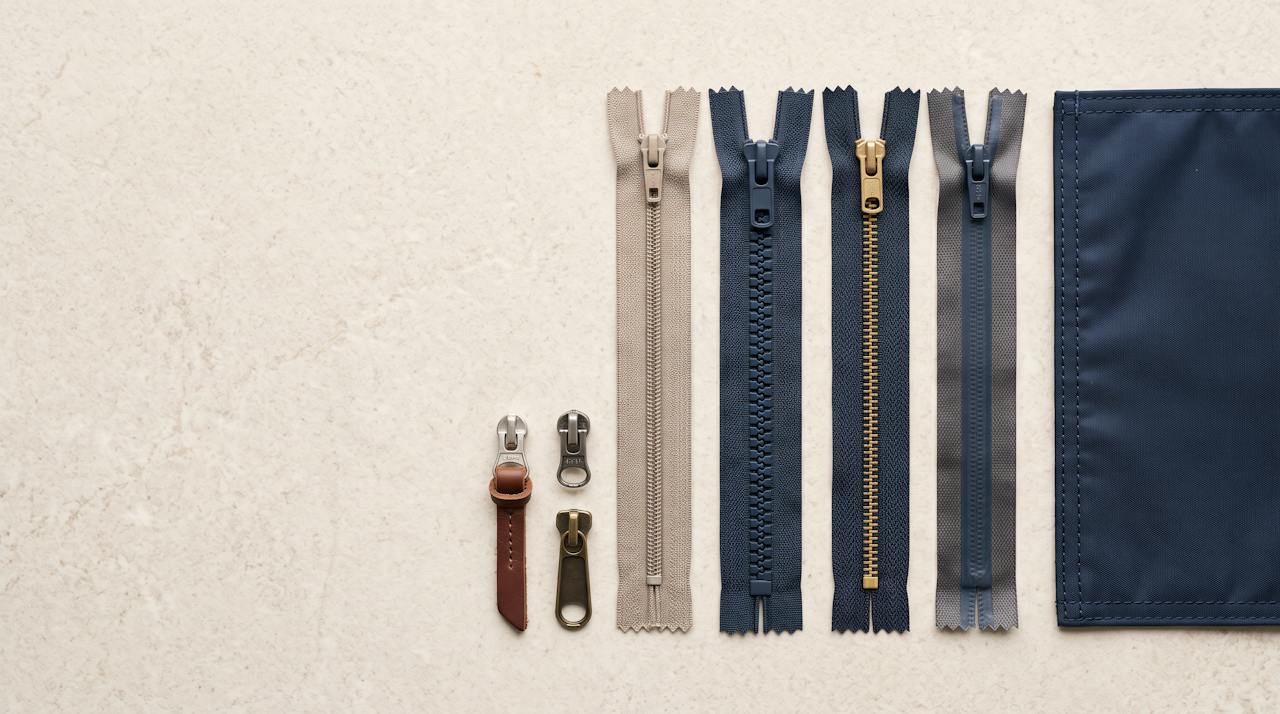
How to Choose a Zipper for a Cosmetic Bag or Travel Pouch
Coil, moulded or metal; size #3, #5 or #8; sliders, pullers and water-repellent tape — and how to specify all of it so bulk matches your sample.
For most cosmetic bags and travel pouches, a #5 coil zipper with a non-lock slider is the sensible default: it curves smoothly around corners, runs quietly and takes a custom puller well. Step up to #8 for heavy toiletry kits, drop to #3 for slim card pouches, and reserve metal for premium looks where added weight and cost are acceptable.
A cosmetic bag has one moving part. Everything else — fabric, lining, print, label — sits still and looks good. The zipper is what the customer touches every day, and it decides whether the bag is remembered as well made or as the one that jammed in a hotel bathroom.
It is also the component buyers specify most loosely, often with three words on a tech pack: nylon zip, black. Chain type, size, slider, puller, tape finish and branding are six independent decisions. A factory that is not told what you want will make all six for you — reasonably, and differently from the sample you approved.
Coil, moulded or metal: what the chain changes
YKK groups mainstream chains into three families in its own guide to zipper types: coil, moulded tooth and metal.
Coil is a continuous polyester or nylon spiral sewn to the tape. It is flexible, light, follows curves, and can recover from a minor mis-engagement rather than losing a tooth permanently. It is the workhorse for cosmetic bags and the right default unless you have a reason to move away.
Moulded tooth — YKK's trade name is VISLON® — is individual teeth injection-moulded from polyacetal resin, which YKK positions as lighter than metal at comparable size. The teeth are visually distinct and take colour boldly, so it reads technical rather than beauty. The trade-off is stiffness around a tight radius.
Metal is discrete teeth clamped on tape in brass, nickel, aluminium or manganese. It carries a premium signal plastic cannot fake, and it is heavier, costs more, and brings EU nickel rules into scope where the bag contacts skin.
Size: #3, #5 and #8 are not interchangeable
The number is a nominal chain width in millimetres across the closed teeth, and it runs consistently across all three families. Coil is commonly offered in #3, #4.5, #5, #8 and #10; VISLON® runs 3VS, 4VS, 5VS, 8VS and larger, per YKK's product listing.
#3 suits slim, low-stress items — card pouches, flat envelope cases, internal pockets. It is the size buyers over-use: on a stuffed toiletry bag you are asking a small chain to resist a lot of outward force. #5 is the default for a standard cosmetic bag, strong enough for a full bag and blessed with the widest choice of sliders and decorative pullers. #8 belongs on large toiletry kits and hanging organizers, and reads as deliberate design rather than accidental upgrade.
Do not mix sizes across a range without checking. A #3 sitting next to a #5 on the same shelf looks like a cost cut.
Sliders and lock type: the spec buyers forget
Most in-use complaints start at the slider, not the chain. YKK's note on pin lock versus auto lock sliders is worth reading first. An auto-lock slider locks the moment the hand leaves the puller — right for jacket fronts. A non-lock slider runs freely and is the type YKK associates with handbags, backpacks and luggage; for a pouch opened and closed all day, that is usually what you want.
Specify slider finish separately from chain colour: a gunmetal slider and a nickel slider on the same black coil will both be quoted as "black zip". Two sliders head-to-head give a two-way opening that lets a flat pouch lie open on a counter — a genuine usability upgrade, and a spec change to decide before sampling.
Pullers: where the brand actually lands
The puller is the cheapest way to make a generic pouch look designed: stamped or die-cast metal with your logo, injection-moulded, a leather or PU tab, a woven ribbon, or a cord loop with a metal end.
Three constraints. Weight — a heavy metal puller on a #3 chain stresses the pull-tab connection. Colour — a plated or painted puller is matched to a Pantone reference, not to the tape, so approve both together on one physical card. Tooling — a custom-shaped metal puller needs a mould, and that mould sits inside your sample timeline. For how the same logo behaves on the body panel, see embroidery versus debossing on soft goods.
Water-repellent tape and what it does not promise
Cosmetic bags live near sinks, so water-resistant zippers come up constantly. YKK's AquaGuard® laminates a polyurethane film to the back of the chain, in coil and VISLON® versions with shiny, matte and coloured film finishes.
Read YKK's wording before it reaches your packaging. In its care guidance the company calls AquaGuard® water repellent, not waterproof or watertight, reserving "waterproof" for its AQUASEAL® construction; the same page warns that ironing may flatten or melt the film. A waterproof claim needs the fabric, seams and construction behind it too — the same scrutiny we apply in verifying a material claim before you print it on a hangtag.
Branded versus generic, and recycled options
A branded chain buys batch consistency, published technical data and a component your compliance file can name. A good unbranded chain can perform well — you simply verify it by testing instead of by catalogue. ASTM D2061 is the standard set of zipper strength tests, covering chain strength, slider pull-off and stop holding; naming it turns a subjective argument into a number.
If the bag carries a recycled story, the zipper should not be the exception. YKK's NATULON® material-recycled line uses tape made from recycled materials such as PET bottles, and pairs logically with an rPET body fabric. One note on metal: nickel release from articles in direct and prolonged skin contact is restricted in the EU under REACH Annex XVII, tested to EN 1811. Raise it early, not at pre-shipment.
Where zippers fail — and what to write down
Failures cluster. The slider spreads and stops engaging, usually because the size was under-specified for how full the bag gets. The pull-tab separates under a heavy custom puller. The tape tears from the seam at a corner, which is a bar-tack question rather than a zipper one. A moulded chain distorts on a radius that wanted coil. Plating wears through, which is a finish specification.
Most of it is preventable on paper. A usable zipper line names chain type and grade, size, tape colour reference, slider model and lock type, slider finish, puller material and artwork, number of sliders and opening direction, tape finish, and end-stop and bar-tack treatment — plus the acceptance test bulk will be held to. Verify it physically once before the line runs: see what a PPS actually confirms, and how to set an AQL inspection plan for how zipper defects get classified.
Getting the decision made early
Zipper choice costs twenty minutes at design stage and a great deal at pre-shipment. Decide chain, size, slider and puller before the first sample, approve a physical zipper card alongside the fabric swatch, and write the acceptance criteria into the purchase order.
ROOTSMEN has manufactured custom cosmetic bags, pouches and travel organizers since 1981, with its own factory in Guangdong since 1993, and treats component specification as part of development rather than an afterthought. Certifications include FAMA (Disney), ISO 9001, SMETA, GMP and BSCI. If you have a design in progress, get in touch to pin the zipper line down properly.
| Chain type | Construction | Typical sizes | Best suited to | Watch out for |
|---|---|---|---|---|
| Coil | Continuous polyester or nylon spiral sewn to tape | #3, #4.5, #5, #8, #10 | Standard cosmetic bags, pouches, curved openings, GWP runs | Under-sizing at #3 on bags that get overpacked |
| Moulded tooth (VISLON®) | Injection-moulded polyacetal teeth on tape | 3VS, 4VS, 5VS, 8VS and larger | Technical or outdoor-look kits, bold colour-blocked teeth | Stiffer chain; less happy around a tight corner radius |
| Metal | Discrete teeth clamped on tape — brass, nickel, aluminium, manganese | Commonly #3, #5, #8 | Premium and leather-look pouches, retail hero pieces | Weight, cost, and EU nickel-release rules for skin contact |
| Water-repellent (AquaGuard®) | PU film laminated to the back of a coil or VISLON® chain | Coil and VISLON® versions | Bags used near water; a sleek filmed tape look | Water repellent, not waterproof; heat and ironing damage the film |
| Recycled (NATULON®) | Tape made from recycled materials such as PET bottles | Varies by variant | Bags with an rPET body and a recycled-content story | Claim substantiation must match the rest of the bag |
Event Details
From the Stand
Frequently Asked Questions
The questions this topic actually raises when a program is being scoped.
Use #5 for a standard cosmetic bag. It carries a full bag comfortably, looks proportionate on a pouch of 18–25 cm, and offers the widest choice of sliders and custom pullers. Drop to #3 only for slim flat cases, and step up to #8 for large toiletry kits.
Coil is better for most travel pouches. Its continuous spiral flexes around curved corners and recovers from minor mis-engagement, whereas moulded teeth are stiffer. Choose moulded when you want a bold technical look or chunky coloured teeth as a design feature, and allow a larger corner radius in the pattern.
A generic zipper can be acceptable, provided you test it. A branded chain gives you published specifications and batch consistency you can name in a compliance file. If you go unbranded, specify performance instead — reference ASTM D2061 strength tests and hold bulk to the approved sample card.
No. YKK describes AquaGuard® as water repellent, not waterproof or watertight, and reserves the waterproof description for its AQUASEAL® construction. A filmed tape resists splashes and slows water ingress, but a bag marketed as waterproof needs the seams, fabric and construction to support the claim too.
Usually because the specification named only the chain. Slider model, lock type, finish and puller are separate line items, and an unspecified slider gets substituted with whatever is in stock. Approve a physical zipper card, attach it to the purchase order, and confirm it again at the pre-production sample.
Often yes, though the route differs. Woven tabs, printed ribbon and laser-marked stock pullers avoid tooling; a custom-shaped die-cast metal puller needs a mould, which adds development time. Discuss the puller at design stage — ROOTSMEN handles this during development rather than after sampling.
Related Products
Builds where this decision applies.

Have a product requirement of your own?
Tell us the product, the quantity and the timeline — we'll scope a development plan.