
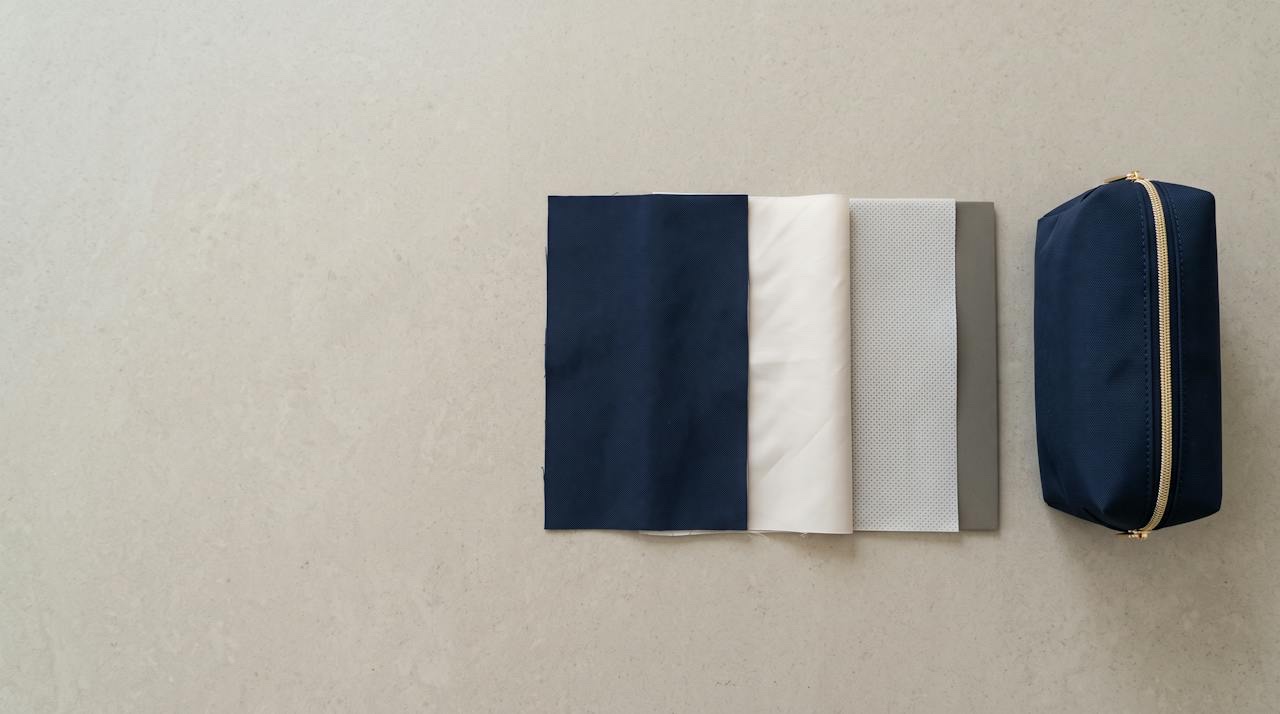
Lining and Interlining: What Actually Holds a Cosmetic Bag’s Shape
Shell, lining, interlining, foam and board — what each layer really does to structure, weight, cleaning and cost, and how to specify them so bulk matches your sample.
A cosmetic bag keeps its shape from the layers you cannot see. The shell gives colour and abrasion resistance, the lining protects the inside and hides seams, and the interlining — fusible interfacing, sew-in foam, EVA or PE foam, or a board base — supplies the stiffness. A pouch collapses when the interlining is thin, missing or quietly changed between sample and bulk.
Buyers approve a cosmetic bag on the outside: colour, print, puller, label. Then bulk arrives and the bags sag on the shelf, or a boxy cube slumps as soon as it is unpacked. Nothing on the outside changed. The structure did.
Structure lives in the layers nobody photographs. A bag is a sandwich — shell, interlining, lining — each with a separate job. Specify only the shell and you have specified about a third of the bag.
Shell, lining, interlining: three different jobs
The shell is the face fabric: colour, print or embroidery, and most of the abrasion the bag will ever see. Abrasion is measurable — the Martindale method in ISO 12947-2 rubs a specimen at fixed intervals until breakdown — so it is the layer buyers compare most readily.
The lining faces inward, hiding seam allowances and interlining edges, giving the cavity a clean colour and taking the spills. It contributes almost nothing to stiffness.
The interlining sits between them and is the only layer whose purpose is shape: a fusible interfacing, a foam laminate, a sew-in foam sheet or a rigid board. Change it and the same shell and lining produce a completely different bag.
Common linings and what each one gives you
Polyester taffeta is the default: a smooth, closely woven filament fabric, light and available in almost any colour. It prints well for branded linings, but it is not waterproof.
Nylon lining is softer and stronger for its weight, which matters in thin travel organizers where the lining is a structural skin as much as a finish.
PU-coated linings carry a polyurethane layer on the back face, so spills bead rather than wick and the inside wipes out — the usual choice for wash bags.
Laminated linings bond a film, commonly TPU or PEVA, to the fabric for a wipe-clean, near-waterproof cavity. They are stiffer and change how a bag folds, so they suit toiletry kits more than slim beauty pouches. On recycled versus conventional lining yarns, see nylon and rPET for cosmetic pouches.
Fusible or sew-in: the two ways to add body
Fusible interlining carries a heat-activated adhesive and is bonded to the shell in a fusing press before sewing. It stabilizes loosely woven shells and gives crisp, flat panels, which is why it dominates in structured, boxy bags.
Fusing is a process, not a material, and it is where structure quietly goes wrong. Temperature, pressure and dwell time must suit the shell: too little and the bond releases in transit as bubbling or delamination; too much and the adhesive strikes through or glazes the face.
Sew-in interlining is caught in the seams instead of glued. It cannot delaminate, keeps a softer hand, and is the safer route on PU, PVC and other coated shells that dislike heat — at the cost of more careful handling at the sewing line.
Foam and board: where real structure comes from
Interfacing adds body. Foam adds volume — the padded, self-supporting wall that makes a cube stand up empty.
Foam laminates are a foam core faced with fabric. Pellon's Flex-Foam 2-Sided Fusible, for example, is described as foam sandwiched between two layers of soft fabric, with a polyester outer and polyurethane inner and a stated thickness of 6.05 mm. That wall is plump and quilted, and its bulk has to be planned into seam allowances.
EVA foam is firmer — a closed-cell ethylene vinyl acetate that holds a moulded or die-cut form, suiting semi-rigid cases and inserts. PE foam is a lighter closed-cell polyethylene sheet, the everyday padding in panels and dividers. Both are olefin foams, and the test methods for density and compression sit in ASTM D3575 — worth naming if you want a measurable foam spec rather than an adjective.
Board bases — a plastic or fibreboard insert in the bottom panel — stop a filled bag bowing, sewn into a pocket or supplied loose so the base lifts out for cleaning.
What each layer costs you elsewhere
Every gain in structure is paid for somewhere. Foam and heavy interlining add weight, which matters on air freight and on a gift-with-purchase programme. They also add bulk at the seams: several layers meeting at a corner can be too thick to turn cleanly, so an over-specified sample sometimes looks worse than a simpler one.
Cleaning splits the same way. A coated or laminated lining wipes out; a fabric lining over foam absorbs and dries slowly. Pellon's care guidance for its fusible foam — gentle machine wash, tumble dry low or lay flat — is a reminder that a laundering claim on a hangtag must be true of the whole sandwich, not just the shell.
Cost direction goes one way: more material, more cutting, more operations. The layers you cannot see are a real share of the unit price of a custom cosmetic bag.
Why pouches collapse — the four usual causes
No interlining at all. A single-layer shell with a taffeta lining will always be floppy. If your reference was structured and your specification named no middle layer, the factory had nothing to quote and nothing to cut.
A substituted interlining. Interfacing and foam are specified by weight, thickness and construction; a lighter substitute is invisible in a photograph and obvious in the hand.
Failed fusing. Panels that bubble or separate after a hot container crossing point to bonding parameters, not the material.
Geometry. A gusset, a boxed corner, a board in the base and a stiff zip tape do more for a flat-bottom shape than an extra millimetre of foam. If the sample stands and bulk does not, compare the patterns first.
What to specify so bulk matches the sample
Write the sandwich panel by panel: shell material and weight, interlining type with weight or thickness, lining material and any coating, and where the interlining stops relative to the seam. Name the fusing requirement too — bonded panels must pass the same peel and heat checks in bulk as at sampling.
Keep a sealed counter-sample and a cut section of the wall, so an inspector can see the layer stack and hold it against production — the logic behind what a pre-production sample actually confirms, and something to fold into your AQL inspection plan as a named defect rather than a judgement call.
Hidden layers are still product. STANDARD 100 by OEKO-TEX is component-based: the certification covers every thread, button and accessory, tested against a list of over 1,000 harmful substances — so a lining or interlining sits inside any claim you make about the bag.
Getting the middle layer right with your factory
Stop describing structure with adjectives. Firm, padded and premium feel mean different things in two workshops; a named interlining with a thickness, a named lining with a coating and a sealed section of wall mean the same thing everywhere.
ROOTSMEN has made cosmetic bags, pouches, travel organizers and promotional and gift-with-purchase soft goods since 1981, with its own factory in Guangdong since 1993, and works to ISO 9001 alongside SMETA, BSCI, GMP and Disney FAMA requirements. Construction questions are best settled during development, where a change of foam or lining is a sampling decision rather than a bulk problem.
If a pouch is not standing the way you want, send the reference and the specification and talk it through, or see the cosmetic bag range for how different constructions behave.
| Layer | What it is | Shape effect | Weight added | Cleaning | Cost direction |
|---|---|---|---|---|---|
| Polyester taffeta lining | Light woven filament fabric | Negligible — finish only | Minimal | Absorbs spills | Baseline |
| PU-coated lining | Fabric with polyurethane back coating | Slight body | Low | Wipes out | Slightly up |
| Laminated lining (TPU/PEVA film) | Film bonded to fabric | Adds stiffness, changes fold | Low to moderate | Wipe-clean, near-waterproof | Up |
| Fusible interfacing | Woven or nonwoven with heat-set adhesive | Crisp, flat panels | Low | Risk of bubbling if fused poorly | Up |
| Sew-in interlining | Same body, caught in the seams | Softer, no delamination risk | Low | Stable in wear | Up, more labour |
| Fusible foam laminate | Foam core faced with fabric | Padded, self-supporting wall | Moderate | Slow to dry | Up |
| EVA foam | Firm closed-cell ethylene vinyl acetate | Holds a moulded or die-cut form | Moderate to high | Wipe surface, slow to dry if enclosed | Up |
| PE foam | Lighter closed-cell polyethylene sheet | Cushions panels and dividers | Low to moderate | Slow to dry | Modest |
| Board base | Plastic or fibreboard insert in the base | Stops the bottom bowing when filled | Low | Removable if loose | Modest |
Event Details
From the Stand
Frequently Asked Questions
The questions this topic actually raises when a program is being scoped.
Because there is no interlining, or a lighter one than your sample had. Shell and lining alone cannot stand up. Structure comes from a fusible interfacing, a foam layer or a board base, so check whether the middle layer was specified by weight and thickness rather than assumed.
The lining is the visible inside fabric that hides seams and takes spills. The interlining is hidden between shell and lining, and its only job is shape and body. Most structure complaints are interlining problems, even though buyers usually describe them as lining problems.
Use fusible for crisp, flat, boxy panels on woven shells, and sew-in for coated shells such as PU or PVC that do not take heat well, or where you want a softer hand. Fusible is faster; sew-in cannot delaminate. Both work, so decide at sampling.
EVA is firmer and holds a moulded or die-cut form, which suits semi-rigid cases and protective inserts. PE foam is lighter and softer, and is the usual padding for panels and dividers. Specify density and thickness either way, not just the foam name.
No. A PU-coated or laminated lining makes the cavity wipe-clean and resistant to spills, but seams, zip tape and shell are all water paths. Treat it as a wipeable interior rather than a waterproof one unless the construction has been designed and tested for that.
Name it. Record the interlining type, weight or thickness and panel placement in the tech pack, approve it at the pre-production sample, keep a sealed counter-sample and a cut wall section, and list substitution as a defect in the inspection plan rather than leaving it to judgement.
Related Products
Builds where this decision applies.

Have a product requirement of your own?
Tell us the product, the quantity and the timeline — we'll scope a development plan.