
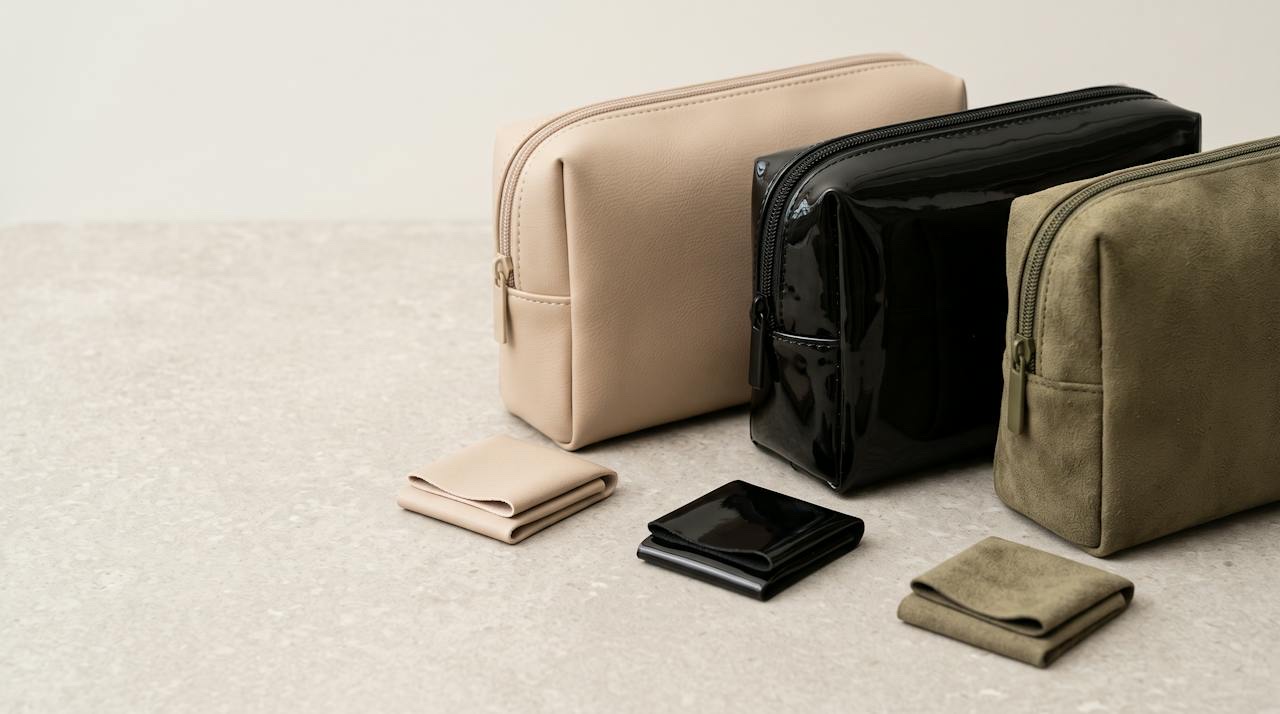
PU Leather vs PVC vs Microfiber: Which Vegan Leather Suits a Cosmetic Bag?
How PU, PVC, microfiber and bio-based PU compare on look, wear, cleaning, chemical rules and label wording.
For most cosmetic bags, PU-coated fabric is the balanced choice: soft hand, good print and emboss results, moderate cost. PVC is cheaper and very wipeable but stiffer, and its plasticizers must meet EU REACH phthalate limits. Microfiber leather feels closest to real leather and resists peeling best, at a higher cost. Whatever you pick, word "vegan leather" claims precisely.
"Vegan leather" is now a search term in its own right, and many beauty brands want it on their next pouch. But the phrase covers very different materials. For a cosmetic bag, which lives in humid bathrooms and gets smeared with foundation, the choice between PU, PVC and microfiber affects how the bag looks after a year, what testing you need and what you can safely print on the hangtag.
This guide compares the three, touches on bio-based PU, and ends with a practical way to decide.
What each material actually is
PU leather is a polyurethane coating on a textile backing, usually a knitted or woven polyester. The coating carries the grain and colour; the backing gives strength.
PVC leather uses polyvinyl chloride, which is rigid on its own and needs plasticizers to become flexible enough for a bag.
Microfiber leather is typically a PU coating on a dense non-woven base of very fine fibres, built to imitate the structure of a hide. It is the heaviest-duty of the three.
Bio-based PU replaces part of the petroleum-derived content with plant-derived feedstock. It remains a polyurethane, so treat it as a PU variant rather than a new category.
Look, hand and weight
PU gives a soft, supple hand and takes embossed grains, metallic finishes and pastel shades well, which is why it dominates beauty pouches. PVC tends to feel firmer and slightly plastic, but it holds a crisp, glossy or patent look and keeps its shape in structured cases.
Microfiber has the most leather-like drape and a clean cut edge, but its thicker base usually makes it the heaviest option. For travel kits and multi-piece organizers where weight matters, a lighter PU is often the better fit.
Decoration also behaves differently. Smooth PU and PVC surfaces suit screen printing, foil and heat transfer, while debossing reads especially well on thicker microfiber. Test your logo on the exact material and colour; our guide to choosing a print method for gift-with-purchase runs covers the trade-offs.
Durability: cracking, peeling and hydrolysis
The common failure in cheap PU is peeling: the coating delaminates from the backing, often at folds and corners. Humidity and heat can also break PU down over time through hydrolysis, so ask your supplier what hydrolysis or ageing tests the material has passed.
PVC resists moisture well but can stiffen and crack in the cold as plasticizers migrate out. Microfiber generally shows the best abrasion and tear resistance and the least peeling, which suits premium or long-life pieces.
Whatever you choose, lock the approved material into the pre-production sample and check folds and edges there; our note on what a PPS actually confirms explains how.
Cleaning and cosmetic stains
All three wipe clean better than fabric, which is their main appeal for makeup bags. PVC is the most forgiving with liquids and oils. PU and microfiber can absorb pigment from lipstick or foundation if the top coat is thin, so specify a stain-resistant finish and test it with real products during sampling.
For wet items such as toners or brushes, pair the outer material with a wipeable lining rather than relying on the shell alone.
Cost direction
As a rule of thumb, PVC sits at the lower end, standard PU in the middle, and microfiber and bio-based PU at the upper end. Coating thickness, backing quality, special finishes and colour matching all move the figure, as we explain in what drives the unit price of a custom cosmetic bag.
Remember to compare total value rather than material alone. A cheaper coating that peels within months can cost a brand more in returns and reputation than a sturdier material would have cost at the start.
Chemical restrictions to plan for
In the EU, REACH Annex XVII entry 51, as amended by Commission Regulation (EU) 2018/2005, has restricted DEHP, DBP, BBP and DIBP since 7 July 2020 to 0.1% by weight, individually or combined, in plasticized material in articles. This matters most for PVC, but the definition of plasticized material also names polyurethanes, coatings and printed designs, so PU bags and their prints are in scope too.
Ask for third-party test reports on the actual material and colour, and check our overview of compliance documents for the US and EU for other markets.
Wording "vegan leather" and green claims safely
"Vegan" should mean no animal-derived materials anywhere, including glues and trims, so confirm that with your supplier in writing. Pairing it with the actual material, such as "vegan leather (polyurethane)", is clearer for shoppers.
Be careful with eco language. In the EU, Directive (EU) 2024/825 targets unsubstantiated generic environmental claims, with the new rules applying from 27 September 2026. In the US, the FTC's Green Guides on recyclable claims say a product should not be marketed as recyclable unless it can be recovered through an established recycling programme. Coated, multi-layer materials rarely meet that, so avoid "recyclable" unless you can prove it, and verify any recycled or bio-based content first; see how to verify a recycled material claim.
How to choose, and working with ROOTSMEN
Choose PU for most retail and gift-with-purchase pouches, PVC for budget or clear-look structured cases where compliance is documented, and microfiber when longevity and a premium hand justify the cost. Consider bio-based PU only when you can substantiate the bio-based content.
ROOTSMEN, a Taiwan OEM/ODM maker founded in 1981 with its own factory in Guangdong since 1993, develops custom cosmetic bags for brand owners and retailers. Contact us to discuss material options for your next programme.
| Factor | PU leather | PVC leather | Microfiber leather | Bio-based PU |
|---|---|---|---|---|
| Hand and look | Soft, supple, versatile finishes | Firmer, glossy or patent looks | Closest to real leather | Similar to standard PU |
| Main durability risk | Peeling and hydrolysis | Stiffening and cracking in cold | Lowest peeling risk | Depends on formulation |
| Cleaning | Wipes clean; needs good top coat | Most resistant to liquids | Wipes clean; needs good top coat | Wipes clean; check finish |
| Weight | Light to medium | Medium | Heaviest | Light to medium |
| Cost direction | Mid-range | Lowest | Highest | Upper range |
| Key chemical check | REACH phthalates in coating and prints | REACH phthalates in plasticizer | REACH phthalates in coating | REACH phthalates; bio-based content proof |
Event Details
From the Stand
Frequently Asked Questions
The questions this topic actually raises when a program is being scoped.
For most makeup bags, yes. PU feels softer and takes embossing and colour well, while PVC is firmer but more resistant to liquids and usually cheaper. PVC also needs closer attention to plasticizers, since EU REACH limits four phthalates to 0.1% by weight in plasticized material.
PU peels when the coating separates from its backing, often at folds, and humidity can speed breakdown through hydrolysis. Choosing a better-grade coating and backing, requesting ageing or hydrolysis test results, and checking folds on the pre-production sample all reduce the risk considerably.
It is worth it when the bag must last and feel premium. Microfiber leather has a dense non-woven base that gives a leather-like drape and strong resistance to peeling and tearing, but it is heavier and costs more than standard PU, so it suits premium lines better than giveaways.
Yes, if no animal-derived materials are used anywhere, including adhesives and trims. Get written confirmation from your supplier, and consider naming the material, for example "vegan leather (polyurethane)". Avoid adding generic eco claims such as "eco-friendly" unless you can substantiate them.
Only with strong proof. The FTC Green Guides say products should not be marketed as recyclable unless they can be recovered through an established recycling programme, and coated multi-layer materials rarely qualify. In the EU, Directive (EU) 2024/825 also tightens rules on unsubstantiated environmental claims.
PU is usually the sensible starting point for gift-with-purchase pouches because it balances soft hand, print quality and cost. PVC or microfiber is worth considering if the brief calls for a firmer structured look or a longer-life premium piece, with test reports matched to each target market.
Related Products
Builds where this decision applies.

Have a product requirement of your own?
Tell us the product, the quantity and the timeline — we'll scope a development plan.