For gift-with-purchase, the branding method is a cost and schedule decision as much as a visual one. At the quantities these programmes run, a method that adds a small per-unit cost adds a large total, and a method that adds two days to setup can cost a launch window.
As with embroidery and debossing, the artwork usually decides. Send the file with the brief and most of the discussion resolves itself — colour count, detail and the smallest size the mark appears at answer three quarters of the question before anyone quotes.
Screen printing#
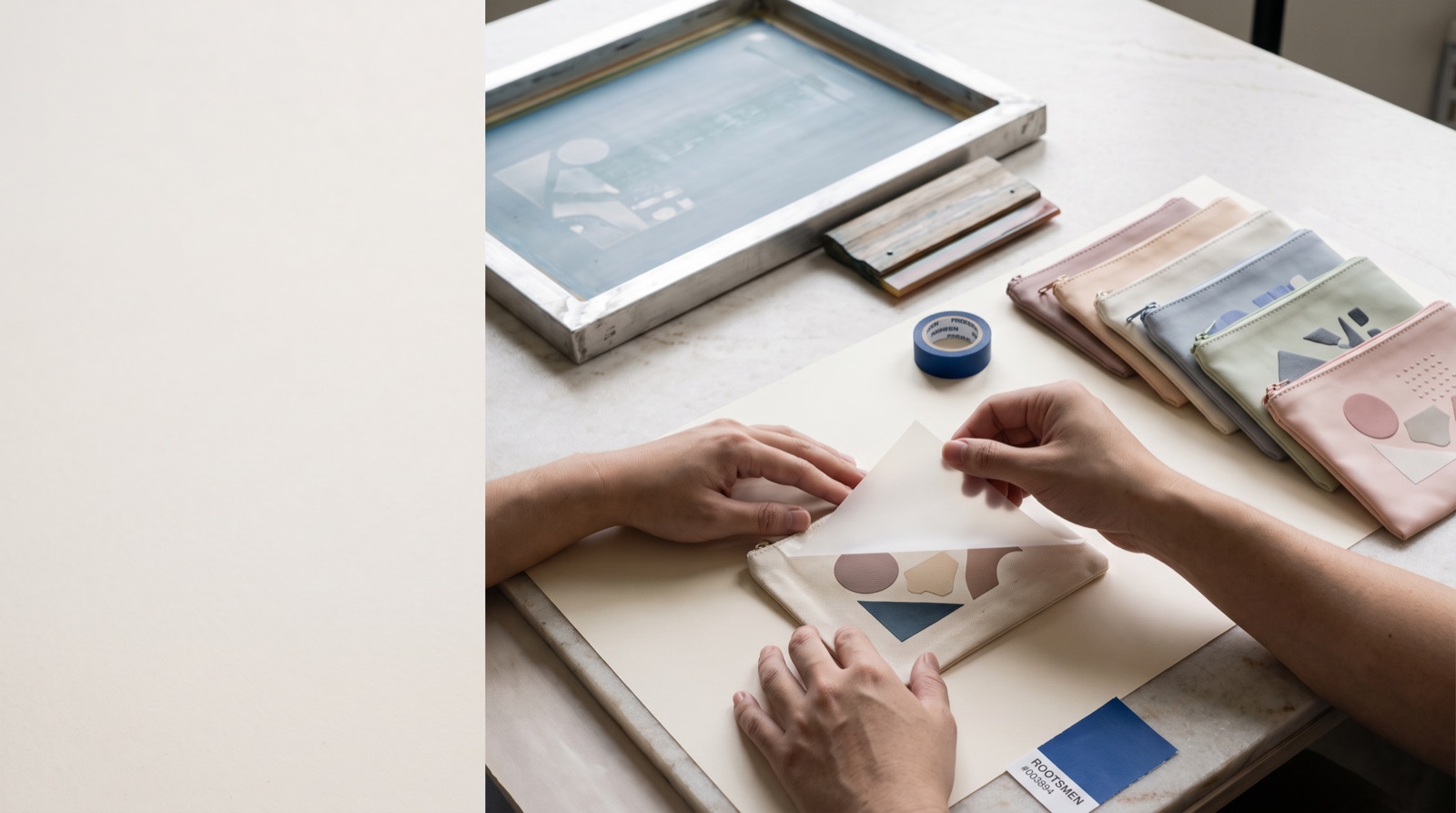
Screen printing is the default for flat, solid marks at volume. A separate screen is burned for each colour in the artwork and the ink is pushed through it onto the piece, so setup is charged per colour: a one- or two-colour mark is cheap to set up and a six-colour mark is not. Once running, the per-unit cost is low and colour consistency across the run is excellent.
It does not handle gradients or photographic detail. A mark that depends on a subtle blend either needs simplifying for this method or needs a different method. Halftones can approximate a gradient, but on a textured shell they coarsen, and the result usually looks like a compromise rather than a choice.
Two practical constraints. Each colour is a separate registration — the alignment of one screen to the next — and every additional colour is another chance for that alignment to drift, which is why a four-colour screen print on a soft, stretchy panel is harder than the same artwork on a rigid one. And the print area is limited by what can be laid flat: a mark crossing a seam, a gusset or a zip usually cannot be screened in one pass.
On dark shells the ink needs a white underbase printed first, or the colours sink into the background. That is an extra colour in the setup and should be in the quotation rather than discovered in it.
Digital printing#
Digital printing carries no per-colour setup, so it suits detailed artwork, gradients and full-colour imagery. That makes it the right route for marks that would be expensive or impossible to screen print, and the only sensible route for a design that changes between SKUs in the same run.
The per-unit cost stays flatter as quantity rises, which means digital can lose to screen printing at high volumes on a simple mark and win comfortably at any volume on a complex one. The crossover depends on colour count and quantity together, not on either alone — which is why "which is cheaper" has no answer until both numbers are on the table.
Substrate matters more than with screen. Direct digital printing onto coated, textured or pile surfaces is unreliable, and polyester needs either a dedicated process or a transfer. For a shell that resists direct printing, the realistic digital route is a printed transfer applied with heat, which is a different cost structure again.
Heat transfer#
Heat transfer sits between the two: good detail, moderate setup, and it applies cleanly to shells that are awkward to print directly. It is often the practical answer for coated or textured materials, and the only answer on some of them.
The trade-off is hand-feel — the mark sits on the surface rather than in it, and on a large solid area that reads as a patch. On a piece where the branded area is touched frequently, or flexed, that is worth checking on a sample before committing. Edge lift after repeated flexing is the failure to look for, and it shows up on a compressed sample long before it shows up on a flat one.
Within the category there are meaningful differences. A vinyl transfer is cut from coloured film and is crisp but limited to solid shapes. A digital transfer is printed and can carry photographic content. A sublimation transfer dyes the fibre itself, so there is no hand-feel at all — but it only works on light polyester, which rules out most cotton and all dark shells.
The routes that are not printing#
Where the mark needs to read as premium rather than printed, it is worth pricing the alternatives alongside. A woven label holds fine detail at small sizes, is sewn into a seam so it never distorts a panel, and at volume is frequently the cheapest branded element on the piece.
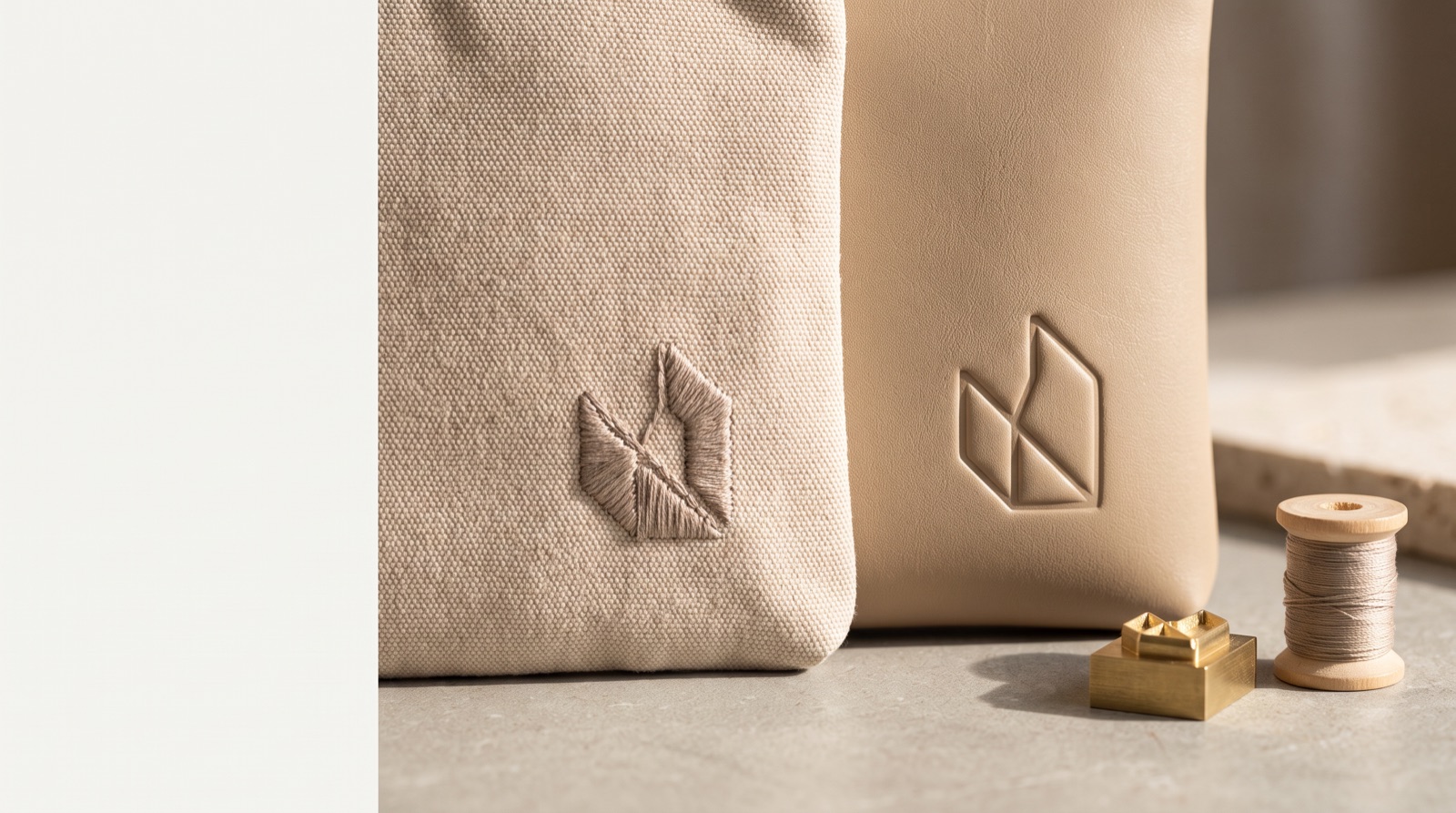
A debossed mark on PU or heavy canvas carries a one-off die cost and a very low per-unit cost, so it improves as quantity rises. On a large run it can undercut an elaborate print it replaces, and it never wears off because there is nothing on the surface to wear.
Rubber or silicone patches and metal plates both carry tooling and add thickness, and both read as deliberate. None of these is a fallback; they are different answers, and a brief that describes the effect it wants rather than naming a process gets the best of them.
Artwork: what to send and what it decides#
Send vector artwork with live outlines, the colours named in a standard reference rather than described, and the smallest size the mark will be used at. Those three things settle method, setup cost and most of the detail question in one pass.
Name which colours are fixed brand colours and which can move. Ink is mixed to a standard and matched on an approved strike-off, but a shell colour shifts a printed colour slightly regardless — the same physics described in lab dips and why colours shift. Knowing which colours have tolerance and which do not prevents an approval loop over a shade nobody was protecting.
Say where the mark sits, measured from a fixed reference — a seam, a zip end, the base — rather than "centred". Centred on a flat pattern piece and centred on a finished, curved panel are different places, and that gap is one of the most common causes of a rejected first article.
Cost: what actually moves the number#
Three things dominate: the number of colours, the number of print positions, and whether the artwork varies within the run. One colour, one position, one design is the cheapest branded piece it is possible to make. Each addition is a separate setup, and setups do not amortise across a run the way material does.
A second print position often costs more than a second colour in the same position, because the piece is handled twice. Where budget is tight, consolidating two small marks into one is usually a bigger saving than reducing colours.
Where the artwork must vary — a set of six designs across one programme — digital is the only method that does not multiply setup by six. That single fact decides a great many GWP programmes on its own.
Compliance, and where print methods run into rules#
Printed inks are a material like any other, and some markets regulate what may be in them. Where the piece is sold or distributed in the EU or in several US states, restricted substance lists reach print chemistry as well as fabric finishes, and a supplier declaration is the evidence for it.
If the piece is for children, or will be marketed alongside a children's product, the requirements tighten considerably and should be raised at brief stage rather than at inspection. Our note on compliance documents for the US and EU covers what is usually requested.
A sustainability claim printed on the piece carries its own evidence requirement — see verifying a recycled material claim. The claim is easiest to support when it is decided before the artwork is finalised, not after.
Planning backwards from the launch date#
GWP schedules are usually fixed to a launch or event date, and the date does not move. Send it with the brief: it determines how much revision room actually exists, and the branding method affects the schedule as much as the construction does.
The sequence that has to fit is: artwork approved, screens burned or transfers made, a printed strike-off approved on the actual shell, then bulk. Each of those is a real day. A pre-production sample should carry the final branding applied by the production method — a logo applied by hand for the photograph has confirmed nothing about the run.
Where the date is tight, the two levers that genuinely buy time are reducing colour count and freezing artwork earlier. Our notes on how long a custom bag order takes and planning a GWP programme around a launch calendar set out where the rest of the time goes.
Choosing quickly#
Flat, solid, one to three colours, high volume: screen. Gradients, photographic content, or artwork that varies within the run: digital. A shell that resists direct printing, or a mark that must survive a textured surface: transfer. Fine detail at small size: a woven label. A mark that should read as quiet and permanent: a deboss.
Send the artwork, the launch date and the volume band together. Those three inputs answer the method question faster than any discussion of preference, and they are the same three that let us tell you what the branding step will cost before it is committed.
| Screen | Digital | Heat Transfer | |
|---|---|---|---|
| Setup cost | Per colour | None | Low |
| Best artwork | Flat, solid, few colours | Gradients, photographic, full colour | Detailed on awkward shells |
| Cost at high volume | Lowest on simple marks | Flatter curve | Moderate |
| Hand-feel | In the fabric | In the fabric | Sits on the surface |
| Watch for | Colour count drives cost | Can lose to screen on simple marks | Feel on frequently-touched areas |