Promotional programmes run at volume, which means small per-unit differences compound quickly. The choice between RPET and cotton canvas is therefore usually settled by landed cost at the target quantity — but the two also send different signals and behave differently in production, and both of those move the number too.
Neither is automatically the sustainable choice. That depends on what can be documented and on how the piece is actually used, not on which material sounds better in a deck.
What the two materials actually are#
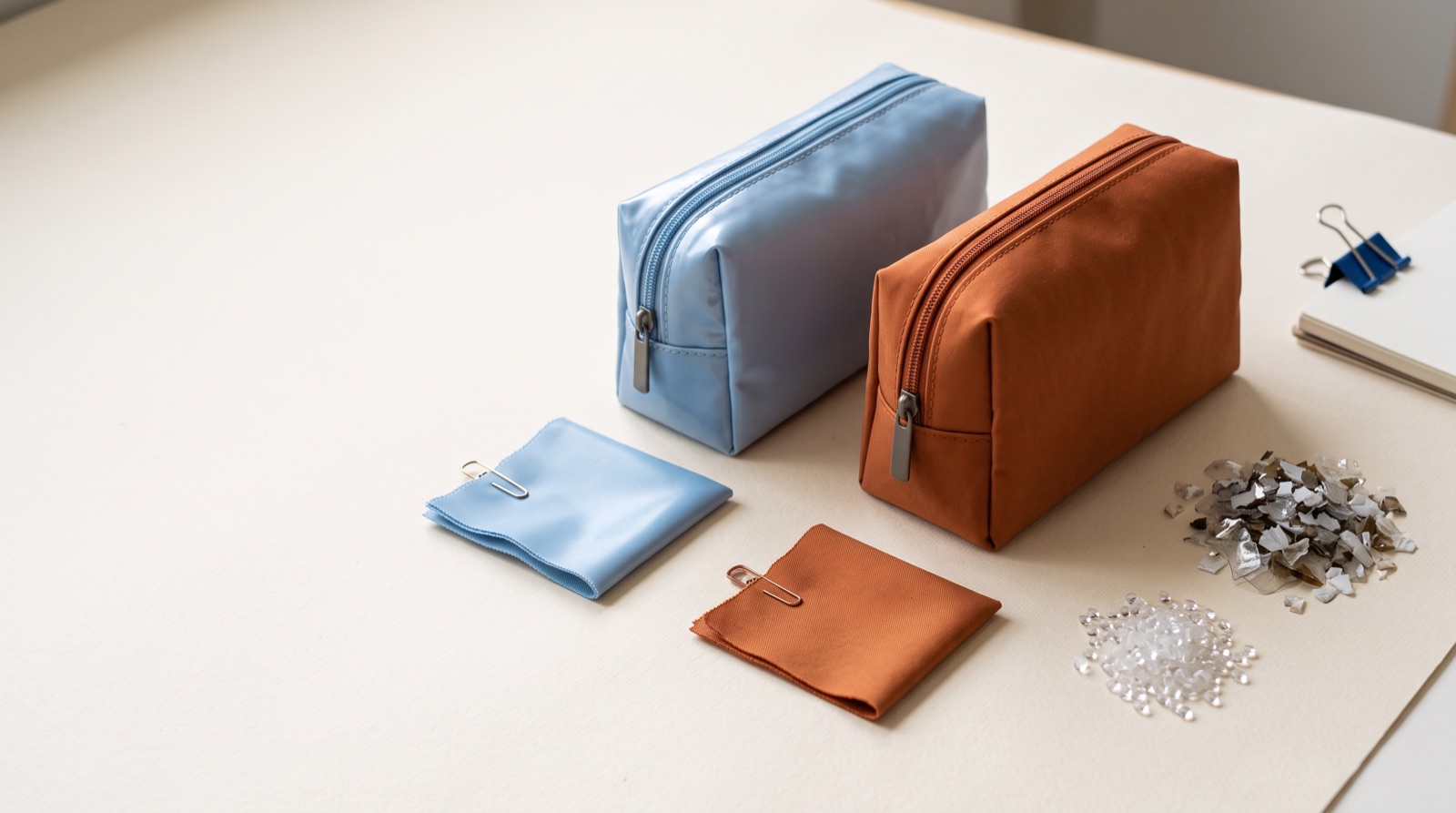
RPET is polyester spun from recycled PET, usually post-consumer bottle flake. For promotional bags it is typically woven as a light plain weave — 210D and 600D are the common weights — and often coated on the reverse for body and water resistance.
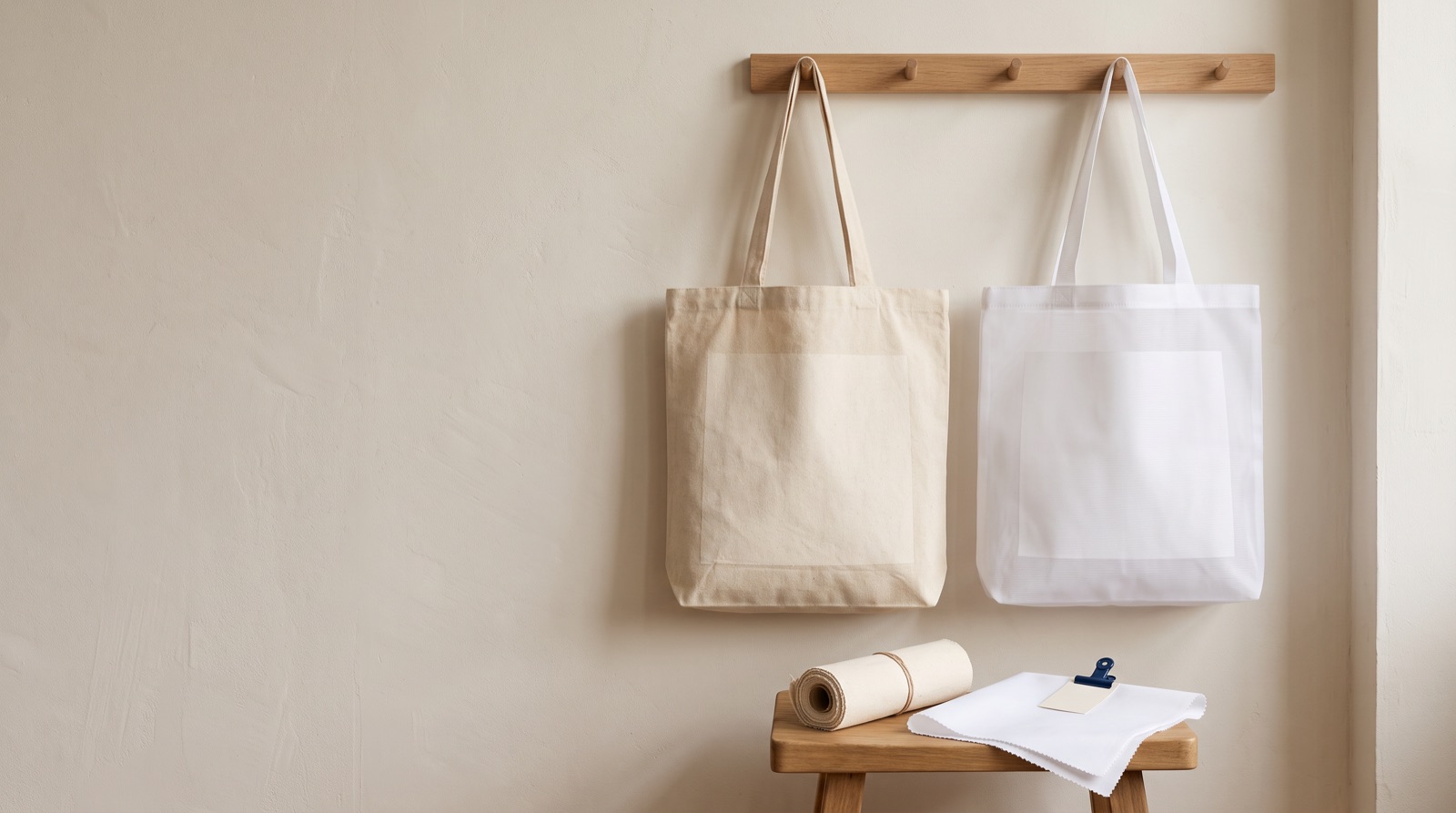
Cotton canvas is a plain-woven natural fibre, quoted by weight in ounces per square yard. Promotional totes run from roughly 5–6 oz at the light end to 12 oz and above for a bag meant to be kept. The difference between those two ends is not subtle: it is the difference between a bag that reads as packaging and one that reads as a product.
There is also cotton drill and there is non-woven polypropylene, which is what many "eco" totes actually are. Non-woven is the cheapest of the three by a distance, and it is worth naming explicitly if it is in scope, because comparing it against 12 oz canvas as though they were alternatives produces a misleading quotation.
Cost behaviour at volume#
RPET is lighter, which reduces both material cost and shipping weight. The second effect is easy to forget and is real at promotional volumes: a container is filled by volume or by weight, whichever runs out first, and canvas totes reach the weight limit sooner. Our note on sea, air or express freight explains how that gets costed.
Cotton canvas costs more per unit and weighs considerably more, but buys something specific: a piece the recipient is more likely to keep and reuse. For a programme measured on impressions over time rather than on units distributed, that changes the calculation entirely — and it is the only argument for canvas that survives a cost review.
The crossover between them is quantity-dependent and construction-dependent, so it is not a number that can be stated in the abstract. What is stable is the shape of the curve: RPET wins on landed cost at almost any promotional volume; canvas wins when the brief is measured on retention.
The rest of the unit price is not the material. Handles, gussets, base panels, linings, pockets and branding all move it, often by more than the shell does — our note on what drives unit price works through the same arithmetic on a smaller product.
How each behaves in production#
RPET is dimensionally stable, takes transfer and sublimation printing well, and does not shrink. A screen print on a coated RPET needs a test on the specific lot, because the coating affects ink adhesion, but once set it is consistent across the run.
Cotton shrinks, and on a piece that will be laundered that has to be handled at material stage rather than at inspection. Pre-shrunk fabric is specified before sampling; asking for it afterwards means re-cutting. Cotton also takes screen print exceptionally well, with the ink sitting into the fibre rather than on top of it, which is much of why a printed canvas tote looks the way it does.
Colour behaves differently too. Cotton is piece-dyed or yarn-dyed and can vary between lots; RPET carries the lot-to-lot variance that comes with recycled feedstock. For either, if several pieces in one colourway will sit together, lock the lot at order stage — the discipline in lab dips and why colours shift applies to both.
What each signals#
RPET reads as considered and contemporary, particularly in a beauty or lifestyle context where a recycled shell aligns with the brand position. It is the safer choice when the piece accompanies a product rather than standing alone — a bag that comes with a purchase rather than a bag that is the purchase.
Heavier canvas — 12 oz rather than a lighter weight — reads as durable in hand, and that is most of what separates a tote that gets reused from one that does not. If the tote is the campaign rather than an add-on to it, weight is not the place to save. A 5 oz tote at 12 oz prices satisfies nobody.
Both can be made to look cheap. The usual tells are unlined raw edges, tape handles stitched with a single bar tack, and a print that stops short of the seam. Where the budget is genuinely tight, it is better to reduce size or print colours than to reduce construction quality — the first is invisible, the second is the first thing a recipient notices.
Branding, and choosing the method before the material#
Screen printing is the default for both at promotional volume: setup is charged per colour, the per-unit cost is low, and colour consistency across a run is excellent. Digital printing carries no per-colour setup and suits gradients or photographic artwork. Our note on choosing a print method for GWP runs covers where the crossover sits.
On canvas, a embroidered mark is also on the table and reads very differently from a print. On RPET it is possible but less common, because the lighter shell needs a stabiliser and the finish can pucker.
Decide the method before the material where the mark is complex. A six-colour logo pushes hard towards digital or transfer, and that in turn favours a shell that takes those processes cleanly — which is a material decision arrived at from the artwork rather than the other way round.
Packaging, and the plastic the programme ships in#
A promotional bag is often individually poly-bagged, and on a large run that is a lot of plastic arriving with a sustainability message printed on it. It is worth deciding early whether the pieces can be bulk-packed by carton instead, or bagged in a recycled or paper alternative.
This matters more than it used to, because it is increasingly the part a buyer's own compliance team asks about. Our note on reducing plastic packaging sets out which options are realistic without risking the goods in transit.
If the pieces are going into a fulfilment centre rather than to an event, packing rules are prescribed rather than optional — see FBA prep for bags and pouches.
Claims, and what has to be true before it is printed#
Both materials can support a sustainability claim and neither does automatically. RPET's claim rests on recycled content documented for the specific material, with transaction certificates and a chain of custody. Cotton's claim, if there is one, usually rests on organic certification or on durability and reuse — and durability is a claim about construction, not about fibre.
"Eco-friendly" on its own is the claim most likely to cause a problem, because it says nothing checkable. A specific, evidenced statement is both more defensible and more persuasive. Our note on verifying a recycled material claim covers what to ask for.
Decide this at brief stage. A claim added to artwork late means either printing without evidence or reprinting — and the artwork is usually the last thing anyone wants to reopen.
Deciding#
Give us the expected volume band rather than a single number when you brief. The breakpoints where one material overtakes the other are quantity-dependent, and knowing the band lets us tell you where they sit for your specific construction rather than in general.
Say what the programme is measured on. "Units distributed at an event" and "impressions over the next year" point at different materials, different weights and different constructions, and that sentence resolves more of the specification than any material question.
If a sustainability claim is going to appear in campaign copy, decide that at brief stage so documentation is confirmed alongside the sample rather than after it. The promotional and GWP range shows where each material is typically used, and planning a GWP programme around a launch calendar covers the scheduling.
| RPET | Cotton Canvas | |
|---|---|---|
| Unit cost at volume | Lower | Higher |
| Shipping weight | Light | Heavy — material at promotional volume |
| Perceived durability | Functional | Substantial at 12oz and above |
| Likelihood of reuse | Moderate | High |
| Best when | The bag accompanies a product | The bag is the campaign |