Embroidery and debossing are both used to make a mark read as considered rather than printed on. They are not substitutes for each other, and on most programmes the choice is settled by the artwork and the shell material rather than by preference.
The question to ask first is not which looks better. It is: how much fine detail does the mark contain, what is the shell made of, and how many pieces are being made? Those three answers usually leave one sensible option, and occasionally they rule both out in favour of a printed mark or a woven label.
What each process actually does to the material#
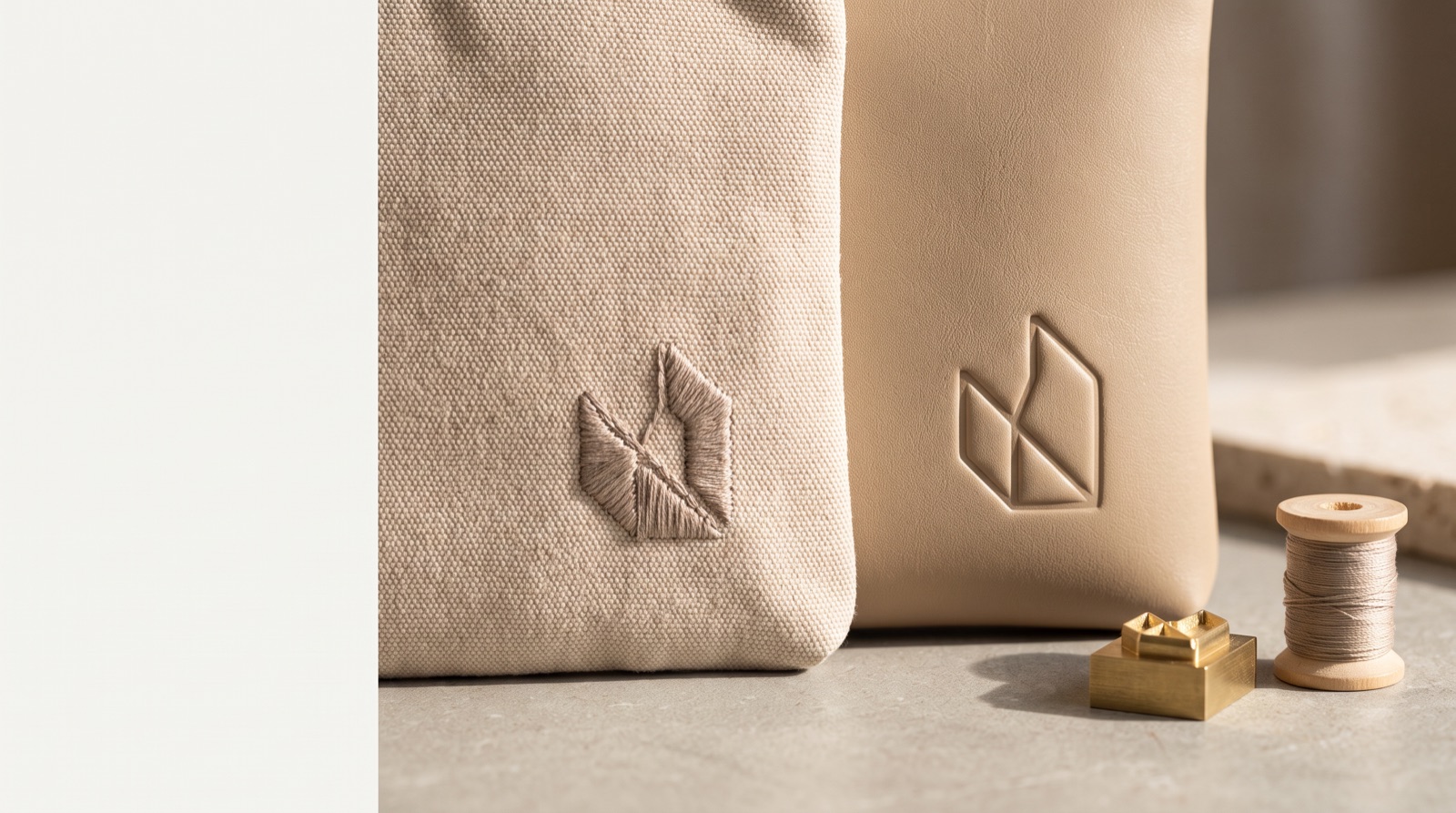
Embroidery adds thread. A digitised file drives a multi-head machine that stitches the mark into the fabric, so the finished logo sits proud of the surface and has real texture. Nothing is removed; something is added, and that addition has weight, thickness and a back side.
Debossing removes nothing and adds nothing. A heated metal die is pressed into the material under pressure for a set dwell time, and the material takes a permanent impression. The mark is the same colour as the shell — it reads by shadow rather than contrast, which is exactly why it looks quiet.
That difference explains almost everything downstream. Embroidery is limited by how finely thread can be laid down; debossing is limited by whether the material will hold a shape it has been pressed into.
Where embroidery works, and where the detail stops#
Embroidery suits marks with weight: solid letterforms, simple icons, wordmarks at a reasonable size. It survives handling and laundering better than most surface decoration, which is why it is the default on pieces expected to be used rather than displayed.
It struggles with fine detail. Below roughly 4 mm cap height, small counters — the enclosed spaces in letters like e, a and o — start to fill in as stitch density rises, and hairlines disappear entirely. A logo that works on a business card does not automatically work at embroidery scale, and the honest answer is often to prepare a simplified version of the mark for this application and approve it once, rather than to argue with the stitch count on every sample.
Two production terms are worth knowing when you read a quotation. Digitising is the one-off conversion of your artwork into a stitch path — it is craft work, not a file export, and a good digitiser will tell you which parts of a mark cannot be held. Stitch count is what the per-unit price is actually based on: a dense fill costs more to run than an outline of the same size, because the machine is on the piece for longer.
Backing, stabiliser and the panel underneath#
Embroidery pulls. The thread tension draws the fabric in slightly, and on an unsupported panel that shows as puckering around the mark or as a logo that no longer sits square. The fix is a stabiliser — a backing material placed behind the panel during stitching — and on lightweight shells it is not optional.
This is a sampling question, not a specification question. The same mark on 210D nylon and on 600D polyester behaves differently, and a mark that sits perfectly on a flat panel can distort once that panel is curved around a boxed corner. If the logo lands near a seam, a zip or a gusset, ask to see it on the actual construction rather than on a flat swatch. Where the shell is light, the choice of lining and interlining affects how the finished mark reads as much as the stitching does.
There is also a back side. On an unlined pouch the reverse of the embroidery is visible and can be abrasive against contents — a real consideration on a cosmetic pouch that will hold glass. Either the piece is lined, or the mark moves to a panel where the back is covered.
Where debossing works, and what it needs from the material#
Debossing works best on materials with enough body to hold an impression: PU, thicker canvas, some coated fabrics, and most synthetic leathers. The impression is made by heat, pressure and dwell time together, and all three are set against the specific material rather than carried over from the last job.
On thin or highly textured shells the impression relaxes. The mark is crisp on the sample and softer after a season of use, because the material is trying to return to its original state. If the piece has to look the same in six months as it did on approval, that needs testing at sample stage, not assuming — and a heavier material or an added backing layer is usually the answer.
Material choice also sets the ceiling on detail. A simple wordmark or monogram debosses cleanly on PU or microfibre; a mark with fine internal detail fills in as the material displaces, in much the same way a small embroidered letter does. Debossing is a quiet finish, and it suits marks that are already quiet.
Embossing, blind deboss, and the finishes people mean but do not say#
Debossing presses the mark in; embossing raises it, which requires a counter-die and is less common on soft goods because a raised mark on a bag panel catches wear. A blind deboss is the plain impression with no colour in it — the default, and the most restrained.
Colour can be added in the same operation. A foil deboss lays metallic or pigmented foil into the impression, which gives contrast at the cost of a finish that can wear at the edges over time. Briefs often say "debossed" when they mean "debossed with gold foil"; the two are priced and tooled differently, so it is worth being explicit.
Both routes need a metal die cut to the artwork. That is a one-off tooling cost per mark and per size, which is why a programme that runs one logo on eight products is cheaper per piece than one that runs eight variations.
The options that get ruled in once you compare honestly#
When the mark is too detailed for embroidery and the shell is too soft for a lasting deboss, the answer is usually neither. A woven label holds far finer detail than embroidery at small sizes, is sewn into a seam so it never distorts a panel, and is often the cheaper of the three at volume.
Rubber or silicone patches hold detail and read as durable and contemporary; they carry their own tooling cost and add thickness. Heat transfer handles gradients and photographic content that neither embroidery nor debossing can approach, with the trade-off that the mark sits on the surface rather than in it.
None of these is a downgrade. They are different answers to the same question, and a brief that asks for the effect rather than naming the process gets the best of them.
Cost, schedule and quantity#
Embroidery carries a one-off digitising charge and a per-unit cost driven by stitch count. It scales predictably: the hundredth piece costs what the first one did, because the machine time per piece does not change. That makes it well-behaved at moderate volumes and comparatively expensive at high ones.
Debossing carries a one-off die cost and a low per-unit cost, so it improves as quantity rises. On a large corporate gift programme a debossed mark is frequently cheaper than a dense embroidered one.
Both add a step to the schedule, and both need their own approval. Build that into the plan alongside the rest of the timeline — the branding sample is a separate approval from the construction sample, and treating them as one is a common way to lose a week. Our note on how long a custom bag order takes sets out where those approvals sit.
What to send with the brief#
Send vector artwork — AI, EPS or a PDF with live outlines. A raster file can be traced, but tracing is interpretation, and interpretation is where a mark stops looking like itself. Include the smallest size the mark will ever be used at; that single number resolves most of the embroidery question before anyone quotes.
Name the thread or impression colours in a standard reference rather than describing them. Embroidery thread is matched from a thread card, not from a screen, and the approval is made against the physical card — the same discipline described in our note on colour matching and why colours shift.
Say where the mark goes, measured from a fixed point — a seam, a zip end, the base — rather than "centred". Centred on a flat pattern piece and centred on the finished bag are not the same place once the panel is curved.
Deciding quickly#
Detailed mark, forgiving fabric shell: embroidery, with a simplified artwork version prepared in advance. Simple mark, a material with body, and a brief that wants restraint: debossing. Fine detail at small size, on any material: a woven label. Gradients or photographic content: print or transfer.
Send the artwork with the brief in vector form and say what the piece has to survive. Both routes are decided by what the file actually contains and what the shell can actually hold, and a decision made from the real file on the real material is a decision that survives sampling.
| Embroidery | Debossing | |
|---|---|---|
| Best artwork | Solid letterforms, simple icons | Simple marks, minimal detail |
| Detail limit | Loses definition below ~4mm cap height | Fine detail fills in as the impression relaxes |
| Suited shells | Most fabric shells | PU, heavier canvas, coated fabrics |
| Not suited to | Tyvek, TPU, PVC (perforation) | Thin or highly textured shells |
| Reads as | Textured, added, visible | Quiet, integrated, tactile |