
How Long Does a Custom Bag Order Really Take?
From brief to delivery: sampling, material lead time, production, inspection and shipping — and how to protect a launch date
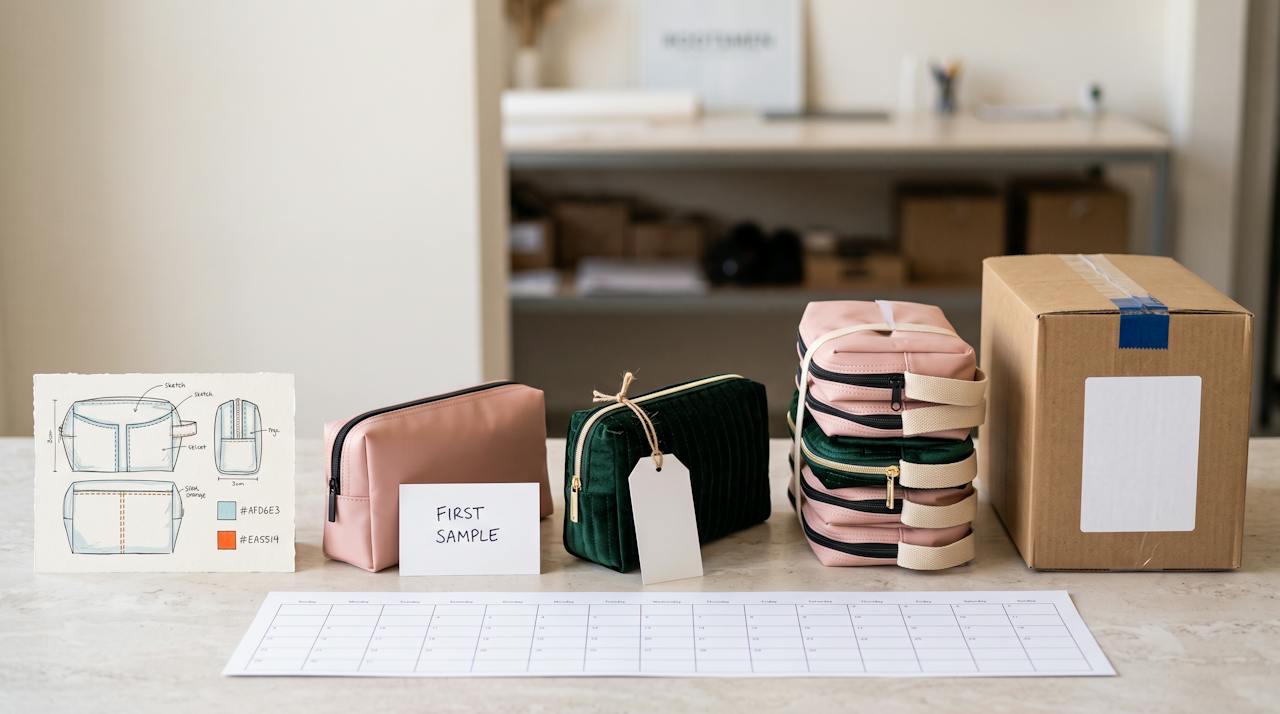
A custom bag order is not one lead time but five: development and sampling, material lead time, pre-production sample approval, bulk production, then inspection, packing and transit. Production itself is often quoted at around 40 days; sampling and materials are quoted per programme, and sea freight adds several weeks. Most launch dates slip in approvals, not in the factory.
Ask a factory "how long will this take?" and you usually get one number back. That number is almost always the production lead time — the days between a confirmed pre-production sample and packed goods. It is the smallest part of the answer.
A bag programme runs on five clocks: development and sampling, material lead time, pre-production sample approval, bulk production, and inspection, packing and transit. Some belong to the factory; several belong to you.
The five clocks in a bag programme
Development and sampling covers drawings, materials, hardware and one or more rounds of physical samples. Material lead time is the ordering and delivery of bulk fabric, zips, webbing, linings and trims. PPS approval is a single gate: the bag built in bulk materials on the bulk line, signed off by you.
Bulk production is cutting, printing or embroidery, sewing, assembly and finishing, and inspection, packing and transit closes the programme. Only the last three are genuinely predictable.
The first two depend on your brief and your response speed — which is why two buyers ordering a near-identical pouch can finish six weeks apart.
Development and sampling: where the weeks go
Sample lead time is quoted per programme, because a flat zipped pouch in stock nylon and a multi-compartment travel organizer with custom hardware are not the same engineering problem. The shape is predictable: a first development sample, your comments, a revision, and lab dips or strike-offs where colour matters.
The lever you control is the number of rounds. Each one adds making time, shipping both ways and review time on your desk. A brief that fixes dimensions, lining, closure and print method converges faster than a mood board.
Settle decoration early, because it changes the sampling path. See choosing a print method for gift-with-purchase runs and embroidery versus debossing before the first sample, not after the third.
Material lead time is the hidden critical path
Bulk materials cannot be ordered until the specification is frozen, and they are rarely sitting in a warehouse in your colour. A custom-dyed nylon, a specific ripstop weight or a branded zip puller carries its own mill lead time, and that runs in series with production.
Certified recycled materials need extra calendar. Under the Global Recycled Standard, only goods covered by a valid transaction certificate count as certified, so organize that paperwork alongside the material — see how to verify a recycled material claim.
If the material is still open, close it early; the trade-offs are in nylon versus rPET for cosmetic pouches. The same decision made after the PPS restarts the material clock.
The pre-production sample gate
The PPS is the most load-bearing date in the programme: the bag made from bulk materials, on the bulk line, with the real decoration and hardware — the last honest preview of what arrives in the container.
Treat it as a gate, not a formality. Everything downstream schedules from approval, so a sample sitting unapproved for a week moves delivery by a week. Approving conditionally — "we'll fix the zip colour in bulk" — is how a programme acquires a second round.
What a PPS should confirm, from measurements and tolerance to colour, labelling and packing, is set out in what a PPS confirms before bulk production.
Bulk production: what "about 40 days" means
ROOTSMEN publishes production at approximately 40 days. Read that as the window from approved PPS and materials in house to finished, packed goods — cutting, decoration, sewing, assembly, finishing and internal checks — not as the time from your first enquiry.
That distinction causes most timeline disputes. A buyer who hears "40 days" and diaries delivery 40 days from the brief has deleted sampling, materials and shipping from the plan. Asking "40 days from what?" produces a schedule you can defend internally.
Quantity, decoration complexity and the number of colourways sit inside that window — the same variables that drive the unit price of a custom cosmetic bag.
Inspection, packing and documents
Final inspection is scheduled against finished production, and a third-party inspector needs booking in advance. Agree the sampling plan before production starts, not when the cartons are sealed.
Most bag orders are inspected on an attributes plan, and the usual civilian reference is ANSI/ASQ Z1.4, successor to MIL-STD-105E. Fixing lot size, inspection level and acceptance limits in advance gives a failed lot a defined path — rework and re-inspect — instead of an argument. See setting an AQL inspection plan.
Allow time for paperwork: retail packing, barcodes, care and content labelling and market documentation must be right before goods move — see compliance documents for the US and EU. Licensed programmes add approvals that run on the licensor's calendar.
Sea versus air, decided early
Transit is the last clock and the one most often planned wrongly. Sea freight is the default for bags — light but bulky, and suited to container economics — but it adds weeks of sailing plus port handling, customs clearance and inland delivery. Air compresses that and costs a multiple.
Decide at order stage, not at packing. Sea freight means committing to a vessel schedule; deciding to fly goods late usually means splitting the shipment, which multiplies documentation and can strand part of a launch assortment.
For a hard launch date, a planned split is the sensible hedge: air for launch week, the balance by sea. Model it in the budget from the start rather than improvising in week ten.
What actually causes delay
Four things account for most slipped dates. Late or changing approvals — artwork, lab dips, the PPS — are by far the largest. Specification changes after materials are ordered restart the longest clock. Factory holidays are predictable yet routinely forgotten: closures are published in advance in the State Council's annual holiday notice, and capacity tightens for weeks either side. Late inspection failures add rework, a second inspection and sometimes a missed vessel.
Notice what is not on the list: the factory being slow. A supplier working to ISO 9001 and audited through SMETA or amfori BSCI is usually the most predictable link in the chain.
Protective habits: freeze the specification before materials are ordered, name one person with authority to approve samples, and ask for a production schedule showing when each approval is needed.
Planning backwards from your launch date
Start from the on-shelf date and subtract in reverse: distribution and customs, ocean or air transit, packing and inspection, production, PPS approval, material lead time, sampling rounds, briefing. On one page with named owners, the date you need to move is usually your own artwork approval.
ROOTSMEN has made cosmetic bags, pouches, travel organizers and promotional and licensed soft goods since 1981, from Taipei with its own factory in Guangdong since 1993, and publishes production at approximately 40 days, with sample lead time quoted per programme. Certifications include FAMA for Disney licensed work, ISO 9001, SMETA, GMP and BSCI — relevant to your calendar because licensed and audited programmes carry approval steps worth scheduling.
The most useful opening question is not "what is your lead time" but "here is my on-shelf date — what do you need from me, and when?" Send a brief through contact, or see cosmetic bags and travel accessories.
| Stage | Cannot start until | Who holds the clock | Most common cause of slippage |
|---|---|---|---|
| Development and sampling | Brief, drawings and material direction are agreed | Shared — factory makes, buyer comments | Extra sample rounds caused by an incomplete brief |
| Material lead time | Specification is frozen, including colour and trims | Mills and trim suppliers | A specification change after materials are ordered |
| Pre-production sample approval | Bulk materials are in house | Buyer | Sample sits unapproved, or is approved conditionally |
| Bulk production | PPS is approved in writing | Factory | Holiday closures and peak-season capacity |
| Inspection, packing and transit | Production is finished and packed | Inspector, then carrier | Unbooked inspection, failed lot, or a missed vessel |
Event Details
From the Stand
Frequently Asked Questions
The questions this topic actually raises when a program is being scoped.
Plan for five stages, not one: sampling, material lead time, pre-production sample approval, production and shipping. Production is commonly quoted at around 40 days from approved PPS and materials in house; sampling and material lead times are quoted per programme, and sea freight adds several weeks on top.
No. A production lead time normally runs from approved pre-production sample and materials in house to packed goods at the factory. Sampling, material procurement, inspection and transit sit outside it. Always ask a supplier "lead time from what, to what?" and diarize the answer against your on-shelf date.
It is rarely worth it. The PPS is the only check that bulk materials, the bulk line and real decoration produce the bag you approved, and skipping it moves risk into a quantity you have already paid for. If time is tight, compress your own approval turnaround instead.
Late approvals on the buyer's side — artwork, lab dips and the pre-production sample. Each idle day moves delivery one for one, and a specification change after materials are ordered restarts the longest clock. Naming one decision-maker with authority to sign off usually saves more time than anything the factory can do.
Sea for almost all bag volumes, because bags are bulky and ocean economics suit them; air only where the launch date justifies a multiple of the cost. Decide at order stage rather than at packing, and if the launch date is hard, budget a planned split shipment instead of improvising one.
Significantly, and predictably. Chinese New Year and National Day closures are published in advance by the State Council, and capacity tightens for weeks before and after as everyone competes for the same slots. Any programme landing near those windows should be booked earlier, with materials confirmed well ahead.
Related Products
Builds where this decision applies.

Have a product requirement of your own?
Tell us the product, the quantity and the timeline — we'll scope a development plan.