A hanging organizer is a travel bag that unfolds and hangs from a hook so its contents can be reached without unpacking. It is one of the few soft-goods products that carries its full weight from a single point, and that one fact drives the construction.
Briefs usually describe it as a wash bag with a hook added. It is not: the hook, the panel layout, the stitching at the hang point and the balance of the loaded bag are all specific to this format, and a bag that was designed as a flat wash bag and given a hook will fail at the hook.
The hook is a structural component#
Everything in the bag hangs from the hook attachment, and a loaded organizer can be surprisingly heavy — full bottles are dense. The failure is almost never the hook itself breaking; it is the webbing tearing out of the panel, or the stitching pulling through the shell.
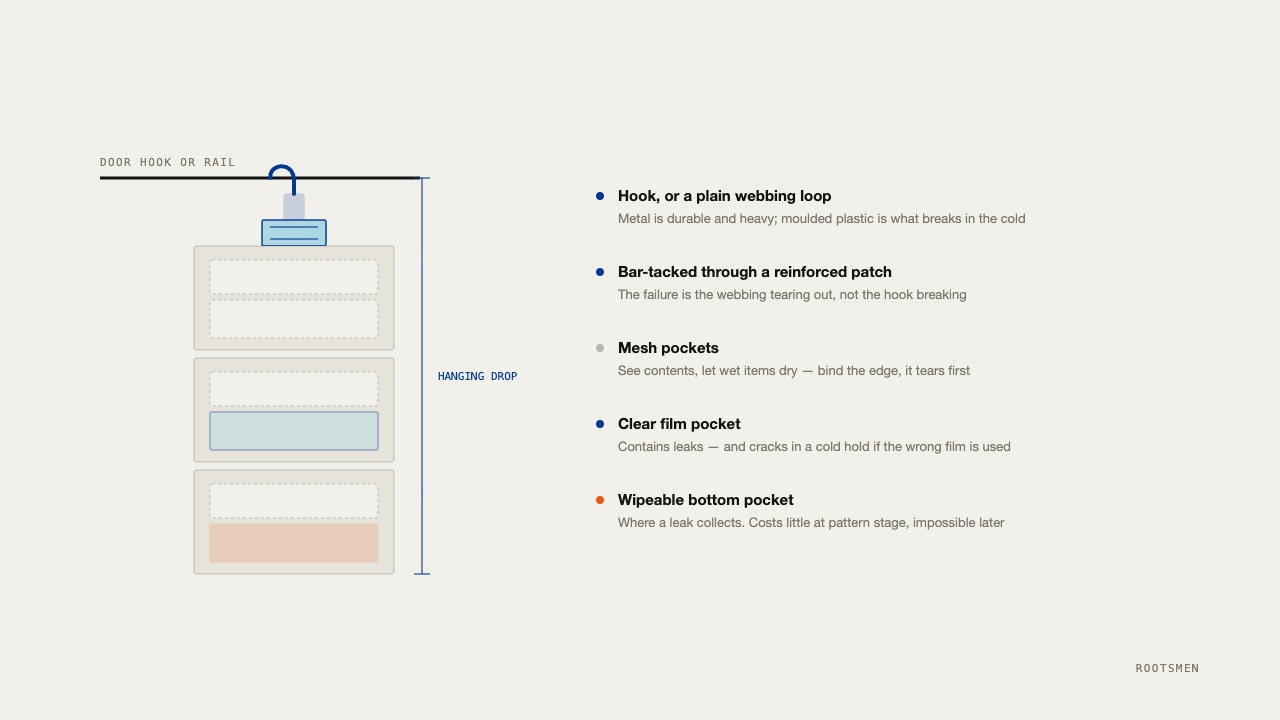
That means the attachment needs reinforcement behind it: a bar-tacked webbing loop sewn through a reinforced patch rather than through a single layer of shell. Ask how the hang point is constructed, not what the hook is made of.
Hook types each have a trade-off. A swivel metal hook is the most durable and the heaviest. A moulded plastic hook is lighter and cheaper and is the part that breaks in cold weather. A webbing loop with no hook is the lightest and most reliable and needs a rail or a door hook to be present. For a product sold internationally, the loop is the safest and the hook is what buyers expect — many programmes specify both.
How the panels fold#
The format is defined by how many panels fold and in which direction. Bi-fold is two panels and the most compact packed; tri-fold is three and gives more organised storage for the same hanging height; a roll format unrolls to a long single face.
More panels means more organisation and a longer hanging drop, which matters more than it sounds — a tri-fold hanging from a standard door hook can reach the floor or the basin, and that is a real product complaint rather than a detail.
Specify the hanging drop as a dimension, not just the folded size. It is the measurement a user experiences and the one briefs almost never contain.
Pockets: mesh, clear or solid#
The interior is the product. Three pocket materials are used and they are chosen for different reasons.
Mesh lets the user see the contents and lets wet items dry, which is why it dominates. It is also the component that tears first, and it should be specified with a bound edge rather than a raw one.
Clear film shows contents and contains leaks, which is its real job in a bag full of liquids. Which film matters — see clear PVC, TPU, EVA and PEVA compared, because a pocket that cracks in a cold hold defeats the purpose.
Solid fabric hides contents and is used where the piece should look tidy rather than practical. It is the right choice for a retail or amenity programme where the organizer is seen on a shelf more often than it is used.
Leaks, and the pocket that catches them#
This product carries liquids by definition, and the brief should say what happens when one leaks. A fabric-lined organizer with a leak is ruined; one with a coated or clear-film lower pocket contains it.
A common and inexpensive answer is to make the bottom-most pocket of each panel from a wipeable material, since that is where a leak collects. It costs very little at pattern stage and it is impossible to add afterwards.
Being honest about what the bag can claim matters here too — a coated lining is not a waterproof bag, as our note on waterproof versus water repellent sets out.
Balance when loaded#
An organizer that hangs crooked reads as badly made even when every seam is perfect. It happens when the heavy pockets are all on one panel, or when the hang point is not centred on the loaded mass rather than on the geometry.
This is a sampling check rather than a drawing check. Load the sample as a traveller would — bottles in the big pockets, small items in the small ones — and hang it. If it twists, the hang point or the pocket layout moves, and both are cheap to change at that stage and expensive afterwards.
Our note on what to check when your first samples arrive covers the rest of the sequence, and what a pre-production sample confirms the gate after it.
Packed size and the airline question#
Hanging organizers are bulky packed, and that drives both freight and shelf presence. A bi-fold with a compression strap packs considerably smaller than a tri-fold without one, and the strap costs almost nothing.
If the piece is sold as cabin luggage equipment, the airport liquids rule still applies to what goes inside it — the organizer is not an exempt container, and a clear pouch that detaches is the usual answer. Our note on clear toiletry bags and airline liquid rules covers the requirement.
What to send with the brief#
The contents, the fold format, the hanging drop you want, and whether a leak has to be contained. Those four settle the pattern.
Say also whether the piece is used or displayed. An organizer specified for a retail shelf and one specified for a frequent traveller are different products, and the difference shows up in the pocket materials rather than in the shell.
See the travel accessories range for built examples, or send the brief and we will quote the construction line by line.
| Decision | What it settles |
|---|---|
| Hook or webbing loop | Durability and whether it works on any rail |
| Hang point reinforcement | Whether the bag tears out under a full load |
| Bi-fold, tri-fold or roll | Packed size against organised storage |
| Hanging drop | Whether it reaches the basin or the floor |
| Mesh, clear film or solid pockets | Visibility, drying and leak containment |
| Wipeable bottom pocket | Whether one leak ruins the bag |
| Compression strap | Packed bulk, at almost no cost |