
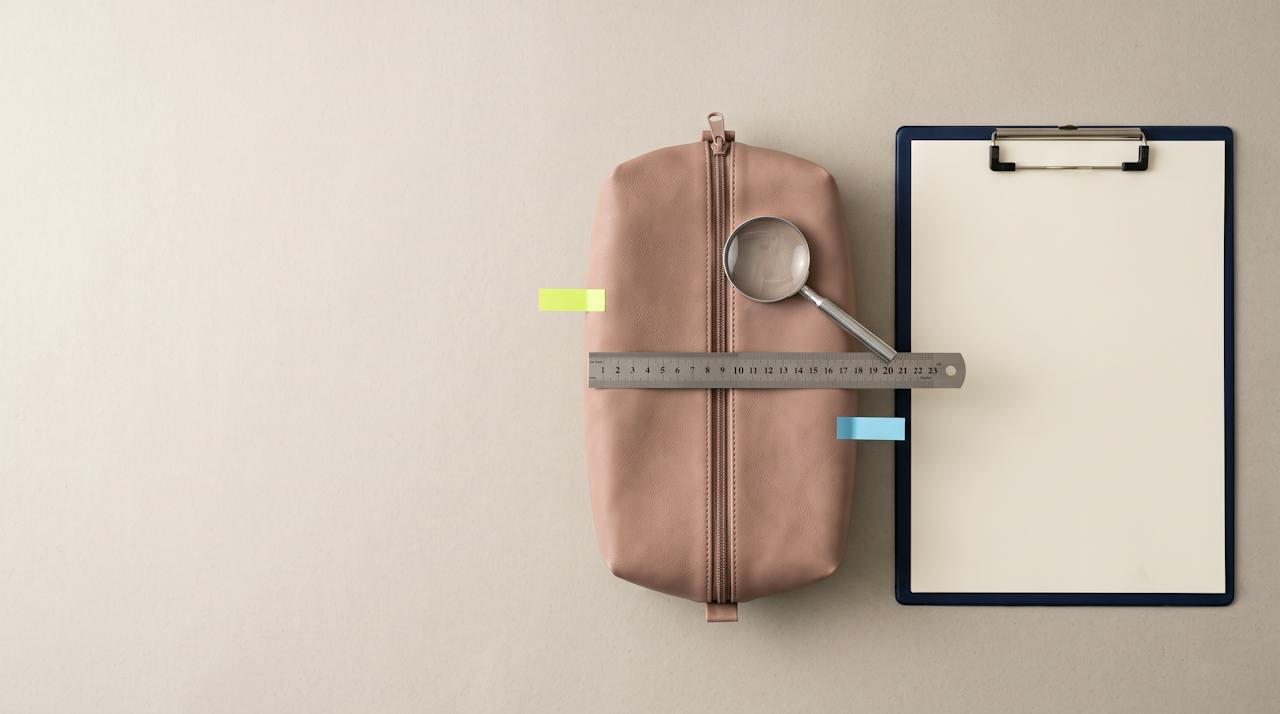
What to Check When Your First Samples Arrive
An order-of-operations checklist for reviewing development samples — measurements, construction, hardware, colour, decoration, odour and packaging — and how to write comments a factory can act on.
Check development samples in a fixed order: measurements against the specification, construction and seams, zipper and hardware function, colour under controlled lighting, decoration placement, then odour, cleanliness and packaging. Record every deviation with a photo, a measured value and a decision — approve, revise or remake — so the factory can act on the comment without guessing what you meant.
The parcel arrives, someone opens it at a desk, everyone agrees it looks nice, and it goes into a cupboard. Weeks later the same team is arguing about a zip pull nobody looked at. First samples are the cheapest moment in a programme to find a problem, and the most commonly wasted.
A development sample is not a finished product. It is a physical answer to the specification you sent, built by people who may have read parts of it differently from how you meant them. Your job is not to admire it but to test the specification against reality and write down where the two diverge.
Before you touch it, put the tech pack, approved materials and the previous round's comments beside it. Reviewing from memory is how colour drift and quiet substitutions survive into bulk.
Measure before you form an opinion
Measurements first. Once you have handled a bag and decided you like it, you will forgive dimensions that are out of tolerance. Lay it flat and unfilled on a hard surface and measure the points listed in the tech pack — width, height, gusset or base depth, zip opening, strap length and drop — using the method the specification describes.
Record the measured value next to the specified value rather than a pass or fail. Base 21.5 cm against 22 cm specified is something a factory can act on; too small is not. Where no tolerance is stated, agree one now and put it in writing. Drift usually has a nameable cause — a lining cut to the shell pattern, a different seam allowance, foam eating width — and that cause tells you whether to correct the pattern or the sewing line.
Construction, seams and the inside of the bag
Turn the sample inside out. Cosmetic bags and travel organizers hide their real quality where the customer only finds it after a month of use. Look for consistent stitch density along the whole seam rather than at corners alone, bar tacks at stress points such as strap anchors and zip ends, and a finished edge wherever raw fabric would fray.
Check that the lining is not pulling the shell out of shape and that interlining or foam is caught in the seam and cannot migrate. Pull deliberately on handles and D-rings — not to break anything, but to confirm reinforcement exists where you asked for it. A missing bar tack is usually a drawing that was never clear, which makes it a tech pack correction rather than a factory error.
Zippers, sliders and hardware
Run every zipper fully open and closed at least ten times, empty and then lightly filled. You are feeling for catching at the corners, a slider that jumps the chain, or a puller that rotates stiffly. Confirm the brand and size stamped on the slider against the approved trim.
Zipper performance is measurable, not a matter of taste. ASTM D2061, Standard Test Methods for Strength Tests for Zippers, covers holding strength of the slider lock and stops, resistance to pull-off of the slider pull, and strength of chain and elements — cite it when you need a laboratory number instead of a hand feel. On metal parts, check plating on undersides and inside edges, where buffing is often skipped.
Judge colour under controlled light
Office lighting, a phone screen and an afternoon window each give a different answer. Colour approval belongs in a light booth under an agreed illuminant, and viewing conditions are themselves standardized: ISO 3664 specifies viewing conditions for critical comparison and for practical appraisal, including illuminance. Check under a second illuminant too, to expose metamerism.
Grade the difference the way a laboratory would. ISO 105-A02 defines the grey scale for assessing change in colour, letting you write grade 4 instead of a bit off. Assess each component separately — shell, lining, webbing, zip tape and thread rarely take dye alike — and name which material is the master when a colour runs across a family, or you will receive five near misses instead of one set.
Print, embroidery and logo placement
Measure decoration placement rather than eyeballing it: distance from the base seam and from the centre line, in the units the artwork file uses. A logo sitting five millimetres high on a small pouch reads as wrong even to people who cannot say why.
Check technique as well as position. Printed marks want opacity over the substrate colour, no cracking when the panel is flexed, and clean edges on fine serifs — the decisions behind those outcomes are in our guide to choosing a print method for gift-with-purchase runs. Embroidery wants registration between colours, no puckering, and backing that does not show; embroidery versus debossing on soft goods sets out where each behaves well. Rub the decoration with a dry cloth, then a damp one; any transfer is a finding.
Odour, cleanliness and how it was packed
Open the bag and smell the inside. A strong solvent or rubbery odour usually points to adhesives, a coating that has not fully cured, or goods packed while warm. It will not disappear inside a sealed polybag on a ship. Look too for chalk marks, loose threads and offcuts in pockets and behind linings; a needle fragment is a safety matter, not a cosmetic note.
Inspect the packaging as a deliverable in its own right. Folding, tissue, polybag warning text, hangtag position and carton marking are all things retailers reject on, and all cheaper to fix in development than at a distribution centre.
Write comments the factory can act on
A sheet that says quality not good costs you a round. A usable comment has four parts: where (component and location), what (the measured fact), why it matters, and the decision — approve, approve with correction, or remake. Number every point, photograph each with a ruler in frame, and mark which items need a new sample and which can be confirmed by photograph.
Carry these agreements forward. The pre-production sample is made from bulk materials on bulk machinery and exists to confirm exactly these points — see what a PPS actually confirms before bulk production. Your measurable findings also become the defect definitions your inspector uses, so take them straight into setting an AQL inspection plan. The sampling itself follows ISO 2859-1, the international scheme indexed by acceptance quality limit.
Working with a developer who expects to be questioned
A good sample review is mildly adversarial: you are hunting for places where your intent and the factory's reading of it drifted apart. The useful question to ask a development partner is not whether they can make the sample, but how they record and close your comments.
ROOTSMEN has developed custom cosmetic bags, pouches, travel organizers and promotional and licensed soft goods since 1981, from Taipei and from our own factory in Guangdong operating since 1993, under FAMA (Disney), ISO 9001, SMETA, GMP and BSCI. If you are preparing a first round, our notes on choosing an OEM/ODM partner cover what to agree before the first sample is cut, and you are welcome to talk to our development team about a specific programme.
| Check | How to do it | Weak comment | Comment a factory can act on |
|---|---|---|---|
| Measurements | Lay flat and unfilled; measure the tech pack points with the specified method | Looks too small | Base depth 21.5 cm against 22 cm specified; correct pattern, confirm on next sample |
| Construction and seams | Turn inside out; check stitch density, bar tacks at stress points, edge finishing | Stitching is messy | Left strap anchor has no bar tack; add bar tack per page 4 of tech pack |
| Zipper and hardware | Cycle each zip ten times empty and lightly filled; confirm branding on the slider | Zip feels bad | Slider catches at both bottom corners when filled; check tape ease at corner radius |
| Colour | Judge in a light booth under the agreed illuminant; check a second illuminant for metamerism | Colour is off | Lining grades 3-4 on the grey scale against standard; resubmit lab dip, shell approved |
| Decoration | Measure placement from base seam and centre line; flex and rub test | Logo looks high | Logo centre sits 5 mm above specified height; reposition and confirm by photograph |
| Odour and cleanliness | Smell the interior; inspect pockets and behind linings for debris | Smells odd | Strong solvent odour at glued base panel; confirm cure time before packing |
| Packaging | Photograph as received; check fold, polybag text, hangtag position, carton marking | Packing needs work | Polybag missing warning text; add per retailer requirement, photo approval acceptable |
Event Details
From the Stand
Frequently Asked Questions
The questions this topic actually raises when a program is being scoped.
Measure it first, against the tech pack, before you form an impression of it. Once you have handled a sample and decided you like it, you will unconsciously tolerate dimensions that are outside tolerance. Record measured values next to specified values rather than writing pass or fail.
Enough to separate a one-off sewing issue from a pattern or specification problem. A single piece cannot show consistency, so a small set lets you see whether a defect repeats. Keep one sealed reference sample untouched for later comparison against production.
Assess it in a light booth under an illuminant you and the supplier agreed in advance, not under office light or on a screen. ISO 3664 standardizes viewing conditions and ISO 105-A02 provides the grey scale for grading colour change, so you can record a grade instead of an opinion.
A strong solvent, glue or rubbery odour usually indicates adhesives, an uncured coating, or goods packed while still warm. It is a legitimate finding rather than a cosmetic one, and it does not dissipate inside a sealed polybag in transit. Raise it and ask what changes in the process.
Yes. Folding method, polybag warning text, hangtag position and carton marking are frequent causes of retailer rejection, and correcting them in development is far easier than at a distribution centre. Photograph the sample exactly as it arrived before you unpack it.
Give each point four parts: where it is, the measured or observed fact, why it matters, and your decision — approve, approve with correction, or remake. Number every point, photograph it with a ruler in frame, and state clearly which items need a new physical sample.
Related Products
Builds where this decision applies.

Have a product requirement of your own?
Tell us the product, the quantity and the timeline — we'll scope a development plan.