Brush holders look like a simple pouch with some elastic in it. They are one of the few products in this category where the contents dictate almost every dimension, and where a specification that is nearly right produces a product that visibly fails: bristles bent, ferrules poking through, a roll that will not stay rolled.
Three formats cover the category — the roll, the stand-up holder and the flat sleeve — and they are built differently enough that choosing late means re-patterning.
The three formats#
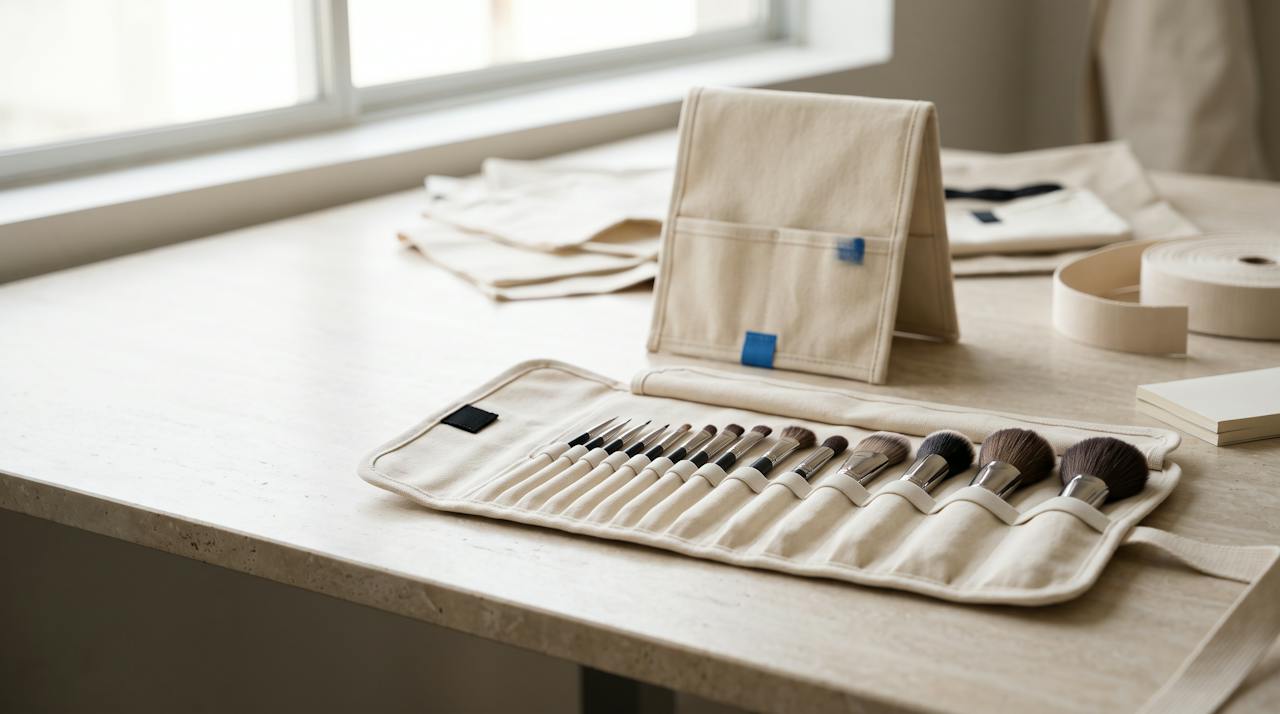
A brush roll is a flat panel with a row of elastic loops or pockets, rolled and tied or snapped shut. It protects bristles well because each brush sits in its own slot and nothing presses on the head. It is the professional format and the one that holds the most brushes for its packed size.
A stand-up holder is a pouch that folds open and locks into a cup or an A-frame so the brushes stand handle-down on a counter. It is the format that photographs best and the one most often specified for retail, because it has a second life on a dressing table.
A flat sleeve is a simple zipped or flap pouch with no individual slots. It is the cheapest, it is what most gift-with-purchase sets use, and it is also where bristles get crushed — acceptable when the brushes are an add-on, wrong when they are the product.
Dimensions come from the longest brush#
Measure the brushes before anything else. The longest brush sets the panel height on a roll and the body height on a stand-up holder, and it needs clearance — a brush that exactly fits catches on the closure every time it is put away.
Roughly 15–20 mm above the tallest brush head is a usual working allowance, more on a roll where the fabric has to curl over the top. Our note on specifying dimensions covers the measuring discipline and the tolerance to quote.
The number of slots is the second decision and it is easy to get wrong in the generous direction. A roll with sixteen slots that ships with eight brushes looks unfinished, and the empty loops sag. Specify the slot count against the set that will actually be sold.
Slots, elastic and why they fail#
Slots are made as elastic loops, as stitched pockets, or as a combination. Elastic is cheaper, holds a range of handle diameters, and is the component that ages worst: it relaxes with use and with heat, and a loop that has gone slack lets the brush slide and the head rub.
Pockets hold their shape indefinitely but only fit the diameter they were made for, which is fine for a matched set and a problem for a holder sold empty.
If elastic is used, specify its width and ask what it is — a woven elastic holds tension far longer than a cheap knitted one. This is a component worth naming in the tech pack rather than leaving to the factory's default, because it is the part that decides whether the product is still good in a year.
Slot width should also vary. A row of identical loops cannot hold both a fine eyeliner brush and a powder brush; graduated widths across the row are a small pattern change and the difference between a product that works and one that looks like it should.
Protecting the bristles#
The failure mode that gets returned is a bent brush head. Three things prevent it, and none of them is the material.
A flap over the heads on a roll, so the bristles are covered rather than pressing against the next layer when rolled. A deep enough body on a stand-up holder, so the heads sit below the rim rather than at it. And enough spacing between slots, so heads do not splay into each other.
Lining matters here in a way it does not on a plain pouch: a smooth lining lets the brush withdraw without dragging, while a rough or napped one catches the bristles. For a premium set it is worth specifying the lining as a performance component, not as a finish.
Closures, and the one that gets specified wrong#
A roll closes with a tie, a snap strap, an elastic band or a zip around the outside. Ties look considered and come undone in a bag. Snaps are reliable and add hardware cost. An elastic band is cheapest and is the first part to fail.
A zip around a roll is the most protective and the most expensive, and it changes the pattern substantially because the roll now has a fixed outer dimension.
On a stand-up holder the closure is usually a zip plus a mechanism — a drawstring, a press stud, or a fold-and-snap — that locks it open. That mechanism is what buyers judge the product on, and it is the part most likely to need a second sample round.
Branding on a narrow panel#
Brush products give very little flat area to brand. On a roll, the outer face when closed is the only surface that reads, and it is curved. On a stand-up holder it is the front panel below the opening.
That favours small, simple marks and rules out most of what works on a flat pouch. A woven label or a debossed mark usually sits better here than a print, which can crack along the roll.
Decide the branding before the pattern, because on this product the mark often dictates where a seam can go.
What to send with the brief#
The brushes, or their measurements: length of the longest, diameter of the thickest handle, and how many of each. That single list settles the panel size, the slot count and the slot widths.
Then the format, the closure, and whether the piece is sold with brushes or empty. A holder sold empty has to fit brushes nobody has specified, which is a different and harder brief — say so if that is the case.
ROOTSMEN builds brush rolls, stand-up holders and sleeves as part of the cosmetic range. Send the brush set and we will come back with a pattern proposal rather than a guess.
| Roll | Stand-up holder | Flat sleeve | |
|---|---|---|---|
| Bristle protection | Best, each brush separated | Good, heads below rim | Poor, heads compress |
| Packed size | Smallest for brush count | Bulkiest | Smallest overall |
| Second life on a counter | No | Yes | No |
| Relative cost | Middle | Highest | Lowest |
| Usual use | Professional sets | Retail, gifting | Gift with purchase |