
Hotel Amenity Kits and Travel Sets: How Brands Specify Them
What goes into a hospitality or airline amenity kit, which bag formats survive the cabin and the housekeeping trolley, how sustainability rules are reshaping the brief, and what a supplier needs before development starts.
An amenity kit is a small branded bag holding a fixed set of comfort items. Brands specify it in four layers: the contents list, the bag format (zip pouch, drawstring, flat folder or hard case), the material and its recycled or certification claims, and the branding method. Packing and kitting rules are then written as a separate document, because the kit is assembled, not just sewn.
An amenity kit looks like a giveaway. It is one of the most tightly specified soft goods a brand ever buys: a small bag that must hold a fixed list of items, survive a cabin trolley or a housekeeping cart, carry a logo a licensor may have to approve, and arrive already filled and labelled.
Most of the difficulty is not in the sewing. It is in the contents, the regulations governing what may be inside, and the kitting operation that turns an empty pouch into a finished unit.
What actually goes into a kit
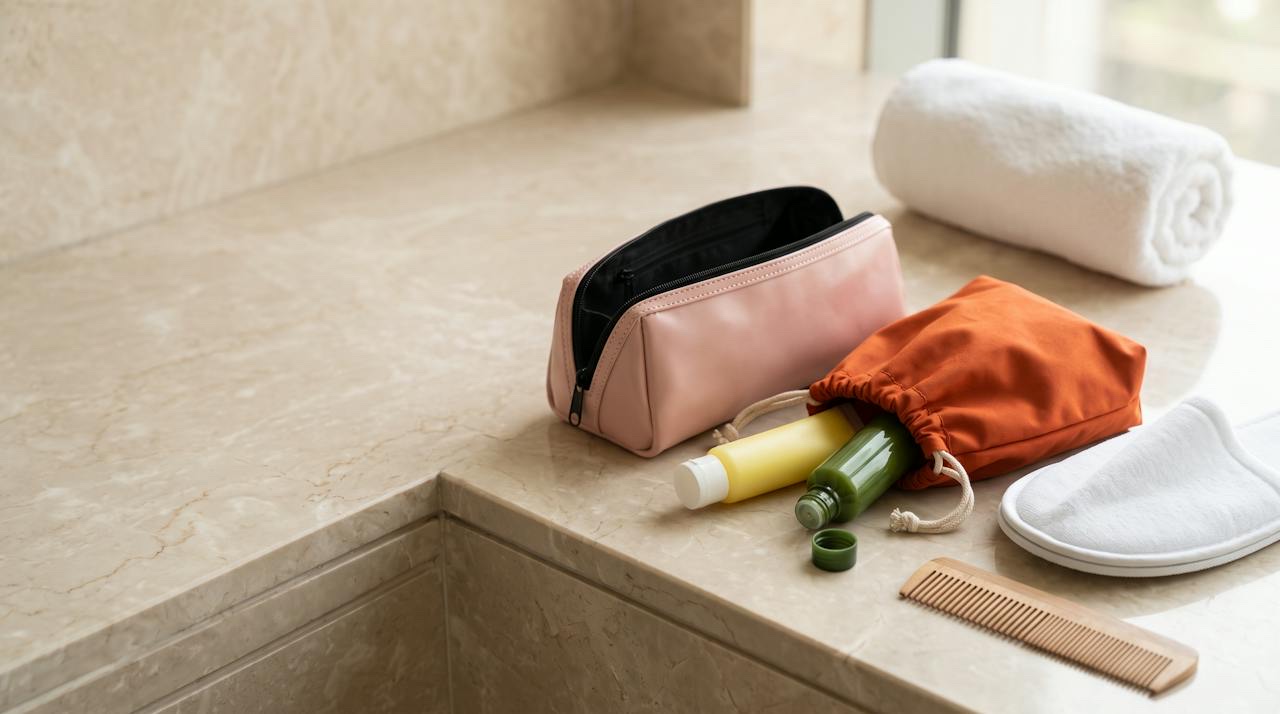
Airline kits and hotel kits solve different problems. A long-haul cabin kit is about getting through a night in a seat: eye mask, socks, ear plugs, a dental set, lip balm. A hotel or resort kit is about the bathroom — soap, shampoo, conditioner, lotion, a shower cap — or, increasingly, about what the guest takes home.
The contents list drives the bag, not the other way round. A dental set and a folded eye mask want a shallow, wide envelope. Bottles want depth and a base that stands. Ask for the finished contents list and a photograph of the items laid flat before anyone draws a pattern.
Equally important is what the kit does after the flight or the stay. Kits designed to be kept are specified like retail product: better zips, a lining, a properly finished label. Kits surrendered at the door are specified for cost and recyclability. These are opposite briefs.
The four bag formats, and when each one wins
The zip pouch is the default for premium cabins and keepable hotel sets. It closes securely, protects contents in transit and is the format most likely to be reused. It also costs most to make and adds a metal or plastic component to the recycling conversation.
The drawstring bag is simple, packs flat and reads as casual and sustainable. It suits cotton, canvas and recycled fabrics and forgives contents of uneven shape. It protects nothing and will not stand up on a shelf.
The flat folder or envelope — a fold-over with a snap, hook-and-loop or magnet closure — is the thin, elegant answer for a dental set, an eye mask and socks. It uses the least material and photographs well, but holds almost nothing bulky.
Hard or semi-rigid cases (moulded EVA, a boxed shell with a board base) suit collectables, licensed character pieces and keepsakes. They are heaviest, costliest to ship and least forgiving of a late contents change.
Materials: what hospitality buyers now ask for
Recycled polyester from post-consumer bottles (rPET) is now the default request in hospitality and aviation alike, because it tells a simple story on a hangtag and behaves much like the virgin polyester it replaces. Cotton and organic cotton canvas compete for drawstring and tote formats.
Beyond the headline fibre, the practical questions decide whether the kit works: does the fabric need a coating to resist a leaking bottle? Does a second lining material complicate a single-material recycling claim? Our notes on nylon versus rPET for cosmetic pouches and rPET versus cotton canvas cover the trade-offs.
Whatever the fibre, the claim on the hangtag attracts the scrutiny. Recycled content is normally supported through chain-of-custody certification and transaction documents, not a supplier's word — see our guide to verifying a recycled material claim.
The rules that are rewriting the contents list
Hospitality kits are being reshaped by packaging law rather than textile law. In California, Assembly Bill 1162 prohibits lodging establishments from providing shampoo, hair conditioner or bath soap in non-reusable plastic containers under six ounces in guest rooms and shared bathrooms — from 1 January 2023 for larger properties, 1 January 2024 for smaller ones.
The European Union has gone further. Under Regulation (EU) 2025/40 on packaging and packaging waste, Annex V restricts single-use packaging for cosmetic, hygiene and toiletry products in the accommodation sector where it is intended for an individual booking and discarded before the next guest arrives; those restrictions apply from 1 January 2030.
Many hotel groups have also signed the Global Tourism Plastics Initiative, led by UN Tourism and UNEP with the Ellen MacArthur Foundation, whose signatories commit to eliminating problematic or unnecessary plastic packaging and moving towards reuse models.
None of this bans the amenity bag. It pushes miniature bottles out and pulls other things in — solid bars, refillables, and a bag expected to be kept rather than binned. If your brief still assumes four plastic bottles in a zip pouch, check the markets it ships to.
Aviation has its own constraints
Airlines face a waste problem hotels do not. IATA's Sustainable Cabin programme lists amenity kits alongside textiles, headsets and bottles among the cabin items in the waste stream handled by cleaners and caterers on the airline's behalf.
International Catering Waste rules complicate it further. IATA's report on international catering waste notes that many countries require catering waste from international flights to be incinerated, sterilized or deep-buried to protect agriculture, which in practice blocks reuse and recycling of many items taken off international services.
The blunt consequence: a kit the passenger takes home gets recycled, a kit left in the seat pocket often does not. Hence the shift towards genuinely keepable pouches, and towards offering kits on request rather than pre-placing them at every seat.
Branding, licensing and approvals
Branding on a kit is small, repeated and unforgiving, and the method interacts with the material: embroidery on thin recycled taffeta needs backing, debossing needs a substrate that holds an impression. Our comparison of embroidery versus debossing is the quickest way through that decision.
Co-branded and licensed kits add an approval layer. Where a kit carries a fashion house, a character or an entertainment property, artwork, colour standards, audit status and usually physical samples must be approved by the licensor before bulk starts — and that chain, not the factory, normally sets the critical path.
Airlines and hotel groups also have brand manuals covering logo placement, clear space and colour references. Supply those with the brief, not after the first sample.
Packing, kitting and the brief itself
A kit is assembled, not merely sewn, and assembly needs its own specification: which items go in, in what orientation, whether the pouch is closed, whether it is poly-bagged, and how finished kits are cartoned and labelled. Components often come from several suppliers, so name who supplies what.
Quality is judged on the assembled unit, so the inspection plan must cover contents and orientation as well as stitching — see setting an AQL inspection plan. The pre-production sample should likewise be a filled kit with its insert and packaging, not a bare pouch; our note on what a PPS actually confirms explains why.
A good brief is short but complete: contents list with dimensions and weights, intended afterlife, target markets, format preference, material and certifications, branding method and brand manual, licensing status, kitting and packing instructions, and the inspection standard.
Working with a manufacturer on a kit programme
ROOTSMEN has made custom cosmetic bags, pouches, travel organizers and promotional and licensed merchandise since 1981, from a Taipei base with its own factory in Guangdong since 1993, and is certified to FAMA (Disney), ISO 9001, SMETA, GMP and BSCI.
If you are shaping an amenity kit or travel set, send the contents list and the markets it will ship to; format, material and branding follow. Representative formats sit under travel accessories and cosmetic bags, or get in touch.
| Format | Best for | Protection | Likely to be kept | Watch out for |
|---|---|---|---|---|
| Zip pouch | Premium cabin kits, keepable hotel sets | High | High | Zip quality and the recyclability of a mixed-material unit |
| Drawstring bag | Casual, natural-fibre and sustainability-led kits | Low | Medium | No structure; contents shift and the bag will not stand |
| Flat folder / envelope | Dental set, eye mask, socks, thin items | Medium | Low | Very little volume; closure choice affects feel |
| Hard or semi-rigid case | Collectable, licensed or keepsake kits | Highest | High | Weight, shipping volume and low tolerance for contents changes |
Event Details
From the Stand
Frequently Asked Questions
The questions this topic actually raises when a program is being scoped.
A hotel kit is built around bathroom and room products and increasingly around what the guest keeps; an airline kit is built around sleeping and comfort in a seat. The airline version also has to answer cabin waste and international catering waste rules that hotels do not face.
It depends on the market. California's AB 1162 prohibits shampoo, conditioner and bath soap in non-reusable plastic containers under six ounces in guest rooms, and the EU packaging regulation restricts single-use cosmetic and toiletry packaging in accommodation from 1 January 2030. Check every destination market before fixing contents.
Choose it from the contents list and the intended afterlife, not from a catalogue. Bulky or bottled contents need a zip pouch; thin items like a dental set and eye mask suit a flat folder; casual sustainability-led programmes suit drawstring; collectables and licensed pieces justify a hard case.
It is the most common request and it performs much like virgin polyester, but the benefit depends on the claim being substantiated and on the kit being kept or recycled rather than binned. Verify recycled content through chain-of-custody documents before printing anything on a hangtag.
Licensed kits add an approval layer ahead of production: artwork, colour standards, factory audit status and usually physical samples go to the licensor for sign-off. That approval chain often sets the critical path, so declare any licensor at the briefing stage rather than after samples.
Send the finished contents list with item dimensions and weights, the markets the kit will ship to, your format and material preferences, any certification required, your brand manual and licensing status, kitting and packing instructions, and the inspection standard. Those inputs cover almost every question development will raise.
Related Products
Builds where this decision applies.

Have a product requirement of your own?
Tell us the product, the quantity and the timeline — we'll scope a development plan.