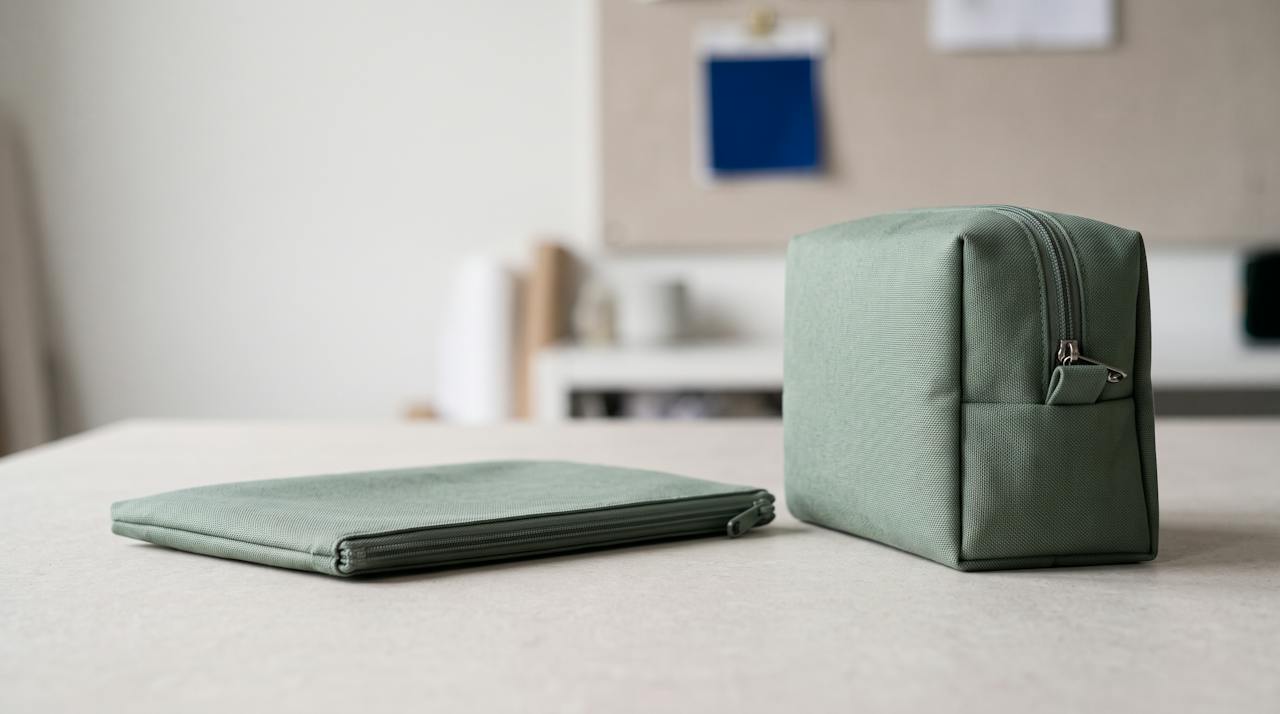
Almost every cosmetic bag brief resolves to one of two constructions. A flat pouch is two panels joined at the edges — it lies flat, it ships flat, and it takes the shape of whatever is inside it. A box pouch has a gusset: extra material that gives it depth and lets it stand up with nothing in it.
Buyers usually arrive having chosen a material and a colour and not having chosen between these two, which is the wrong way round. The construction decides how much material the bag uses, how many operations it takes to sew, whether it needs reinforcement, and what it costs to ship — all before the shell is picked.
What separates them#
A flat pouch is the simplest soft-goods construction there is: two panels, a zip along one edge, seams on the other three. There is no third dimension, so the piece is as deep as whatever is pushed into it.
A box pouch adds depth through a gusset, and the gusset can be made two ways. A boxed corner is made by folding and stitching across the bottom corners of a flat pouch — cheap, quick, and it gives a soft triangular base. A separate gusset panel is a strip of material joined to both faces around the full perimeter, which gives a true rectangular section and a flat base, and costs considerably more because it adds panels and a long seam.
Those three options — flat, boxed corner, separate gusset — are the real choice, and briefs that say only "box pouch" leave the most expensive part of it unspecified.
What each costs to build#
Material consumption rises with the gusset. A separate gusset panel adds surface area roughly in proportion to the bag's perimeter times its depth, which on a mid-size pouch is a meaningful share of the shell.
Sewing time rises faster than material. A flat pouch is a handful of operations. A boxed corner adds two. A separate gusset adds a long perimeter seam on both faces, usually with the piece being turned and handled more, and on a lined build that doubles again.
Structure is the third cost. A box pouch that is supposed to stand up empty needs something holding it there — a heavier shell, an interlining, or a base board — and that is a material and an operation that a flat pouch never needs. Our note on lining and interlining covers which layer does what, and what drives the unit price puts the components in order.
Shipping, and the cost nobody quotes#
Soft goods are usually charged by the space they occupy rather than their weight, so construction is a freight decision as much as a product one. A flat pouch packs almost without air. A box pouch with a rigid base does not, and the difference compounds across a carton, a pallet and a container.
This is where a structured bag quietly costs more than the quotation suggests. Work out how many pieces fit a standard export carton for both constructions before the decision is frozen — our note on sea, air or express freight explains how the space is charged.
Where a structured look is wanted but the freight is not, a boxed corner with a firm interlining is the usual compromise: it reads as a box pouch on shelf and still collapses for packing.
How each one behaves in use#
A flat pouch holds flat things well and loose things badly. Brushes lie down, compacts stack, and a bottle makes the whole bag bulge. It is the right construction for a gift-with-purchase set, a sample kit, or anything that sits inside another bag.
A box pouch holds upright things. A standing 150 ml bottle, a stack of jars, a full daily routine — these need depth and a base that does not tip. It is also the construction that photographs as a product rather than as packaging, which matters on a retail shelf.
The deciding question is not aesthetic: does anything in this bag need to stand up? If yes, it is a box pouch and the depth comes from the contents. If no, a flat pouch will do the job for less. Our note on cosmetic bag sizes covers measuring from the contents.
Where the zip goes, and what it does to the shape#
On a flat pouch the zip runs along the top edge and the construction is settled. On a box pouch there are three common positions and they are not interchangeable.
A top zip straight across is the simplest and the cheapest, and it gives the narrowest opening — the bag has to be squeezed to get a hand in. A zip that wraps around the corners opens much wider and is the one buyers usually mean when they say a bag opens properly; it costs more because the zip is longer and the corners are the hardest part of the sew. A three-sided or horseshoe zip opens the bag almost flat and is the most expensive of the three.
The opening is the single most common complaint on a finished box pouch, and it is decided by this choice rather than by the zip itself. Specify the wrap, not just the zip — our note on choosing a zipper covers the chain, slider and puller separately.
What changes at sampling#
A gusset is where patterns most often need a second round. The depth that looks right on a drawing can be wrong in the hand by five millimetres, and the corner where three seams meet is where thickness stacks and a cheap build shows.
Two checks catch most of it. Load the sample with the real contents and close it — a box pouch that needs force to shut is under-sized in depth, not in width. Then look at the corner: on a separate-gusset build, the seams should meet cleanly with no pleat, and on a boxed corner the triangle should sit flat rather than twisting.
Changing between flat and boxed after the first sample is a new pattern rather than an adjustment, which is why the construction belongs in the brief. Our note on what to check when your first samples arrive sets out the rest.
Deciding, and what to send#
Flat pouch when the contents lie down, the piece ships inside something else, or the programme is cost-led. Boxed corner when it should read as structured on shelf but still pack efficiently. Separate gusset when the bag must stand up empty and hold upright contents, and the budget and the freight can carry it.
Send the contents, the depth you are aiming at, and how the bag opens. Those three settle the construction in one exchange, and the construction settles most of the quotation.
The cosmetic bag range shows both constructions built, with dimensions on each.
| Flat pouch | Boxed corner | Separate gusset | |
|---|---|---|---|
| Stands up empty | No | Partly | Yes |
| Material use | Lowest | Low | Highest |
| Sewing operations | Fewest | Two more | Perimeter seam both faces |
| Needs structure added | No | Sometimes | Usually |
| Packs flat for freight | Yes | Yes | No, if a base board is used |
| Best for | Contents that lie flat | Shelf presence on a budget | Upright bottles and jars |