
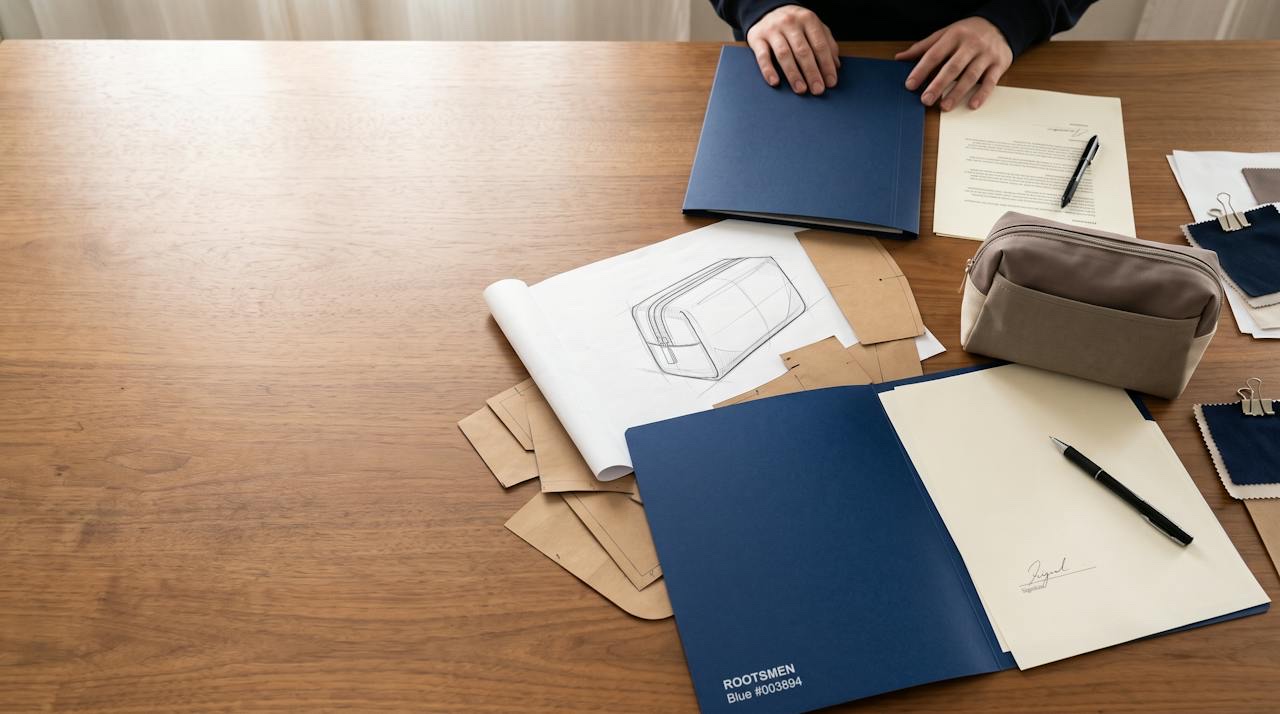
Protecting Your Design When You Work With a Factory
NDAs, pattern ownership, tooling, exclusivity and registered design rights — what to agree before the first sample is cut.
An NDA keeps your files confidential, but it does not decide who owns the pattern, the tooling or the right to the finished look. Agree ownership of patterns, artwork and moulds in writing before sampling, set exclusivity on your style rather than on a material, and register the design and your logo before launch.
You have a sketch, a tech pack and a factory you like. Before the first sample is cut, one question is worth settling: if this bag sells, who owns what? Most brand owners reach for an NDA and stop there. It is a sensible first step, but it answers only one of the questions that matter — and not the one that usually bites.
Soft goods are a copy-friendly category. A cosmetic pouch has no code and no circuit board — its value sits in the shape, the panel breakdown, the hardware and the print. That value is protected by a patchwork: contract, design registration and trade mark. Here is what each one does, and what to put in writing before sampling starts.
An NDA protects information, not appearance
A non-disclosure agreement is a contract. It says that specified information stays confidential, for a defined period, and will not be used for anything other than quoting and producing your programme. A workable one names what counts as confidential (tech packs, artwork, pattern files, costings), says whether subcontractors may see it, sets a survival period, and names a governing law and a forum.
Its limit is built into the word confidential. Once your bag is photographed on a shelf, the appearance is public. An NDA also creates no property: a breach gives you a claim against that factory, not a right you can assert against a third party who copied the product from a store. For the look itself you need a design right, and for the name and logo, a trade mark.
Who owns the pattern?
The pattern is the set of graded panel shapes, seam allowances and marker files from which every unit is cut. It is the most transferable asset in the programme and the one most often left unspoken. If the factory's patternmaker drafts it from your sketch, that factory may reasonably regard the files as its own work product.
Two sentences usually settle it: patterns, graded specifications and digitized artwork created for your styles are your property, and native files are released on request, including at the end of the relationship. Keep the ask proportionate — generic construction know-how, such as how the maker binds a raw edge, is the factory's trade.
Tooling, moulds and dies are a separate line
Bespoke hardware brings physical tooling into the picture: a mould for a custom buckle, an embossing plate, an etched die for debossing, a digitized embroidery file, screens cut for a print. Each lives at a supplier and can be used again.
Ask three questions for every item. Who paid for it? Who owns it? Where is it stored, and can it be transferred? Ownership should follow whoever funded it, and a tooling schedule naming each item, its location and its owner beats a general clause. Decoration routes differ in how much tooling they create — see embroidery versus debossing on soft goods and choosing a print method for gift-with-purchase runs before you commit to a route.
Exclusivity: a style, not a material
Exclusivity requests fail when drawn too wide. You can reasonably ask that your pattern, your artwork, your custom hardware and the finished style are not offered to anyone else. You cannot sensibly ask a factory to stop using a mill's stock recycled polyester, a standard coil zip or a common ripstop weave — those belong to the supply chain, and such a promise is either refused or quietly broken.
Write the scope down: which styles, which markets, for how long, and what happens to branded leftovers such as printed labels, custom pullers and reject units. Disposal of branded seconds matters more than buyers expect — that is how grey-market copies reach a shelf. Material choice is a separate decision — see nylon versus rPET for cosmetic pouches and ripstop nylon versus rPET for travel organizers.
Registered designs and unregistered rights
A design right protects appearance. In the EU, a registered design runs five years from registration and renews in five-year blocks up to twenty-five, while an unregistered EU design arises free on public disclosure, lasts three years, and covers deliberate copying only — not independent creation of something similar — as the Your Europe guidance explains.
The UK runs a similar pair. A registered design lasts five years, renewable to twenty-five, and covers appearance rather than function. Unregistered design right covers the shape and configuration of a three-dimensional object for ten years from the end of the year of first sale or fifteen from creation, whichever ends first, plus a three-year supplementary right in appearance from the date the design is made public. In the United States the equivalent registration is a design patent, covering the ornamental characteristics of an article — shape, surface ornamentation, or both — rather than how it works. For several markets at once, WIPO's Hague System takes a single international application covering designated member countries.
The practical lesson is sequence. Unregistered rights start running the moment you show the product, and they are the weakest of the set. If a style is worth registering, register it before the launch photograph.
Trade marks cover the logo, not the bag
A trade mark is a different instrument. The USPTO describes it as any word, phrase, symbol or design that identifies the source of goods or services, and notes that rights attach to the mark for those specific goods, not to the word in the abstract. Use creates limited rights; registration gives you something far easier to enforce.
For a cosmetic bag this matters twice over. Your logo, woven label and hangtag should sit under a registration covering bags and cases in the relevant classes. And if the artwork is licensed, the licence sets what may be made, where it may be sold and which factories are authorized to make it.
What to put in writing before sampling
Almost all of this can be settled in a short development agreement signed alongside the NDA, before a panel is cut. Cover: ownership of patterns, graded specs and digitized artwork; a tooling schedule naming each mould, plate and screen; exclusivity scope with markets and duration; a flow-down clause binding subcontractors; disposal of branded components, samples and rejects; and whether the factory may show your product in its own marketing.
Then tie it to the technical process. The pre-production sample is the record of what the approved design actually is, and an AQL inspection plan defines what counts as a reject that must not reach a market. Choosing the partner well matters more than any clause — see choosing an OEM/ODM partner.
Working with a maker that expects these questions
A factory used to brand programmes will not find any of this awkward. ROOTSMEN has built custom cosmetic bags, pouches, travel organizers and promotional pieces since 1981, with its own factory in Guangdong since 1993. Its audited certifications — FAMA for Disney licensed work, ISO 9001, SMETA, GMP and BSCI — exist precisely because licensors and retailers expect documented control over what is made and what happens to it.
Bring the design questions and the commercial questions to the same conversation. Talk to us about your styles, or see what we build for cosmetic bags and promotional and gift-with-purchase projects.
| Instrument | What it covers | How you get it | Typical term |
|---|---|---|---|
| NDA / development agreement | Confidential files, pattern and tooling ownership, exclusivity | Signed contract with the factory | As agreed, plus a survival period |
| Registered EU design | Appearance of the product | Application to the EU office | 5 years, renewable to 25 |
| Unregistered EU design | Appearance, against deliberate copying only | Arises automatically on public disclosure in the EU | 3 years, no renewal |
| UK registered design | Appearance, not function | Application to the UK office | 5 years, renewable to 25 |
| UK unregistered design right | Shape and configuration of a 3D object | Arises automatically | 10 years from first sale or 15 from creation, whichever ends first |
| US design patent | Ornamental characteristics of an article | Application to the USPTO | Set by statute; check current term before filing |
| Trade mark | Logo, name or symbol identifying the source | Use, with far stronger rights on registration | Renewable indefinitely while in use |
Event Details
From the Stand
Frequently Asked Questions
The questions this topic actually raises when a program is being scoped.
No. An NDA protects confidential information and gives you a claim against that factory if it leaks. It does not give you ownership of the pattern, the tooling or the appearance of the product, and it stops working once the bag is publicly on sale. Pair it with a development agreement and a design registration.
Whoever your contract says. If nothing is written, a factory whose patternmaker drafted the pattern may treat those files as its own work product. State in the development agreement that patterns, graded specifications and digitized artwork for your styles belong to you and are released on request.
Only if the agreement says so. Payment for tooling and ownership of tooling are separate points, and moulds physically live at the supplier. List every mould, embossing plate, screen and embroidery file in a tooling schedule with its location, owner and whether it can be transferred elsewhere.
Usually not, and it is the wrong thing to ask for. Stock materials such as recycled polyester, ripstop nylon or standard coil zips belong to the supply chain. Ask instead for exclusivity on your pattern, your artwork, your custom hardware and the finished style, with markets and a duration written down.
Before, wherever the style matters commercially. Unregistered rights start running from public disclosure and, in the EU, cover deliberate copying only, for three years. A registered design in the EU or UK runs five years and is renewable to twenty-five, which is a far stronger position against a copyist.
Generally no. A trade mark protects the logo, name or symbol that identifies the source of your goods, for the goods it is registered for. The bag's appearance is the job of a design registration. Most brands need both: a trade mark for the mark, a design right for the look.
Related Products
Builds where this decision applies.

Have a product requirement of your own?
Tell us the product, the quantity and the timeline — we'll scope a development plan.