Ask three suppliers for an "OEM quotation" and you will get three different products back. The words are used loosely across the bag industry, and the loose use is not harmless: the difference between them is who designed the product, who owns the pattern, and whether anyone else can buy the same thing next season.
The short version: OEM means you bring the design. ODM means the factory brings it. Private label describes whose name is on it. White label means the same stock product is sold to several brands. They answer different questions, which is why a programme can be OEM and private label at the same time.
OEM: you bring the design#
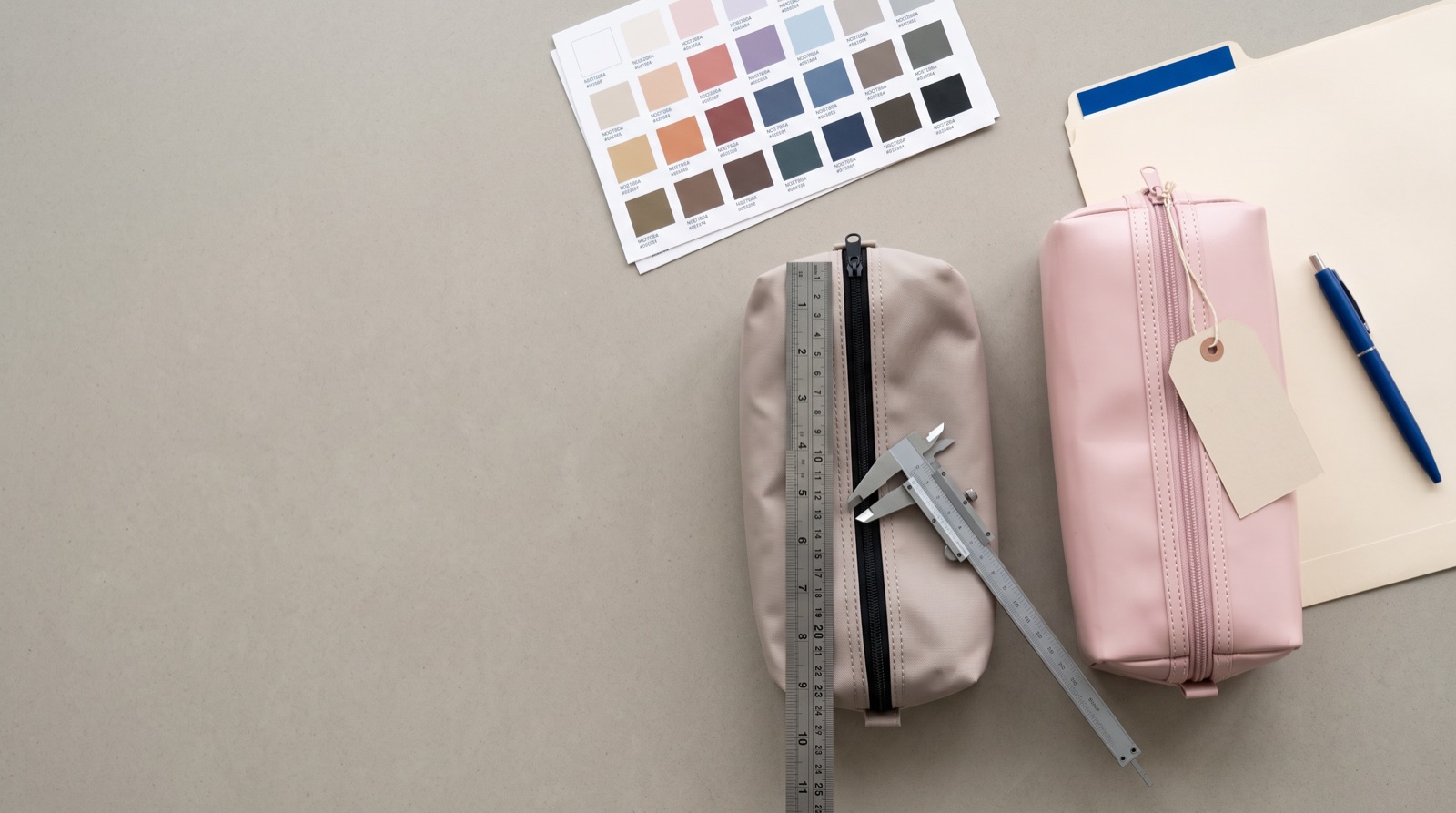
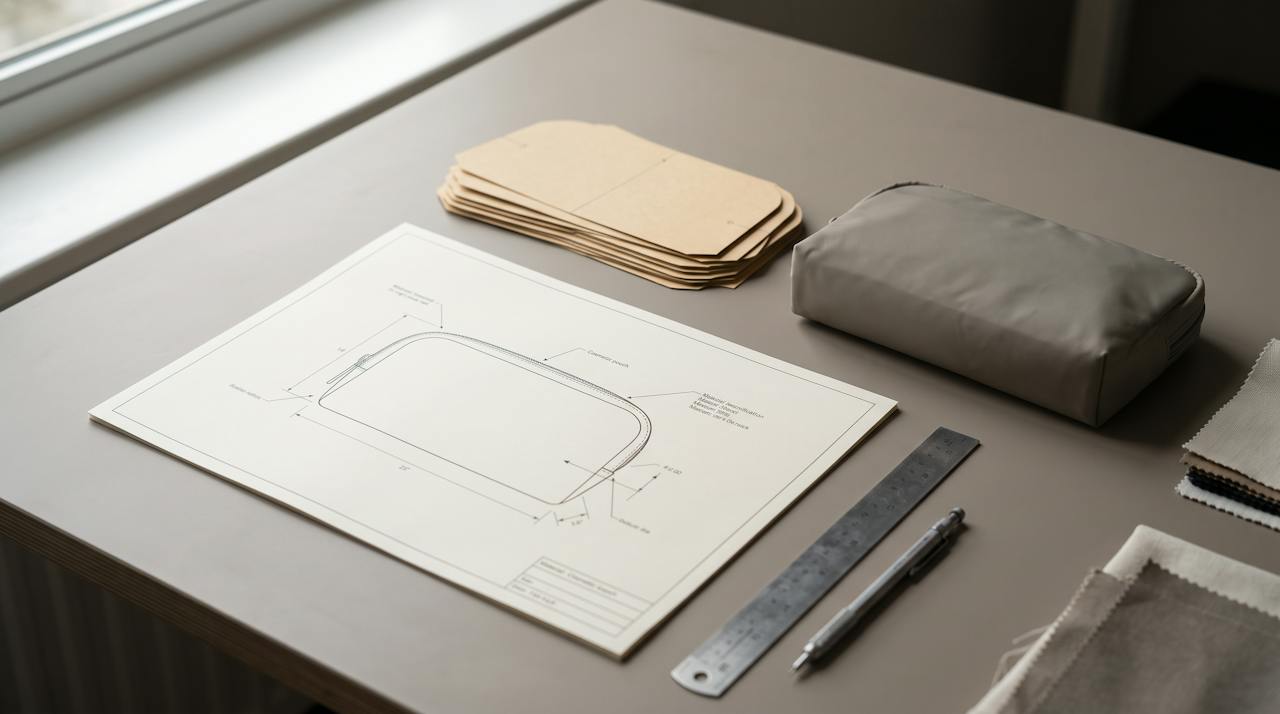
OEM stands for original equipment manufacturer. In soft goods it means the buyer supplies the design — drawings, a tech pack, a reference sample, or all three — and the factory engineers and builds it.
The factory's work here is real and is often underestimated: turning a drawing into a pattern, choosing a construction sequence a line can actually run, sourcing hardware that exists in the quantity you need. But the product concept is yours, and that is what decides the ownership questions further down.
This is the route for a brand with a point of view about the product. It costs more at the front — development takes rounds — and it produces something no competitor can order.
ODM: the factory brings the design#
ODM stands for original design manufacturer. The factory already has the design, usually as a developed style in its own library, and the buyer adapts it: colours, materials, dimensions within limits, branding.
This is faster and cheaper, because the pattern exists, the construction is proven and the sampling round that usually finds the problems has already happened on someone else's programme. For a first order, a test market or a gift-with-purchase that has to land on a date, that speed is worth a great deal.
The trade-off is exclusivity. Unless it is agreed in writing, an ODM style stays in the factory's library and can be offered to anyone else. That is not sharp practice — it is the definition of the model — but it surprises brands who assumed otherwise.
Private label: whose name is on it#
Private label describes the branding, not the development. The product is made by one company and sold under another company's name. It says nothing about who designed it.
So a private-label programme can be OEM (your design, your name) or ODM (their design, your name). Both are normal. The confusion arises when a buyer hears "private label" and assumes it implies exclusivity — it does not, on its own.
If exclusivity matters, it is a separate clause: which style, in which markets, for how long, and at what volume commitment. Our note on protecting your design when working with a factory covers what to agree and when.
White label: the same product, several brands#
White label is a stock product sold, essentially unchanged, to multiple buyers who each put their own name on it. Customisation is usually limited to the logo and sometimes the colour.
It has real uses — a conference giveaway, a filler item in a kit, a first test of whether a category sells at all. It is the cheapest and fastest route by a distance, because nothing is developed.
It is the wrong route if the product is meant to represent the brand, because by design it does not. If a buyer picks up your pouch and has seen the identical pouch under another name, the money spent on branding it has worked against you.
Which model owns the pattern#
This is the question the four words exist to answer, and it is worth asking explicitly rather than inferring.
On an OEM build, the buyer normally owns the design; whether they own the pattern — the graded set of pieces a factory cuts from — is a separate matter and often is not addressed at all. The pattern is the factory's engineering of your design, and without a written term it typically stays with them. That is the practical difference between being able to move production and not.
On an ODM build, the design and the pattern are the factory's. A buyer can usually own the specific adaptation — their colourway, their dimensions, their trims — without owning the base style. Both positions are workable, but only if everyone is describing the same one.
Tooling is the third piece: dies for a debossed mark, moulds for custom hardware, screens for a print. These are usually paid for by the buyer and held by the factory, and whether they can be released is a question worth asking before they are cut.
How the models price differently#
OEM carries development cost that ODM does not. Pattern making, several sample rounds, sourcing for components that may have their own minimums — that work happens once, before a single unit is sold, and it is the honest reason an OEM quotation looks worse than an ODM one at the same unit price.
ODM moves that cost into the past. The style exists, so the quotation is closer to pure production. What it does not remove is the cost of your changes: a different size is a new pattern, and at that point some of the OEM development has quietly come back.
White label has almost no development cost and almost no flexibility. Its price advantage is real and it disappears the moment you ask for anything.
Across all three, the components that move the unit price are the same — material, construction, decoration, packing. Our note on what drives the unit price works through them.
Choosing the model before you choose the supplier#
Decide this before sending the enquiry, because it changes who you should be talking to. A factory with a strong ODM library and a factory set up for development work are not the same business, and asking one to behave like the other wastes both sides' time.
A usable test: if the product were made perfectly but arrived unbranded, would you still recognise it as yours? If yes, the programme is OEM and should be scoped as one. If no, ODM will get you there faster and cheaper, and the exclusivity question becomes the one that matters.
Our note on how to choose an OEM/ODM bag manufacturer covers vetting once the model is settled, and launching a private-label line covers the full sequence.
What to put in the enquiry#
Say which model you are asking for, and say what you are bringing. "We have a tech pack and a reference sample" and "we would like to see what you already make" lead to different, and equally useful, conversations — but only if you say which one.
Ask three ownership questions in the first exchange rather than the last: who owns the pattern, whether the style is exclusive and on what terms, and who holds any tooling. None of them is awkward at enquiry stage. All of them are awkward after the first order.
ROOTSMEN works on both OEM and ODM programmes — bringing your own design, or adapting a developed build. Which one fits is worth settling in the first conversation. See the product range for where each typically starts.
| OEM | ODM | White label | |
|---|---|---|---|
| Who designs it | You | The factory | The factory |
| Who normally owns the pattern | Negotiable; agree it in writing | The factory | The factory |
| Exclusive by default | Yes, to your design | No | No |
| Development cost | Highest | Moderate | None |
| Speed to first order | Slowest | Faster | Fastest |
| Best when | The product is the brand | Speed and a fixed date matter | The item is a filler or a test |