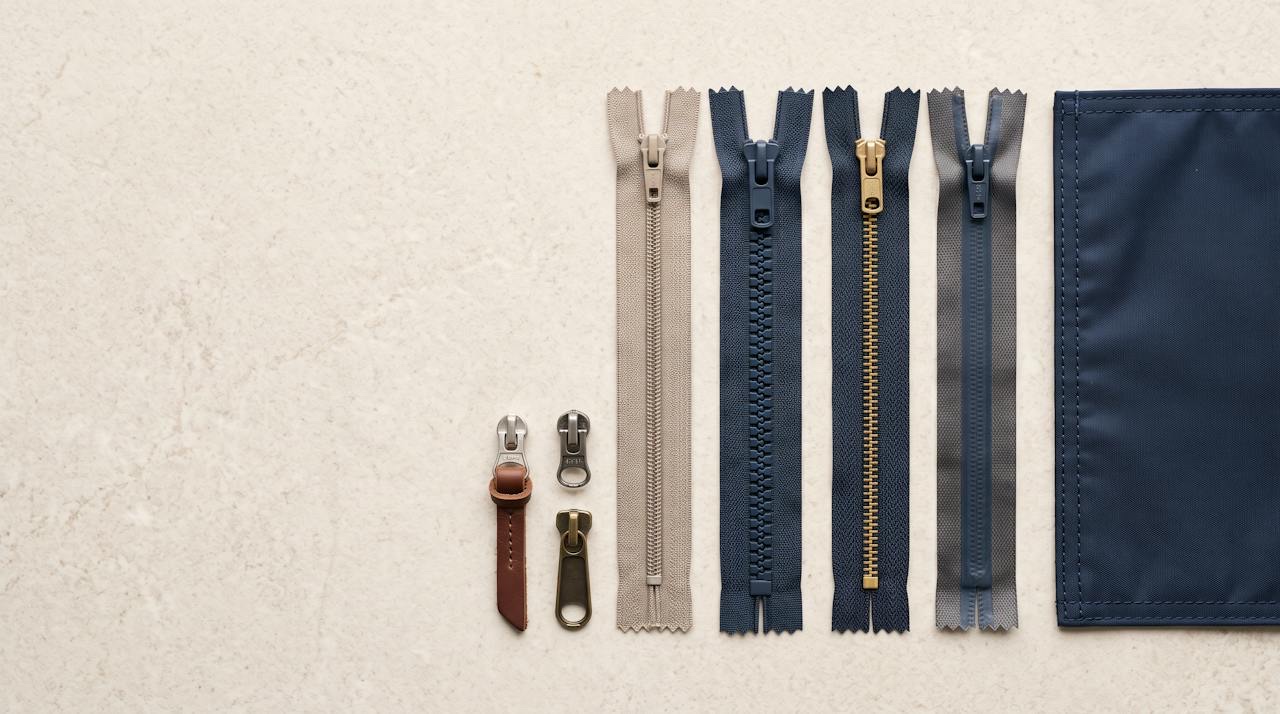
Our general note on choosing a zipper for a cosmetic bag covers element types, sliders and pullers. This note narrows to one line on the tech pack — the gauge — and to the two products where buyers most often get it wrong: the small cosmetic pouch and the wash bag.
The two look similar on a range board. On the bathroom shelf they are not. A wash bag is filled with heavier bottles, opened wet, often hung by its handle and packed to the limit before a trip. A cosmetic pouch carries lighter items and is opened many times a day.
What the gauge number actually measures#
The number on a zipper — #3, #5, #8 — refers to the width of the chain when the teeth are engaged. YKK's fastening catalogue states that zippers "are classified according to their chain width (i.e. the width of the engaged elements)", and YKK's Japanese product pages describe size the same way.
The number is a class, not an exact measurement. YKK groups its products into the JIS chain-width bands shown in the table at the end of this note. A #5 coil from one maker and a #5 coil from another sit in the same band but may differ slightly, which is why sliders and chain must come from the same system.
The strength each class is designed for#
Larger classes are built for higher loads. The Japanese standard for slide fasteners, JIS S 3015:2019, sets minimum strength values by class for chain crosswise strength, top- and bottom-stop strength, slider strength and slider lock, and YKK states that its standard zippers meet them. For continuous-element (coil) zippers on synthetic-fibre tape, the minimum chain crosswise strength rises from 250 N for Light to 450 N for Medium and 540 N for Medium-Heavy.
Crosswise strength is the load that pulls the two sides of the closed chain apart — exactly what an overfilled bag does. YKK also warns that "trying to forcibly close the zipper of an overfilled bag will cause element and tape breakage", so the gauge has to be chosen for the realistic fill, not the photographed one.
Cosmetic pouches: when #3 is enough and when to move to #5#
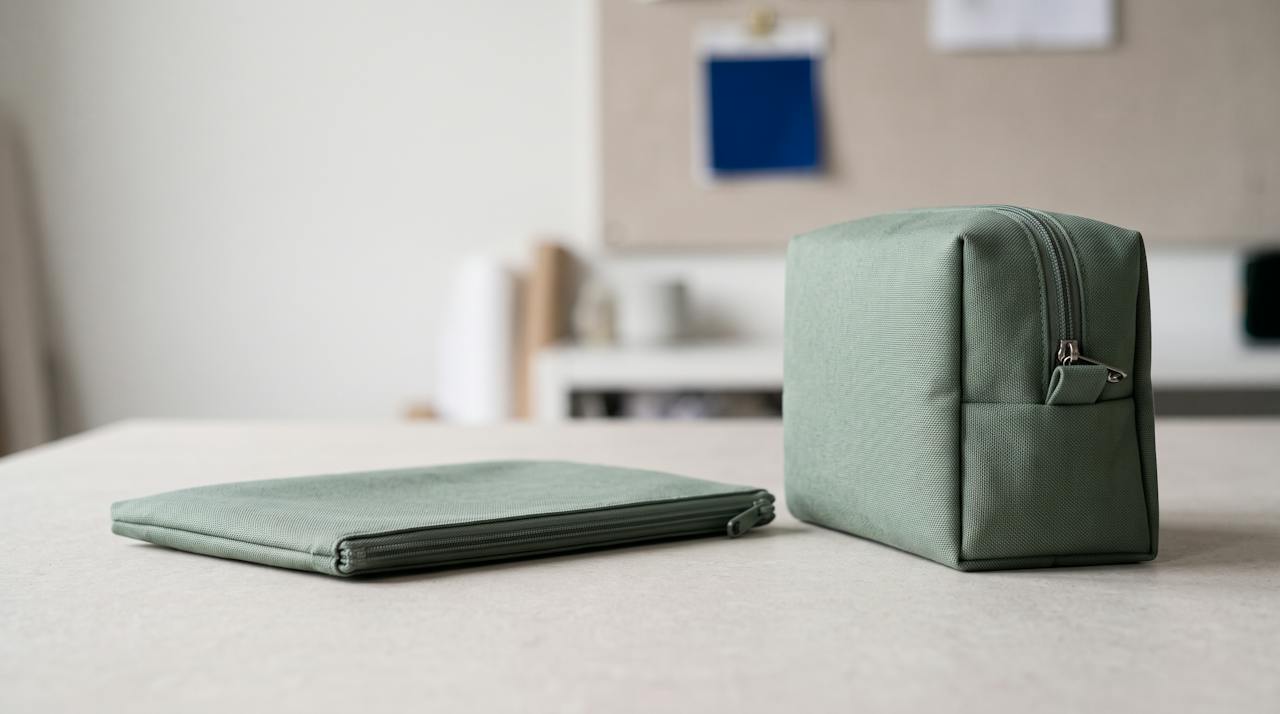
A flat pouch with a short top opening, carrying lipsticks, a compact and a few brushes, puts little crosswise load on the chain. A #3 coil is common here: it is light, flexible on a gentle curve and proportionate to a small pouch. Our note on cosmetic bag sizes helps match the opening to the contents.
Move to #5 when the pouch is boxed, when the opening runs around a corner or down the sides, or when the contents are heavier — full-size bottles, palettes, hairbrushes. A boxed pouch filled to its gusset pushes outward along the whole chain, and the slider on a #3 has less margin. See box pouch versus flat pouch for how the construction changes the load.
Wash bags: why #5 is the usual starting point#
Wash bags carry liquids in rigid bottles, which concentrate load at the corners of the opening. They are also opened with wet or soapy hands, so the puller has to be easy to grip. For a standard zip-top or dopp-style wash bag, #5 is the usual starting point.
Opening shape matters as much as size. A straight top opening shares the load evenly along the chain; a U-shaped or three-sided opening concentrates it at the turns, where the slider also has to follow the curve. On those designs, check the corner radius with the factory before fixing the gauge.
Move to #8 when the bag is large, when it hangs by a hook so that its weight pulls against the opening, or when it is a travel bag that will be packed tight; our note on hanging toiletry organisers covers the hanging case. The trade-off is weight and stiffness on tight curves, so a larger class is not automatically better.
Water-repellent zippers: what they do and where they do not work#
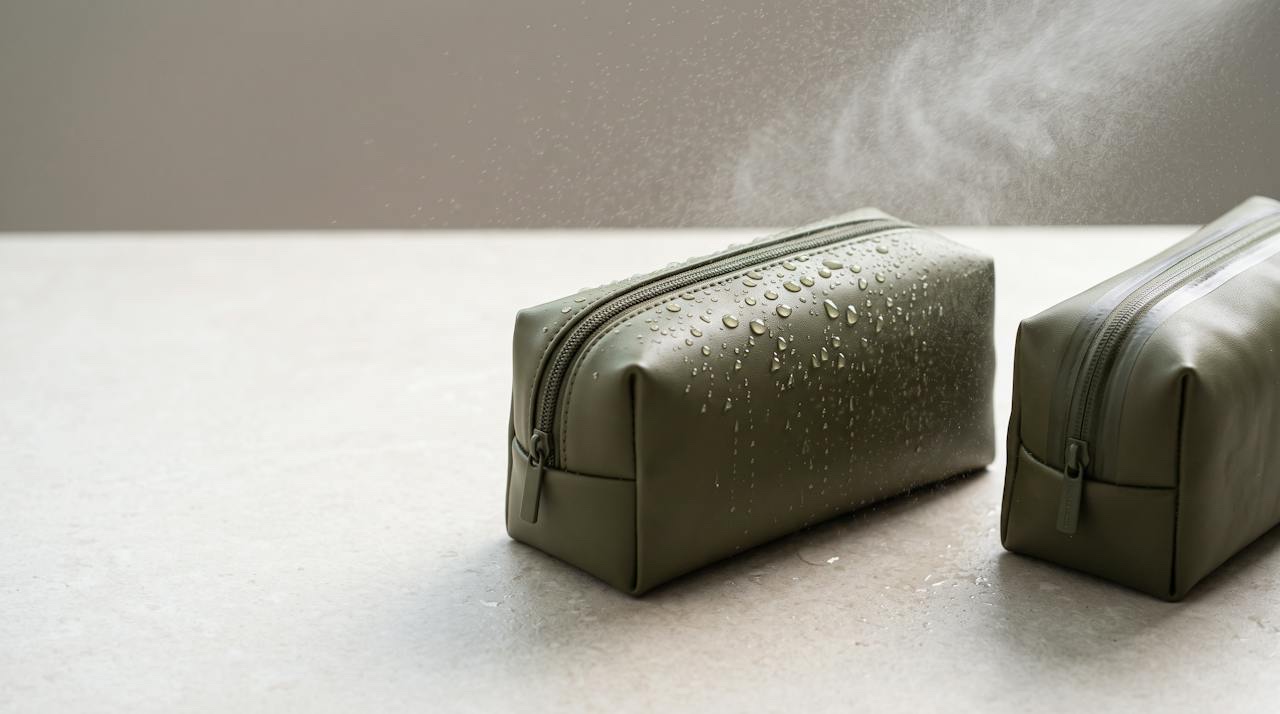
Wash bags are often specified with a water-repellent zipper. YKK's own care guidance is explicit that VISLON AquaGuard is "water repellent, not waterproof/watertight", and that AQUASEAL is the waterproof product. If the brief says "waterproof", the zipper alone cannot deliver it; our note on waterproof versus water-repellent wash bags covers the full construction.
The same guidance carries limits that matter for wash bags specifically. VISLON AquaGuard should not be used in curved applications, because the slider can cut the tape. Contact with vinyl — PVC and some PU-coated fabrics, both common on wash bags — should be avoided. UV can yellow the PU film, and the zipper should not be ironed.
For the EU market, check finishes as well as construction. From 10 October 2026, REACH Annex XVII entry 79 restricts PFHxA and related substances in textiles in clothing and related accessories, such as handbags, per homogeneous material, with other consumer textiles following from 10 October 2027, so ask for test evidence on any water-repellent tape or fabric finish.
Slider, puller and stops: sized with the chain#
The slider has to match the chain's class and system; a #5 slider will not run correctly on a #3 chain. Lock type follows use: YKK describes pin-lock sliders for applications such as purses and bedding, and auto-lock sliders for garments and furniture.
Pullers are where the user's hand meets the load. On a wash bag a larger, grippable puller — or a cord loop — is easier to use with wet hands. YKK's guidance for its waterproof AQUASEAL zipper also warns that angular pulling can cause the elements to mis-engage. Top and bottom stops take load when the bag is opened fully, so they belong in the test plan too.
Testing a zipper before bulk#
ASTM D2061 sets out strength tests for zippers: chain crosswise strength, slider pull-off, holding strength of stops, slider lock and twist. Ask the factory or the zipper maker which tests they run, and to which values. Write the method and the minimum value into the specification, then classify a zipper failure as a major defect in the inspection plan; see setting an AQL inspection plan.
Do one practical check at sample stage: fill the pouch or wash bag with the real contents, close it, and look at the corners of the opening. If the chain bows or the slider labours, step up one class or redesign the opening.
Writing the zipper line on the tech pack#
A complete zipper line states the maker, the element type, the gauge, the tape colour, the slider type and finish, the puller, the opening length and the test requirement. "Nylon zip" leaves the factory to choose; "#5 coil, matched tape colour, pin-lock slider, custom puller, test to ASTM D2061" does not. Our note on writing a tech pack for a cosmetic bag shows where the line sits.
| Gauge (YKK) | JIS class and chain width | Cosmetic pouch | Wash bag | Watch for |
|---|---|---|---|---|
| #3 | Light, 4.0 to under 5.5 mm | Flat or small pouch, short top opening | Small zip-top only | Little margin when boxed or overfilled |
| #5 | Medium, 5.5 to under 7.0 mm | Boxed pouch, wrap-around opening, heavier contents | Standard zip-top or dopp-style | Check curve radius with water-repellent tape |
| #8 | Medium-Heavy, 7.0 to under 8.5 mm | Rarely needed | Large, hanging or tightly packed travel bag | Weight and stiffness on tight curves |
---
Sources#
- YKK Americas — Fastening Catalogue (JIS chain-width classes; "classified according to their chain width"; strength standards based on JIS S 3015:2019 — the catalogue's table header misprints it as "JIS-S2015"; overfill precaution). https://ykkamericas.com/wp-content/uploads/2021/10/FasteningCatalogue_update20220120.pdf (official — manufacturer)
- YKK Fastening (Japan) — About products: size. https://lyncs.ykkfastening.com/shop/pages/about_products_03.aspx (official — manufacturer)
- YKK Americas — Caring for AquaGuard and AquaSeal zippers. https://ykkamericas.com/caring-for-aquaguard-and-aquaseal-zippers/ (official — manufacturer)
- YKK Americas — Difference between pin-lock sliders and auto-lock sliders. https://ykkamericas.com/difference-between-pin-lock-sliders-and-auto-lock-sliders/ (official — manufacturer)
- ASTM D2061-07(2021) Standard Test Methods for Strength Tests for Zippers. https://store.astm.org/d2061-07r21.html (official — standards body)
- Commission Regulation (EU) 2024/2462 — REACH Annex XVII entry 79 (PFHxA). https://eur-lex.europa.eu/eli/reg/2024/2462/oj/eng (official)
- YKK Fastening (Japan) — Strength standards (JIS S 3015:2019), chain crosswise strength table. https://lyncs.ykkfastening.com/shop/pages/about_products_07.aspx (official — manufacturer)
- Japanese Standards Association — JIS S 3015:2019 Slide fasteners. https://webdesk.jsa.or.jp/books/W11M0090/index/?bunsyo_id=JIS+S+3015%3A2019 (official — standards body)
- ---