A factory's minimum order quantity is often treated as a single figure to be negotiated down. On a custom cosmetic bag or wash bag it is better understood as a stack: each material, component and process has its own minimum, set by the mill, the trim supplier or the tooling, and the figure on the quotation is usually the highest of them.
This note deliberately gives no figures, and it does not describe any one factory's terms. Minimums are confirmed per style at quotation, and a number taken from a different bag is not a useful benchmark. What a buyer can control is the conversation: which questions to ask, in which order, and before which decision. If you are still comparing factories, our note on comparing two bag factory quotations covers the cost side.
Why an MOQ is a stack of minimums, not one number#
Every bag combines inputs that are bought in different units. Shell fabric is woven and dyed in lots of a given length per colour. Zipper chain is dyed per tape colour. A custom metal puller needs a mould. A printed lining needs screens or a digital set-up. Woven labels are made in reels.
Each supplier sets its own minimum, and the bag's minimum is shaped by whichever is largest relative to the material each bag consumes. A small pouch consumes little fabric per unit, so the fabric minimum can translate into many more bags than the sewing line itself would need.
The first question to ask, therefore, is not "can you go lower?" but "which input is setting this minimum?"
Fabric and colour: where the minimum usually starts#
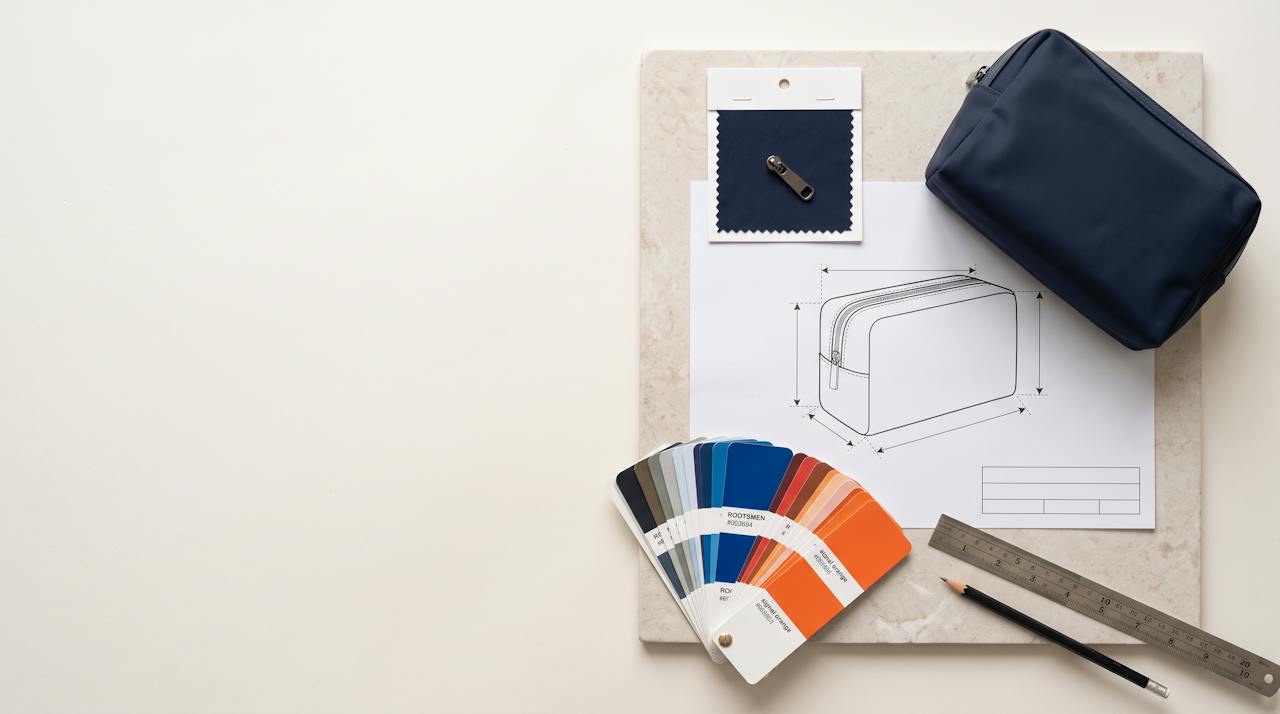
For most soft goods the shell fabric is the controlling input. Ask three things: is the fabric a stock base cloth the mill keeps, or a dedicated construction; is the colour a stock shade or a custom dye; and does the coating, lamination or finish need its own run.
A stock base dyed to a custom colour behaves differently from a fully custom cloth. A custom colour on a recycled base also brings documentation: certified recycled fabric moves with a transaction certificate, and the factory should explain whether one certificate can cover the lot you need. Our note on (/insights/how-to-verify-a-recycled-material-claim-before-you-print-it-on-a-hangtag) covers what those documents show.
Colour approval sits inside this discussion as well. Each additional custom colour is an additional dye lot, an additional lab dip and an additional approval; see lab dips and why colours shift.
Trims and components: zipper, puller, webbing and labels#
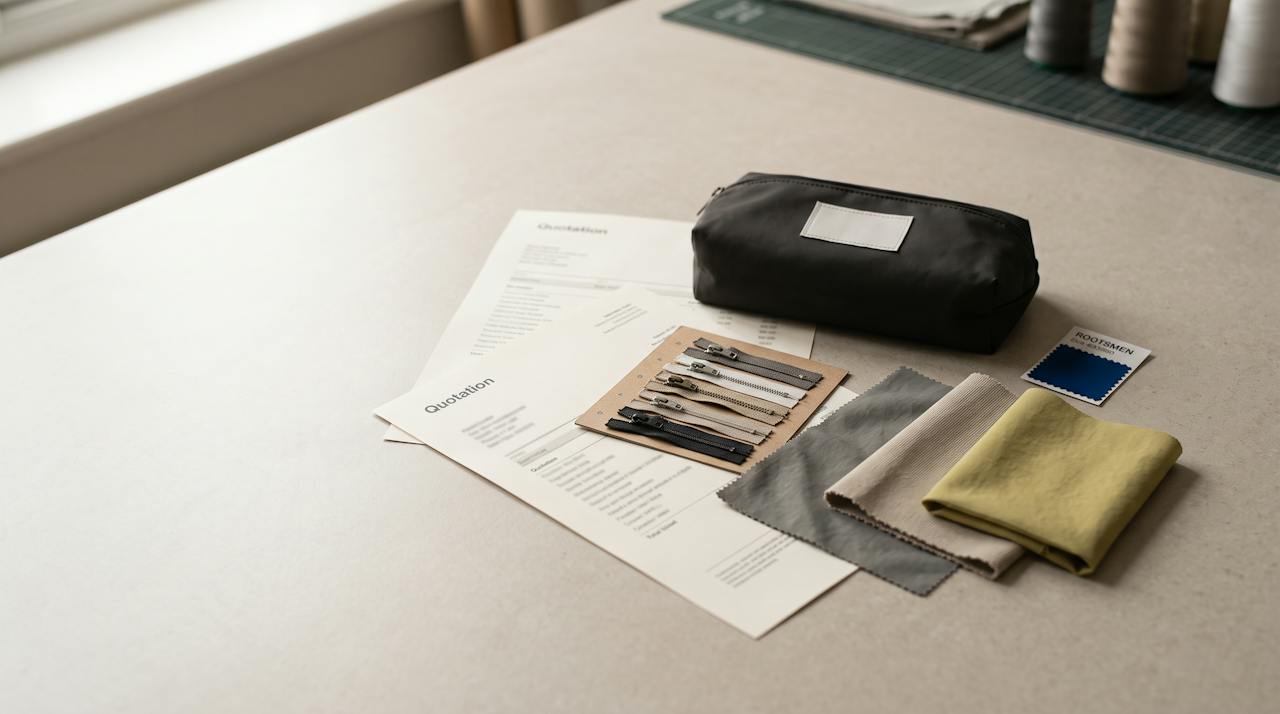
Zippers are the second most common driver. A stock tape colour and a standard slider are one discussion; a custom-dyed tape matched to the shell, a branded puller or a special slider finish are another. Ask whether the zipper brand's minimum applies per colour, per size or per slider type.
Then work through the smaller trims: webbing, binding, cord, metal hardware, woven or printed labels and hangtags. Individually they look minor, but one custom item with a high minimum can set the order quantity for the whole bag. Ask the factory to flag any trim whose minimum exceeds the quantity you are planning.
Decoration and tooling: one-off set-up versus per-unit cost#
Decoration has two parts: a set-up — screens, printing plates, debossing dies, embroidery programming, moulds for rubber or metal badges — and a per-unit process. Set-up costs are fixed whether the order is small or large, so they weigh heavily on small runs.
The useful questions are which tools are one-off, who owns them once paid for, whether they can be reused on a reorder, and whether a different method would remove the tool altogether. Our notes on print methods for GWP runs and embroidery versus debossing compare the options.
Colourways, sizes and how the minimum is split#
Agree how the minimum applies across the range. Is it per style, per colourway, or per size? Can two colourways share the same fabric base and zipper colour, so that only the face fabric changes? Can a family of sizes share trims and decoration tools?
The sewing line has its own logic. Each new style or colourway means changing thread, setting up machines and checking first pieces, so many small runs cost more line time than one longer run. Ask whether colourways that share a construction can run back-to-back on one set-up, and whether the factory treats them as one order or several.
Range architecture is often the most effective way to work within minimums without changing the bag. Fewer distinct materials across more styles generally means fewer separate supplier minimums to meet.
Testing and compliance: minimums you do not see on the quotation#
Testing is charged per material and per test, not per bag, so it behaves like a fixed cost. From 10 October 2026, the EU restriction on PFHxA under REACH Annex XVII entry 79 applies to textiles in clothing and related accessories (the recitals cite handbags as an example), and from 10 October 2027 to other consumer textiles, with limits measured per homogeneous material. A bag with a water-repellent shell, a coated lining and a dyed zipper tape may therefore need several test results, not one. See our note on whether PFAS bans apply to cosmetic bags.
Ask which reports the mill or trim supplier already holds, which the factory must commission, and whether they can be reused across colourways made from the same material.
What locks when the PPS is approved#
The pre-production sample is the reference for bulk. Once it is signed, materials are ordered against it. A change after that point — a different shade, a new puller, an added pocket — can mean a new dye lot, a new trim order or a new tool, each with its own minimum, so settle the MOQ structure before the PPS.
What to agree in writing before you lock the style#
Close the discussion with a short written record. It should cover:
- The element that sets the minimum, and the minimum for each major input
- How the minimum applies per colourway, size and material
- One-off tooling, who owns it, and whether it is reusable on reorders
- Surplus material: who holds it, for how long, and whether it can be used on a reorder
- The agreed tolerance for over- or under-shipment against the ordered quantity
- Which test reports are included, and which are new
- The delivery term, using an Incoterms 2020 rule, so freight and risk are clear
None of this needs a number from a different programme. It needs the factory to show its working on yours.
| Element | Who sets the minimum | What tends to raise it | Question to ask |
|---|---|---|---|
| Shell fabric | Fabric mill / dyehouse | Custom construction, custom colour, special coating or finish | Is this a stock base, and is the minimum per colour? |
| Lining | Fabric mill or printer | Printed or custom-coloured lining | Can the lining be a stock colour across all colourways? |
| Zipper | Zipper manufacturer | Custom tape colour, branded puller, special slider finish | Is the minimum per tape colour, size or slider? |
| Labels and hangtags | Label supplier | Custom weave, special materials, many variants | Can one label serve all colourways? |
| Decoration | Factory or decorator | New screens, plates, dies, moulds | Is the tool one-off, who owns it, is it reusable? |
| Testing | Test laboratory | Each additional homogeneous material | Which reports exist already, which are new? |
| Sewing line | Factory | Complex construction, many small runs | Can colourways run back-to-back on one set-up? |
---
Sources#
- Commission Regulation (EU) 2024/2462 — REACH Annex XVII entry 79 (PFHxA), per homogeneous material; from 10 Oct 2026 for textiles in clothing and related accessories. https://eur-lex.europa.eu/eli/reg/2024/2462/oj/eng (official)
- Textile Exchange — Standards Policy & Resource Updates (transaction certificates; Policy for Scope and Transaction Certificates TE-TXL-POL-203, effective 1 Oct 2026, mandatory 1 Apr 2027). https://hub.textileexchange.org/home/site-wide-content/standards-policy-updates (official)
- ICC — Incoterms® 2020. https://iccwbo.org/business-solutions/incoterms-rules/incoterms-2020/ (official)
- ---