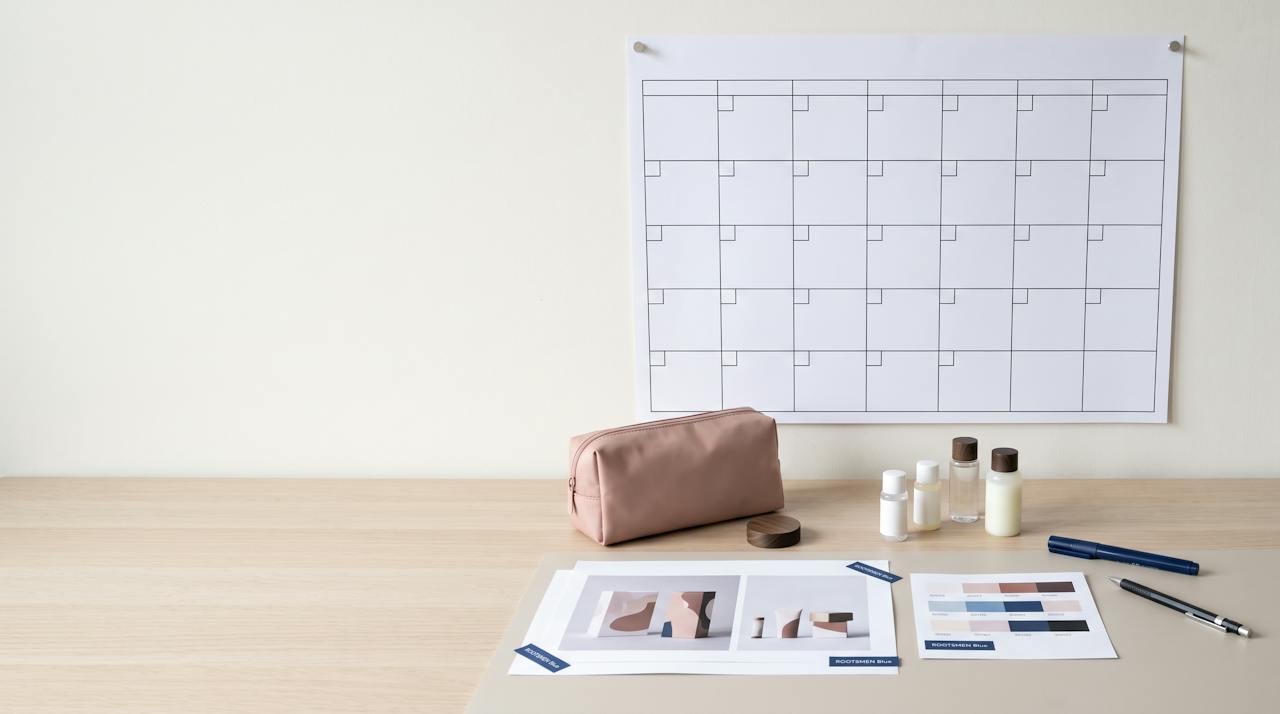
A counter gift-with-purchase pouch has a narrow job. It is handed over at a beauty counter or packed with an online order, it carries a set of minis or a single product, and it should be pleasant enough to keep. It is not a retail bag competing on a shelf, yet it is often briefed with a retail bag as the reference image.
The result is a pouch that costs more, takes longer to develop and uses more material than the programme needs. The fix sits in the brief, before the first sample. Our note on planning a GWP programme around a launch calendar covers timing; this one covers what to write.
What overbuilding looks like on a GWP pouch#
Overbuilding is any feature whose cost or development time is not visible to the customer at the moment of handover. Typical examples are a separately cut gusset where a boxed corner would do, a lining plus a foam interlining on a pouch that carries soft items, a heavier zipper than the load needs, two or three decoration methods on one face, and an individual gift box for an item already handed over in a carrier bag.
Each of these is reasonable on a retail bag. On a GWP pouch, each one adds a material, an approval or a process step — and each additional material is something else to colour-match, test and document.
Start with the contents and the handover#
Write down exactly what goes into the pouch, with the real dimensions of each item, and whether it will be filled at the factory, at a co-packer or at the counter. A pouch that is handed over empty can be packed flat; a pre-filled pouch needs internal dimensions that fit the set without straining the opening.
Size the pouch to the contents, not to the reference bag. Our note on cosmetic bag sizes and dimensions shows how to work back from the items.
State the expected life as well: occasional use in a handbag, daily use, or a travel season. That single line tells the factory how far to build.
Construction: flat, boxed corner or separate gusset#
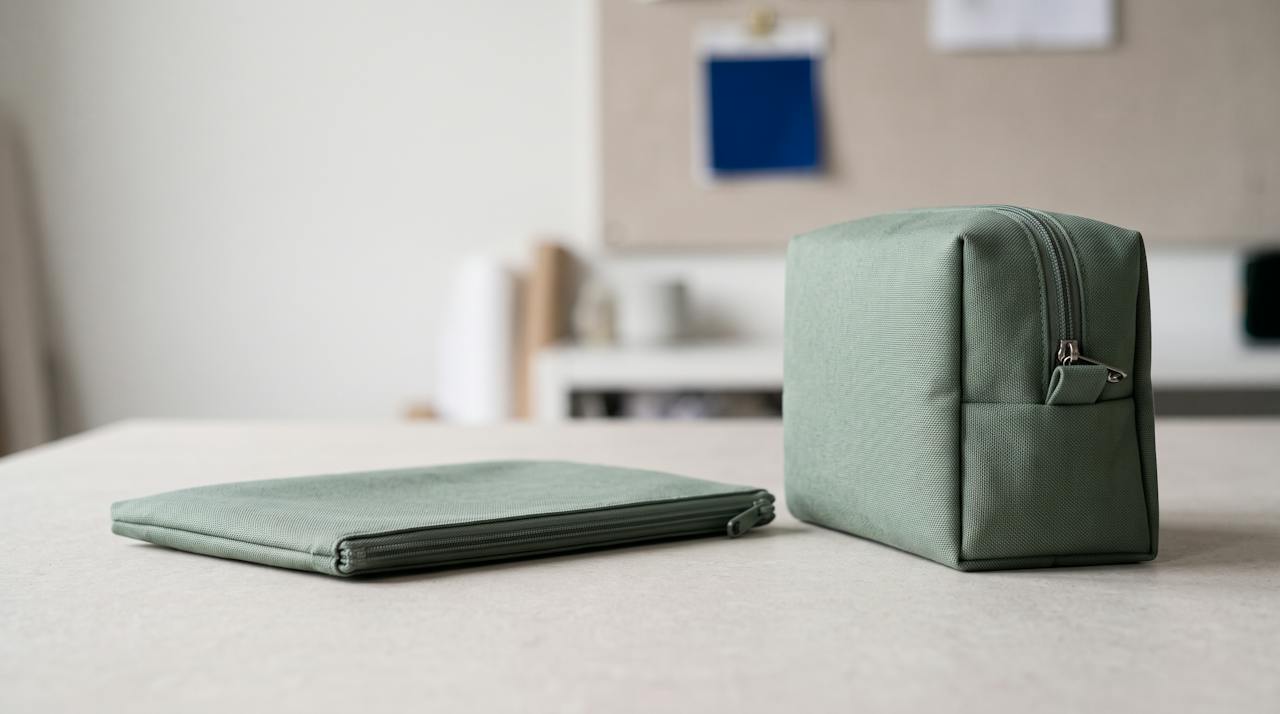
Construction is the largest lever on material use and sewing time. A flat pouch is two panels and a zipper. A boxed-corner pouch adds depth by stitching across the corners of the same panels. A separate gusset adds a cut piece and more seams.
For minis and slim items, a flat or boxed-corner pouch is usually sufficient; a separate gusset is worth it when the pouch needs to stand upright on a counter display or hold taller bottles. See box pouch versus flat pouch for the trade-offs.
If the GWP repeats each season, brief the pattern as a platform. One pattern and one zipper length, refreshed with a new shell colour or print, reuses the approved construction, the tooling and much of the test evidence. A new shape every season restarts development each time.
Shell, lining and interlining: what earns its place#
An unlined pouch in a coated fabric can be appropriate for a GWP — the coating gives body and wipe-clean protection. Add a lining when the inside is visible at handover or the contents could mark the shell. Add an interlining only when the pouch must hold its shape empty.
Each layer is a separate material to source, colour-match and, for EU markets, potentially test. Our note on lining and interlining sets out the options. If the programme carries a recycled message, fewer layers also make the claim simpler, because every component the claim does not cover has to be disclosed.
Zipper and hardware: sized to the load#
A GWP pouch of minis carries a light load. A smaller zipper class with a standard puller is usually enough; YKK's JIS-based classes group #3 as Light, 4.0 to under 5.5 mm chain width. Reserve a heavier class and a custom puller for pouches that will be filled with full-size products or used daily.
A branded metal puller is one of the most common upgrades on a GWP brief. It needs a mould and an approval, and it adds weight. A printed or debossed tab on a stock puller often carries the brand with less development. Our note on choosing a zipper for a cosmetic bag covers puller options.
Decoration: one method, one position#
Pick one decoration method and one main position. Screen print, heat transfer, embroidery and debossing each bring their own set-up and approval; combining them multiplies both. Choose the method that suits the shell — print on smooth coated fabric, deboss on PU, embroidery on canvas or nylon — and approve it on the bulk fabric. See print methods for GWP runs.
Packaging: the PPWR question#
From 12 August 2026, the EU Packaging and Packaging Waste Regulation, Regulation (EU) 2025/40, applies. Its definition of packaging is functional: an item used to contain, protect, handle, deliver or present products, and not integral to the product. The Commission's guidance, C(2026)3702, says dust bags for shoes and garments are packaging when they are intended to contain, protect, handle, deliver or present products to an end user. It also notes that textile sales packaging is exempt from the recyclability requirements under Article 6(11)(g), though other PPWR obligations still apply.
The guidance stresses that each item has to be assessed against that definition. A pouch handed over empty does not contain or present another product; a pouch pre-filled with the products it presents is closer to the dust-bag case. Ask your compliance adviser how your specific format is classified before the brief is final.
Either way, outer packaging is where overbuilding is easiest to remove. A pouch handed over at a counter rarely needs an individual box or polybag; see reducing plastic packaging for bags and pouches.
Claims and the one-page brief#
From 27 September 2026, Directive (EU) 2024/825 prohibits generic environmental claims such as "eco-friendly" unless recognised excellent environmental performance can be demonstrated; a claim specified clearly on the same medium is not generic. If the pouch carries a recycled message, state the material and the share, and keep the transaction certificate on file.
Name the approvers too. A GWP pouch is often signed off by marketing, retail operations and sustainability at different stages, and a late comment from one of them is a common cause of resampling. List who approves the sample, the colour and the claim wording, and in which order.
The brief itself fits on one page: contents and dimensions, handover method, expected life, construction ceiling, shell and lining, zipper class, one decoration method and position, packaging, claim wording and target markets. Sampled against that page, the first round is far more likely to be the right pouch.
| Feature | Retail-bag default | Counter GWP alternative | When the upgrade is worth it |
|---|---|---|---|
| Construction | Separately cut gusset | Flat or boxed-corner panels | Pouch must stand on a display or hold tall bottles |
| Layers | Shell, lining and interlining | Coated shell, lining only if the inside is visible | Pouch must hold its shape empty |
| Zipper | Heavier class, custom metal puller | Lighter class, stock puller with printed or debossed tab | Full-size contents or daily use |
| Decoration | Two or three methods | One method, one position | A collector or limited edition |
| Packaging | Individual box or polybag | Bulk-packed, handed over in the carrier | E-commerce shipping where protection is needed |
| Claim | "Eco" wording | Specific material and share, with certificate | — |
---
Sources#
- Regulation (EU) 2025/40 (PPWR), Art. 3(1)(1) definition of packaging; application from 12 Aug 2026. https://eur-lex.europa.eu/legal-content/EN/TXT/PDF/?uri=OJ%3AL_202500040 (official)
- European Commission — Guidance on the PPWR, C(2026)3702 (dust bags; textile sales packaging). https://eur-lex.europa.eu/legal-content/EN/TXT/?uri=intcom%3AC%282026%293702 (official; dust-bag and Art. 6(11)(g) wording confirmed on EUR-Lex by Owen 2026-11-05)
- European Commission — FAQ on the Packaging and Packaging Waste Regulation (3 Aug 2026). https://environment.ec.europa.eu/publications/faq-packaging-and-packaging-waste-regulation-ppwr_en (official)
- Directive (EU) 2024/825. https://eur-lex.europa.eu/eli/dir/2024/825/oj/eng (official; date confirmed via Commission ECGT FAQ)
- YKK Americas — Fastening Catalogue (JIS chain-width classes). https://ykkamericas.com/wp-content/uploads/2021/10/FasteningCatalogue_update20220120.pdf (official — manufacturer)
- ---