
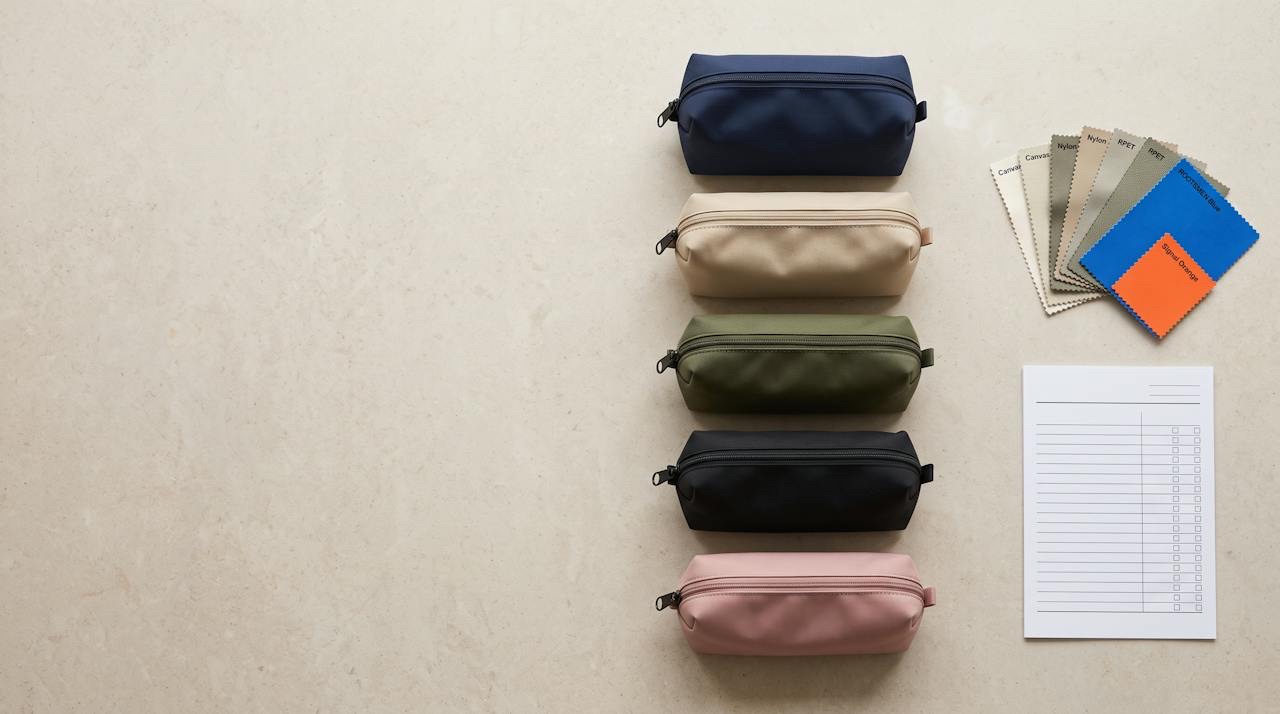
What MOQ Really Means for Custom Cosmetic Bags
Why minimums exist, how they are counted, and what they do to your unit price
MOQ is the smallest quantity a factory can make economically, and for custom cosmetic bags it is almost always counted per style and per colourway rather than per order. It exists because fabric mills dye in fixed lot sizes, trims are ordered in bulk, and printing and cutting setups cost the same whether you make 300 pieces or 3,000.
Almost every custom cosmetic bag enquiry arrives with the same question attached: what is your MOQ? It is a fair question, but on its own it rarely produces a useful answer. Two suppliers can quote the same headline number and mean completely different things — one counting the whole purchase order, the other counting every colour of every style separately.
MOQ is not a policy invented to keep small brands out. It is arithmetic. Fabric is dyed in lots, zips are bought in reels, and a sewing line needs time to learn a new pattern before it produces sellable units. Knowing where each minimum comes from lets you negotiate the ones that are genuinely soft and stop arguing about the ones that are not.
Where the minimum actually comes from
The largest single driver sits upstream of the bag factory. A dyehouse works in batch sizes it cannot usefully split, and filling a vat only partly gives uneven colour. Shade also shifts between batches: as the standard description of dye lots puts it, small differences in temperature and dyeing time produce different shades of the same colour between lots. That is why a mill quotes its minimum in metres per colour, and why splitting one order across two lots is a colour-matching risk rather than a saving.
The same logic repeats downstream in smaller amounts. Custom webbing, custom-coloured zip tape, moulded pullers and metal hardware all carry their own supplier minimums. Screen and transfer printing need screens made once per artwork and colour, and a cutting die is made once per panel shape.
Per style, per colourway, per order — three very different numbers
This is where most misunderstandings start. Per order minimums let you mix freely: 500 pieces total, spread across three styles and four colours, still counts as 500. Per style minimums require each pattern to reach the number on its own. Per colourway minimums — the most common arrangement for custom-dyed goods — require each style-and-colour combination to reach it.
The practical difference is enormous. A three-style, three-colour range at a 500-piece per-colourway minimum is a 4,500-piece commitment, not a 500-piece one. Before comparing quotations, make both suppliers restate their minimum in the same unit.
What a "low MOQ" supplier is really offering
Very low minimums are real, but they are usually bought with a constraint elsewhere. Some suppliers work from stock bodies: an existing pattern in an existing fabric, personalized only with your print or embroidery. That is a decorating service rather than an OEM development, and the silhouette is not yours. Others offer stock fabric only, so you choose from shades already in the warehouse and give up custom colour matching. A third group is trading intermediaries who consolidate several buyers into one factory run, which works until a quality problem needs a conversation with the people who sewed the bag.
None of these is dishonest; they simply answer a different brief. If your brand depends on a distinctive shape, a specific Pantone reference or a documented recycled material, a headline minimum of fifty pieces is unlikely to include any of those.
The minimums hidden underneath the headline number
Even when a factory accepts your piece count, individual components can force it upward. Custom-coloured zip tape is a frequent culprit, as is a bespoke moulded puller or a woven label with a colour change. Speciality fabrics are stricter than commodity ones: a certified recycled polyester in a non-stock colour usually carries a higher minimum than a standard nylon, which is one reason the nylon versus rPET decision affects more than material feel.
Certification adds a paperwork threshold rather than a piece threshold. Under the Global Recycled Standard, each production stage must itself be certified and the transaction documented, so a claimable recycled bag depends on which certified mill supplies you — and their lot size becomes yours. Before fixing quantities, see how to verify the claim.
How to reach a lower minimum without paying for it twice
Four levers work reliably, and all of them consolidate demand rather than ask the factory to absorb a loss.
Share one fabric across several styles. A pouch, a wash bag and a brush roll cut from the same body fabric in the same colour draw on a single dye lot, so the mill minimum is met once for the range instead of three times.
Reduce colourways, not styles. Buyers instinctively cut styles to lower quantities, but since the minimum is usually per colourway, dropping from four colours to two halves your commitment while keeping the range on shelf.
Use stock trims where nobody looks. Standard black or white zip tape, stock webbing and stock sliders release the component minimums without touching the parts a customer judges. Save the custom hardware budget for one visible signature detail.
Match your decoration to the run size. Setup-heavy methods punish short runs; digital and transfer methods absorb them more comfortably, which is the core trade-off covered in choosing a print method for gift-with-purchase runs.
What MOQ does to your unit price
Setup costs are fixed, so they are divided across whatever quantity you order. Pattern making, sampling, cutting dies, screens and the line's learning curve are paid once; at 300 pieces each bag carries a large slice of them, and at 3,000 a small one. Material cost per bag barely moves, which is why the price curve flattens rather than falling forever.
This is also why the cheapest unit price is not the cheapest programme. Ordering 3,000 to reach an attractive rate and then holding 1,800 in a warehouse for two years is usually worse than ordering 800. Compare landed cost over the pieces you will genuinely sell; the other components of that number are broken down in what drives the unit price of a custom cosmetic bag.
Small runs are not simpler runs
A short run is often assumed to need less oversight. The opposite tends to be true: with fewer pieces, each defect is a larger share of the order, and there is no surplus to replace rejects from.
Keep the pre-production sample approval intact even at minimum quantity — it is the last point at which a wrong zip colour or a mis-set logo position costs nothing to fix, as set out in what a PPS actually confirms. Keep a proper inspection plan too: sampling schemes under ISO 2859-1 are indexed by acceptance quality limit and scale the sample to the lot, so a small order is inspected proportionately rather than skipped.
Bringing a realistic brief to the table
The most productive enquiry does not open with a quantity question. State the shape, the material intent, the number of colourways, the decoration and the season you need to hit, then let the supplier say which of those is driving the minimum. Usually one variable is responsible.
ROOTSMEN states an MOQ of 300–500 pieces per style and colourway. Founded in Taipei in 1981 and operating its own factory in Guangdong since 1993, the company develops custom cosmetic bags, pouches, travel organizers and promotional or licensed merchandise, and holds FAMA (Disney), ISO 9001, SMETA, GMP and BSCI certifications. For a structured view of the options before you fix quantities, get in touch with your style list and colourway count.
| Counting method | What must reach the minimum | Three styles in three colours means | Typically offered by |
|---|---|---|---|
| Per order | The purchase order as a whole | 500 pieces total, freely mixed | Stock-body decorating services |
| Per style | Each pattern, colours combined | 1,500 pieces total | Factories using stock fabric |
| Per colourway | Each style-and-colour combination | 4,500 pieces total | Custom-dyed OEM/ODM development |
| Per fabric lot | Each colour at the mill, styles combined | Roughly one dye lot per colour, shared across styles | Ranges built on a shared body fabric |
Event Details
From the Stand
Frequently Asked Questions
The questions this topic actually raises when a program is being scoped.
For custom-developed bags it is usually per style and per colourway, because the fabric is dyed to your colour. Per-order minimums generally appear where the supplier is decorating an existing stock body. Always ask a supplier to restate the number in the same unit before comparing two quotations.
Because the fabric mill, not the bag factory, sets the binding constraint. Dyehouses work in fixed batch sizes and quote minimums per colour, and cutting dies, screens and pattern development are paid once regardless of quantity. At very low volumes those fixed costs would exceed the value of the order itself.
It lowers the setup cost carried by each piece, but the curve flattens quickly. Material and labour per bag change far less than tooling and sampling do. Ordering more than you can sell to reach a better rate usually costs more in warehousing and markdowns than it saves per unit.
Share one body fabric and colour across several styles so a single dye lot serves the whole range, cut the number of colourways rather than styles, accept stock trims and hardware, and choose a decoration method with low setup cost. These consolidate demand instead of asking the factory to absorb a loss.
ROOTSMEN states an MOQ of 300–500 pieces per style and colourway. The exact point within that range depends on construction, fabric and how many colourways share one dye lot, so a range built on a common body fabric is easier to place than several unrelated one-off styles.
Yes, and arguably more so. A small run has no surplus to replace rejects from, so every defect is a larger share of the order. The pre-production sample is the last free opportunity to correct zip colour, logo placement, lining choice and label position before bulk cutting begins.
Related Products
Builds where this decision applies.

Have a product requirement of your own?
Tell us the product, the quantity and the timeline — we'll scope a development plan.