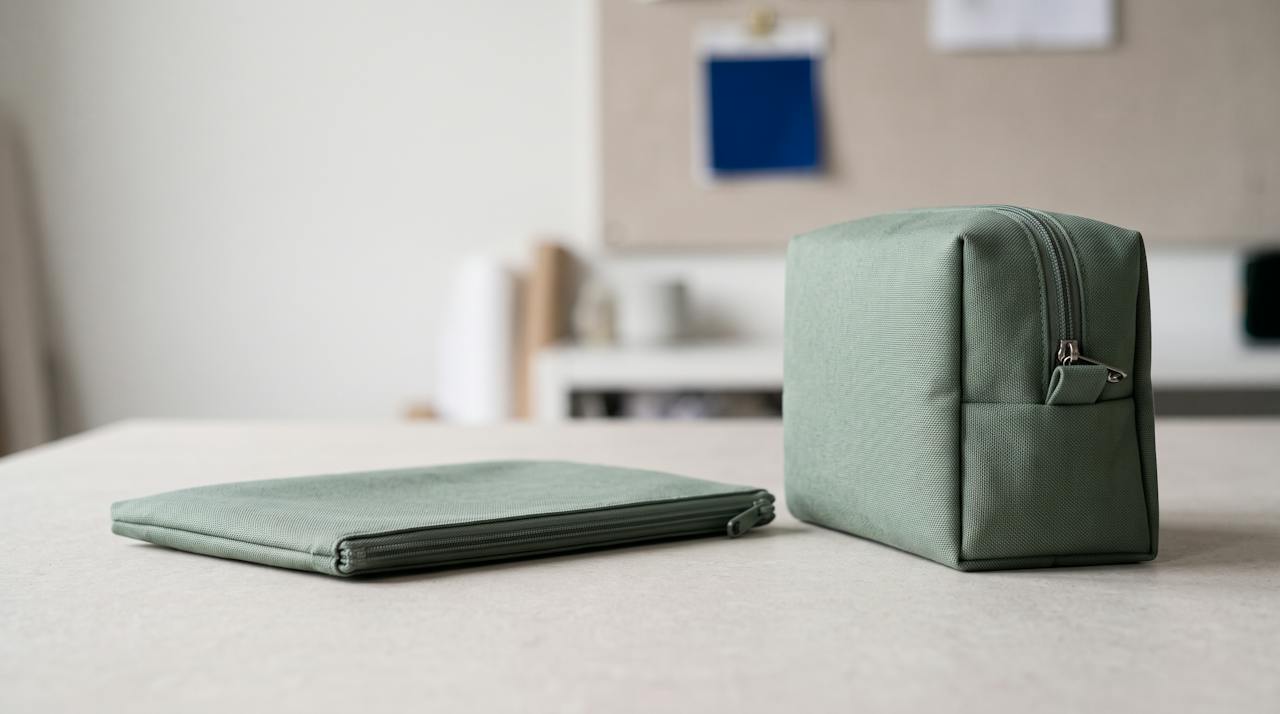
Two buyers can ask for "a makeup bag about this big" and mean completely different things: one pictures a slim flat pouch, the other a boxy bag that stands on the counter. The shape decides what the bag holds, how it opens, how it packs into a suitcase and how much material and sewing it takes, and it also decides how the size should be written down.
This note goes through the common cosmetic pouch shapes, from flat and box pouches to cylinders, trapezoids, train cases, clutches, standing and hanging organisers, then explains how size is written for each one. It follows our note on cosmetic bag sizes and dimensions, which covers how big a bag should be; our cosmetic bag range shows many of these shapes in production.
Flat pouch: what "flat" actually means#
A flat pouch is the simplest shape: two panels of the same size, or one panel folded at the bottom, sewn round the edges with a zip along the top. There is no gusset, so when it is empty it lies completely flat. When it is filled it takes on a pillow shape, deepest in the middle and thinnest at the corners.
Flat pouches suit lipsticks, compacts, sheet masks, sample sets and anything that will travel inside a larger bag. They use the least material, have the fewest pieces and the straightest seams, and they print well because the panels are flat. The limit is height of contents: anything thick or tall pushes the corners in and makes the zip hard to close.
Box pouch: boxed corners or a separate gusset#
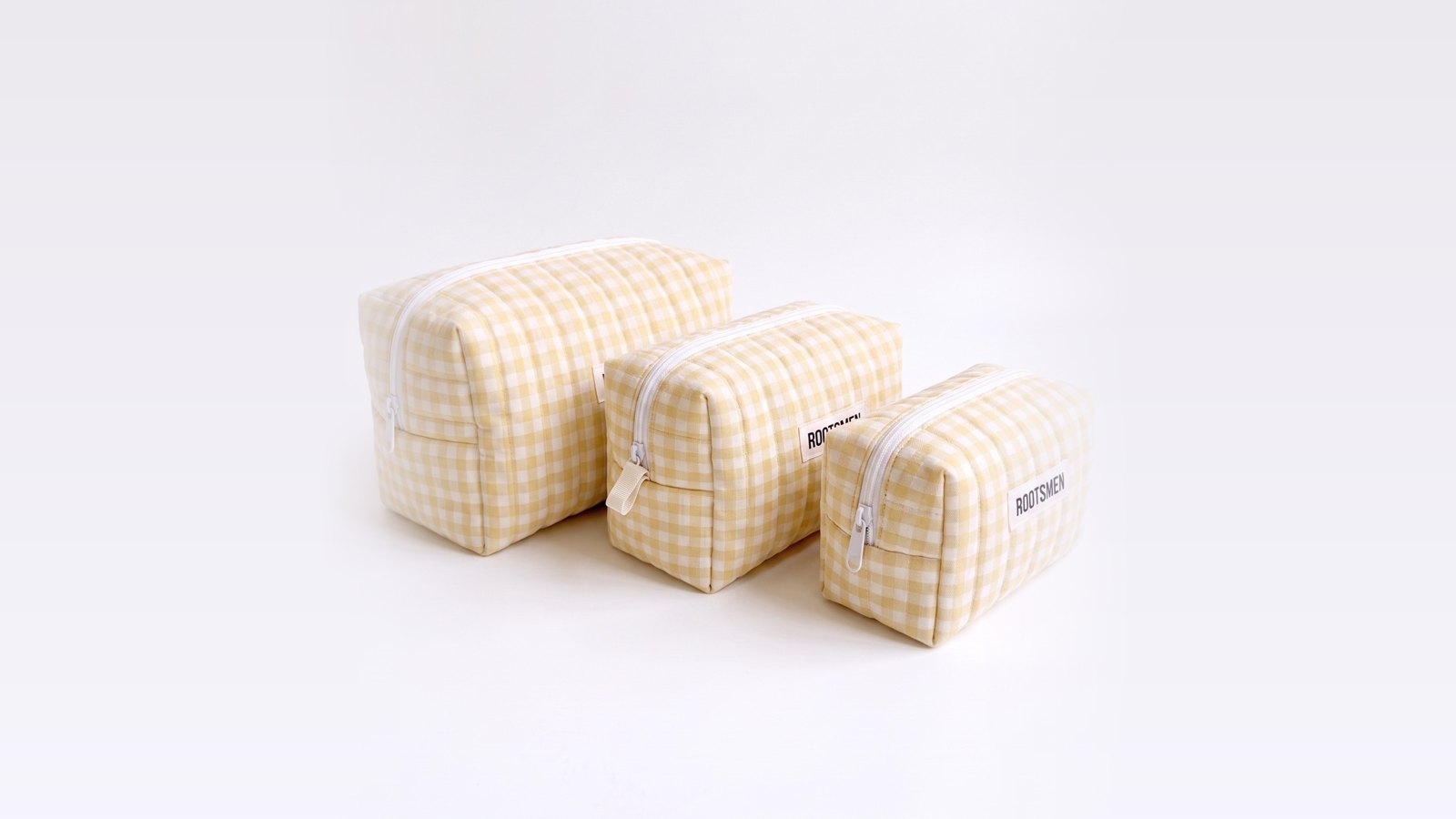
A box pouch adds depth, so the bag has a base and can stand. There are two common ways to get it. Boxed corners are made by sewing across the bottom corners of a flat pouch, which turns them into a base; the result is quick to make but softer in shape. A separate gusset is a strip of fabric sewn between the front and back panels, either along the base and sides or all the way round; it gives cleaner edges and a squarer shape, with more seams to align.
Box pouches open wide, hold bottles upright and work as everyday makeup bags and wash bags. They take more material and more sewing than a flat pouch, and the gusset or corners have to be matched carefully for the bag to stand straight. Our comparison of box pouch vs flat pouch goes through the choice in detail.
Cylinder and barrel pouches#
A cylinder or barrel pouch is a tube of fabric closed with two round or oval end panels, usually with a zip along its length. It holds brushes, pencils, tubes and tall bottles lying down, and it looks distinctive on a shelf. A shorter, fatter version is often called a barrel or drum pouch.
The round ends are the demanding part. A curved seam has to be eased in evenly or the ends twist and pucker, and a thick or coated fabric makes that harder. Cylinders often need a light stiffener or foam to keep their round shape, and they pack less efficiently into a carton than a flat or box shape.
Trapezoid and triangle-base pouches#
A trapezoid pouch is wider at the base than at the top, so it stands steadily and its contents fall towards the bottom. A triangle-base pouch, sometimes made with a triangular gusset at each end, gives a similar tent-like shape. Both are popular because they look neat when standing and are easy to reach into.
The angled side panels need a careful pattern: small changes in the angle change the base size, the top opening and how the zip sits. Material and sewing are close to a box pouch, with a little more care at the corners. The top opening is narrower than the base, so check that the largest item actually goes in.
Structured vanity and train cases#
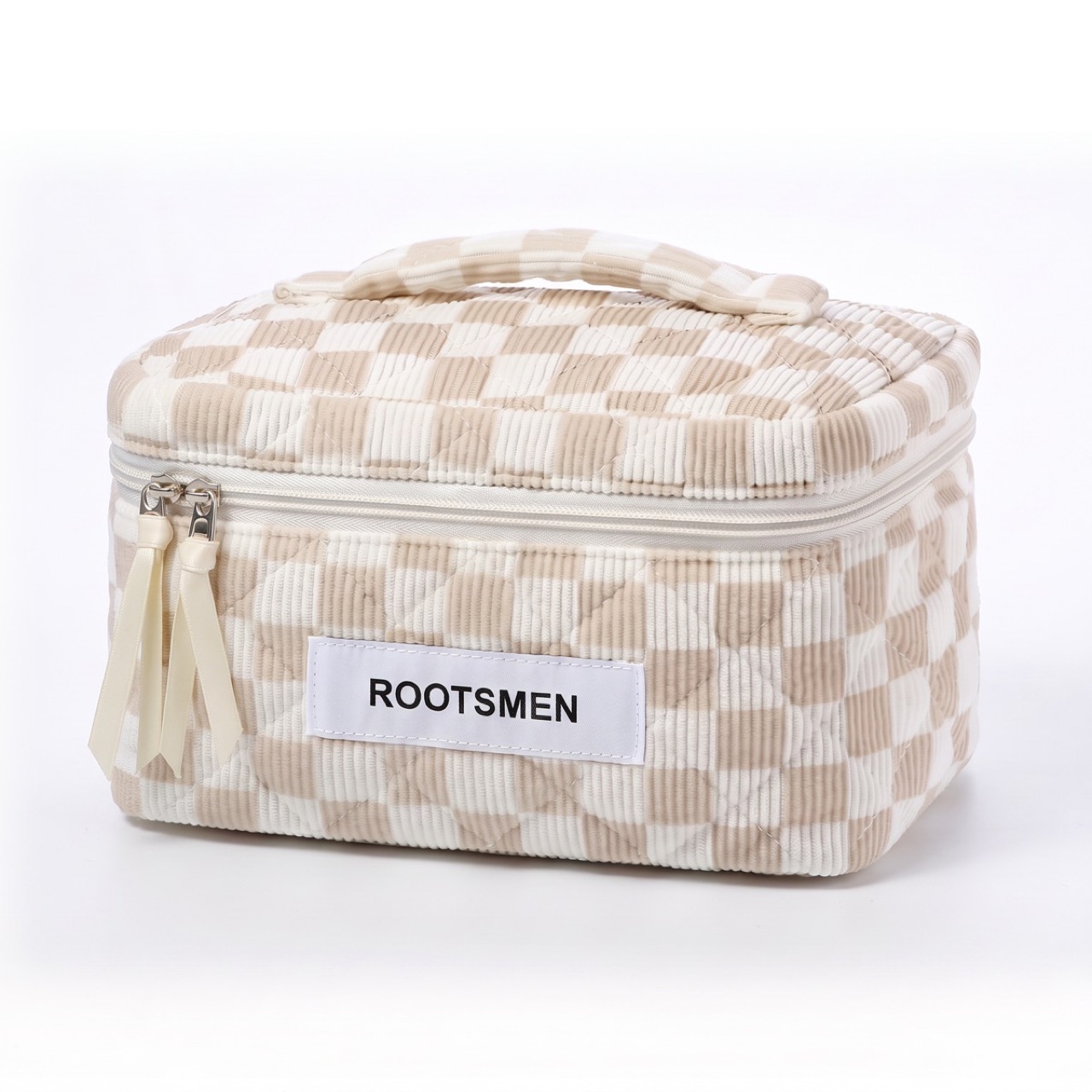
A vanity case or train case is a structured bag: the panels are backed with board, foam or a frame so the case holds its shape empty. It usually has a zip that runs round three or four sides, or a hinged lid, a carry handle, and often inside dividers, elastic loops or a mirror. It protects its contents and opens like a box.
This is the most involved shape to make. Each panel has its own stiffener, edges are often bound or piped, the handle must be anchored firmly, and the inside fittings add pieces and sewing time. Because the walls have thickness, the outside and the inside sizes differ noticeably, which matters when you write the size.
Clutch and envelope pouches#
A clutch or envelope pouch is a slim, mostly flat shape that closes with a flap, a snap, a magnet or a wide zip. It is designed to be held in the hand or to sit flat inside a handbag, and it suits flat items: a palette, sheet masks, a few slim products, documents for travel.
In material and sewing it is close to a flat pouch, with the flap, any interlining that keeps it crisp, and the closure adding pieces. Its size depends on whether you mean it closed or open, so say which.
Standing pouches and fold-out or hanging organisers#
A standing or stand-up pouch has a base panel or a stiffened bottom so it stays upright on a counter and opens like a cup, with brushes and pencils standing inside. Some use a frame at the opening to stay open. The base and stiffener add pieces and the bag must balance well when partly full.
Fold-out and hanging organisers are travel pieces: they unfold or unroll into several pockets or panels and often hang from a hook on a door or towel rail. They hold a full routine in view but take the most sewing of any soft shape, with many pockets, bound edges and a hook or strap to attach. They are also the shape most often misunderstood in a brief, because the closed size and the open size are very different.
How size is written for each shape#
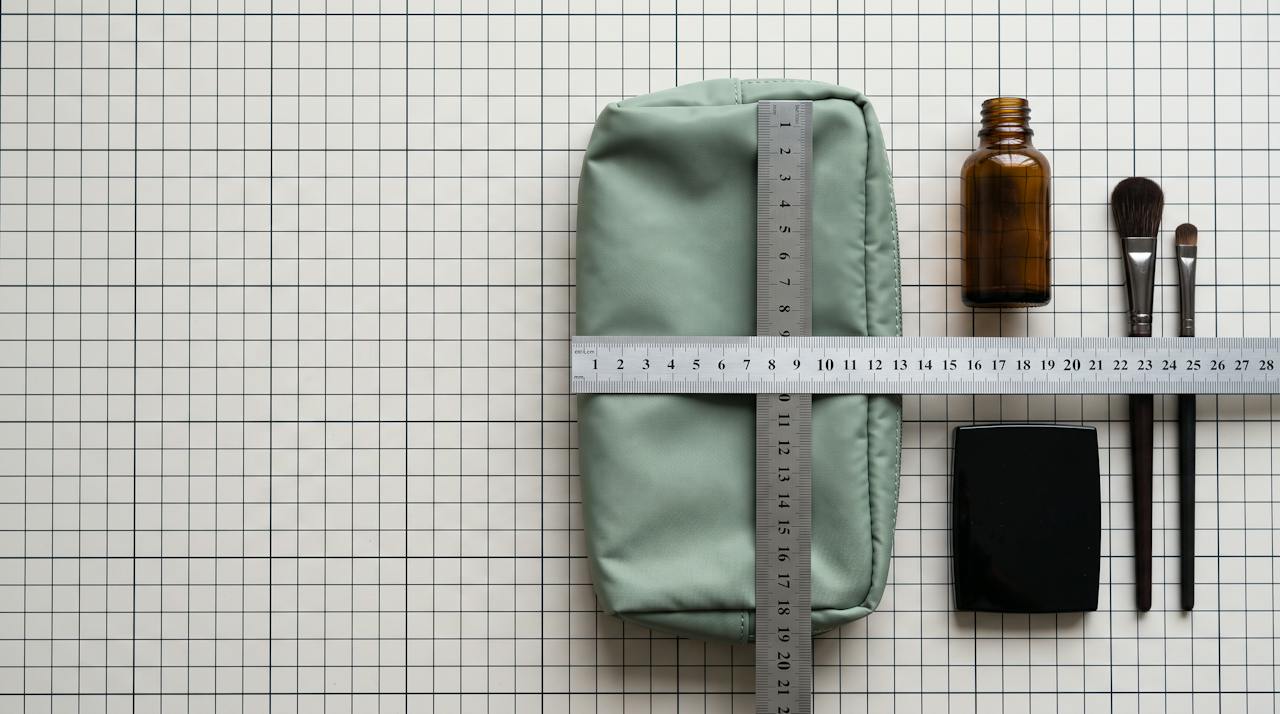
For most pouches, size is written as width × height × depth (W × H × D). Width runs along the zip or the top edge, height runs from the bottom to the top edge with the bag standing on its base, and depth is the distance front to back at the base. Say whether height includes the zip and puller, and whether a flat pouch is measured flat and empty or filled, because a filled flat pouch gains depth and loses width and height.
Other shapes need other figures. For a box pouch, say whether the depth is the width of the gusset strip or the depth created by boxed corners. For a cylinder, give length and diameter, and say whether the diameter is of the end panel or of the filled bag. For a trapezoid, give top width, base width, height and base depth. For a structured case, give the outer size and the inner usable size, and state the handle separately. For a clutch, give the closed size; for a fold-out or hanging organiser, give both closed and open sizes. Outer dimensions matter for packaging and shelves; inner dimensions matter for what fits, and lining, piping and stiffeners make the inside smaller than the outside.
How Japanese and Spanish buyers often write sizes#
Buyers in different markets write the same figures in a different order. Japanese buyers and shops often write sizes as 縦 × 横 × マチ (height × width × gusset depth), though 横 × 縦 × マチ and "W × H × D" are also common. Spanish-speaking buyers often write alto × ancho × fondo (height × width × depth), and some write largo × ancho × alto. These are habits of wording, not standards, and the order changes from one brief to the next.
The safe rule is to label every figure. "Height 130, width 200, gusset 70" cannot be misread; "130 × 200 × 70" can be read as a wide pouch or a tall one. A simple sketch with arrows showing which way each measurement runs removes the doubt in any language.
Writing the size in a spec so every factory quotes the same bag#
When you send a brief to more than one factory, the size line decides whether the quotes are comparable. Name the shape and the construction (flat, boxed corners, separate gusset, structured), give labelled figures in one unit, say which way height is measured, whether the figures are outer or inner, flat or filled, and whether the zip and handle are included. Add a sketch, and if possible a reference bag or the contents the bag must hold. How to write a tech pack shows where the size and the measuring notes belong.
Soft goods never hold a dimension exactly: fabric thickness, lining, filling and the way a bag is laid down all move the figure. Rather than borrowing a tolerance from elsewhere, agree how and where each dimension is measured and what variation is acceptable on the approved sample, write it down, and keep that sample as the reference for bulk.
| Shape | How it is built | Opens and packs | Material and sewing (relative) | How size is written |
|---|---|---|---|---|
| Flat pouch | Two panels, or one folded panel, no gusset | Top zip; packs flat, slips into a bag | Least: few pieces, straight seams | Width × height, measured flat; depth only if it opens when filled |
| Box pouch | Boxed corners or a separate gusset panel | Wide top zip; stands and opens wide | More: corners or gusset, more seams to align | W × H × D; say whether D is the gusset or the boxed-corner depth |
| Cylinder or barrel | Tube body with two round end panels | Zip along the length; holds brushes and tall items | More: curved seams, ends must be eased in | Length × diameter; say if diameter is of the end panel or the filled bag |
| Trapezoid or triangle base | Tapered side panels or a triangular gusset | Narrow top opening over a wider base; stands well | More: angled panels, careful pattern | Top width, base width, height and base depth |
| Vanity or train case | Structured with board, foam or a frame | Zip around or hinged lid, often a handle; holds shape | Most: stiffeners, binding, handle, sometimes a mirror | Outer W × H × D, inner usable size, handle stated separately |
| Clutch or envelope | Flat body with a flap or wide top zip | Flap or zip; slim, sits flat in a larger bag | Modest; a flap and closure add pieces | Closed width × height; flap length if it matters |
| Standing pouch | Base panel or stiffened bottom | Opens upright on the counter like a cup | More: base, stiffener, sometimes a frame | Base W × D and height, standing |
| Fold-out or hanging | Several pockets or panels, binding, hook | Unfolds or unrolls; hangs or lies open | Most sewing: many pockets and bound edges | Closed size and open size, hook or strap stated separately |