Once a brand has worked out which HS code applies to its cosmetic bag, the next question from the importer, the retailer or the packaging designer is usually about the "Made in" label: what it should say, where it goes and who decides. The answer matters because an origin mark that is missing, hidden or wrong can delay goods at customs, force relabelling, or turn into a misleading claim on the shelf.
This note explains the difference between origin marking, HS classification and preferential origin, how the origin of a sewn bag is generally decided, what the US, the EU and Japan expect in broad terms, where to place the mark and how to word it, how to handle sets with components from different places, and which documents support the claim. It follows our guide to which HS code applies to cosmetic bags, toiletry kits and tote bags. It is general information, not legal or customs advice: rules differ by country and change, so confirm the details for your product with a licensed customs broker.
Three different questions: marking, classification and preferential origin#
Origin marking answers "what must the product or its packaging say about where it was made?" It depends on the product's non-preferential origin, which is the general, everyday origin customs uses for marking, statistics and most trade measures. HS classification answers a different question, "what is this product?", and it does not change with the country of manufacture: a cotton toiletry bag has the same heading whether it is sewn in one country or another.
Preferential origin is a third question: does the product qualify for treatment under a particular trade agreement between the exporting and importing country? Each agreement sets its own rules of origin, which may look at a change of tariff classification, the value added in the region or specific processing steps, and its own proof requirements. A bag can have a clear non-preferential origin and still not qualify under an agreement, so treat these as separate checks and ask your broker about each.
What decides the origin of a bag#
For goods made from parts or materials from more than one country, origin is generally where the last substantial transformation took place: the step that turns materials into a new product with a different name, character or use. For a sewn bag or pouch, that is usually where the fabric is cut and the bag is sewn and assembled. Fabric woven in one place, a zipper from another and a woven label from a third do not, on their own, decide the origin; what happens to them in the factory does.
Each country applies its own rules, and some have specific rules for textile products. In the US, for example, textile rules of origin often point to the country where a textile article was wholly assembled. Minor operations such as adding a hangtag, packing, attaching a charm or simple finishing are generally not enough to change origin. If production steps are split between countries, the answer can be less obvious, and it is worth getting a broker's view, or a formal ruling where available, before the labels are printed.
Developed in Taiwan, sewn in China: what goes on the label#
Design, product development, pattern making and sampling add real value, but as a general principle they do not by themselves make a product originate in the country where they happen. A bag developed and sampled in Taiwan and then cut and sewn in China is generally a product of China for marking purposes, and the label would normally say "Made in China". The same logic applies to a bag designed in Europe or the US and made in Asia.
That is the situation for most ROOTSMEN products: development happens in Taiwan and production in our own factory in Guangdong, China, so the general principle points to China. We can tell you where each step takes place, but the origin decision for your import belongs to you as importer, so confirm it with your customs broker. If you want to mention where the design came from, see the next sections on wording: a phrase such as "Designed in" next to a different place name has to be handled carefully.
United States: marking imported bags#
US law and the customs regulations in 19 CFR Part 134 generally require every imported article of foreign origin, or its container, to be marked with the English name of the country of origin, in a conspicuous place, legibly and as permanently as the nature of the article allows, so that the ultimate purchaser can see where it was made. There are exceptions and special cases, but for a finished bag sold to consumers you should plan on a mark on the bag itself, and often on the retail packaging too.
The regulations also address wording. When the article or its packaging carries the name of a place other than the country of origin, for example a brand's home city or "Designed in Taiwan", the actual country of origin generally has to appear in close proximity and in comparable size, with words such as "Made in" or "Product of". Goods that are not properly marked can be held until they are marked or face additional duties. Other US rules, such as textile labelling requirements, may also apply to some products. Our overview of compliance documents for the US and EU covers the wider picture; ask your broker which rules apply to your bag.
European Union and Japan: misleading claims and national rules#
The EU has no general requirement to put a country-of-origin label on most non-food consumer goods, including most bags. Customs still needs the origin for the declaration, and the non-preferential origin is decided under EU customs rules, which also look at the last substantial processing. Where a brand does show an origin, EU rules on unfair commercial practices prohibit claims that mislead consumers about where a product comes from, and some member states have their own rules protecting particular origin claims. Retailers may also ask for an origin mark in their own requirements.
Japan's rules on misleading representations also cover country-of-origin claims, and customs can stop goods that carry a false or misleading origin indication until it is corrected. In practice, many buyers for Japan expect a clear origin statement on the label or packaging. Whatever the market, the safe approach is the same: state the true origin plainly, avoid wording or imagery that suggests a different one, and check each destination's requirements with a local broker or adviser.
Where to put the mark: label, hangtag or packaging#
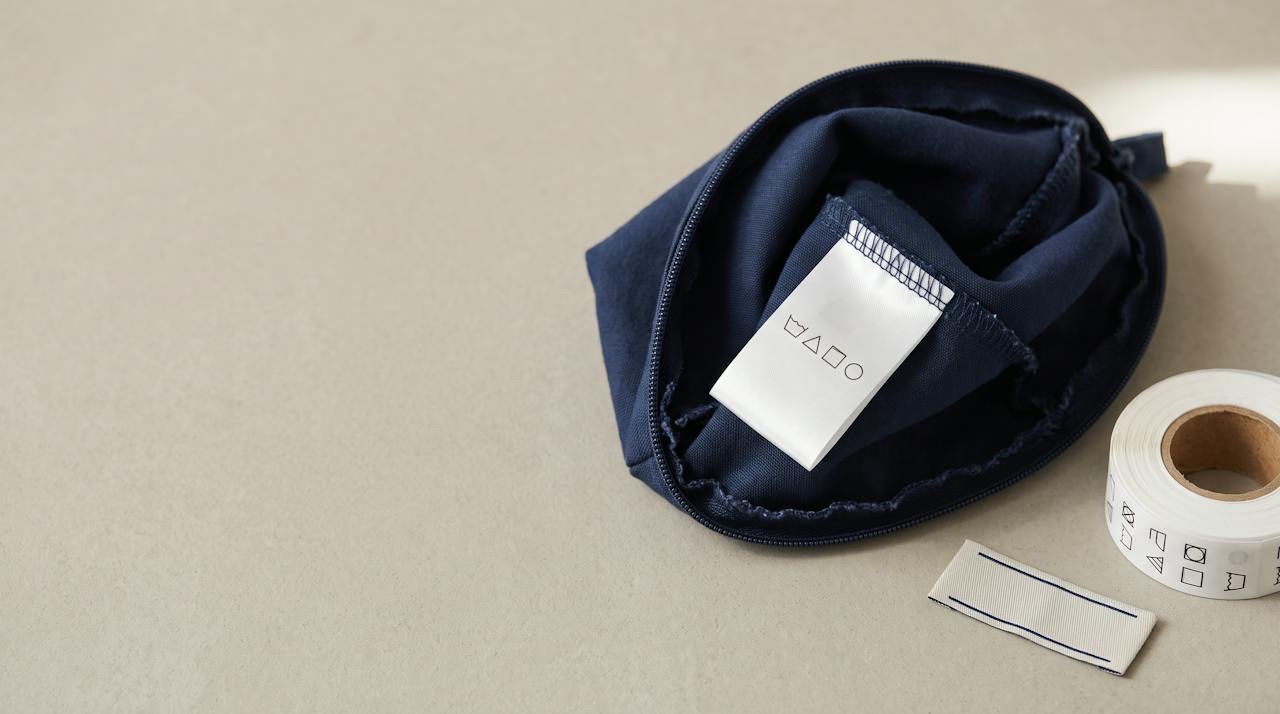
A sewn-in label is the most common and most permanent place for the origin on a bag, either a woven label or a printed care label inside the bag or in a seam. It survives after the packaging is thrown away, which is why it is the usual choice for markets that expect permanent marking. On a small pouch, the origin can share the care label; our note on care labels and washing instructions explains how to fit both on one label.
A printed mark directly on the lining, a heat transfer or a debossed patch can also work if it is legible and durable enough. A hangtag or sticker alone is easy to remove, so it is usually a supplement rather than the main mark on a product meant for permanent marking. Retail packaging, boxes, sleeves and the outer carton often need the origin as well, especially when the bag cannot be seen in its pack. Decide all of these positions when the label artwork is drawn, not after the labels are woven.
Wording and language#
Keep it simple: "Made in China", "Product of China" or the equivalent in the language of the market. Use the full, usual English name of the country for the US rather than an abbreviation or an old name, and make the text large enough to read without searching for it. For multilingual labels, add the local-language version where buyers or local rules ask for it, for example "Fabriqué en Chine" or "中国製".
Be careful with phrases that mention a second country. "Designed in Taiwan", "Developed in Taiwan, made in China" or a brand's home city can be fine as information, but they should not crowd out or outsize the true origin, and in some markets they trigger specific placement rules. Avoid flags, maps or slogans that imply a different origin. If you are unsure, send the label artwork to your broker before production.
Sets, kits and components from different places#
Gift sets and travel kits often combine a bag made in one country with products, bottles or accessories made elsewhere. Each component can have its own origin, and the marking may need to cover the individual items, the container or both. A common approach is to mark the bag on its own label and state the origin of the set's contents on the outer packaging, for example "Bag made in China, contents made in" the relevant country, but the right wording depends on how the set is imported and classified.
Whether the set is treated as one item or as separate items also affects its HS classification, which our guide to HS codes for gift sets and travel kits with products inside covers. Where the set is packed matters too: putting items together in a third country is generally a minor operation that does not change their origin. Settle the marking with your broker before the packaging is printed.
Documents that support the origin claim#
The commercial invoice normally states the country of origin of each item, and the label, the invoice and the customs declaration should all agree. Keep production records that show where the bag was cut, sewn and assembled, and the bill of materials, in case customs or a buyer asks how the origin was decided.
A certificate of origin is needed only in some cases: when the importing country, a letter of credit or the buyer asks for one, or when you claim preferential treatment under a trade agreement, which has its own proof rules. Non-preferential certificates are usually issued by an authorised body in the exporting country, such as a chamber of commerce. Your broker can tell you which document, if any, your shipment needs.
A practical checklist for your "Made in" label#
Before the label artwork is approved: confirm where each production step takes place; agree the origin with your broker for each destination market; choose the permanent position on the bag and any packaging positions; write the wording in the right language and size; check any "Designed in" or place-name text against the true origin; and make sure the invoice will show the same country.
On the pre-production sample, check that the mark is where it was agreed, readable and attached securely, and that it survives the same handling as the care label. If you are developing a new bag or kit and want the labels, packaging and documents planned from the start, see how we work on custom development.
| Question | What it decides | What it usually depends on | Where it shows up |
|---|---|---|---|
| Non-preferential origin | The bag's "nationality" for marking, statistics and general trade measures | Where the last substantial transformation happened, under each importing country's rules | Commercial invoice, customs declaration, certificate of origin if required |
| Origin marking | What the label or packaging must or may say, such as "Made in China" | The non-preferential origin plus each market's marking and consumer rules | Sewn-in or printed label, hangtag, packaging |
| HS classification | Which tariff heading and code the bag falls under | What the bag is, its outer material and its use, not where it was made | Commercial invoice, customs declaration |
| Preferential origin | Whether the bag qualifies for treatment under a specific trade agreement | That agreement's own rules of origin and proof requirements | Proof of origin as the agreement requires |