Most welcome kits are planned as a list of items, and a bag is added at the end to hold them. The bag is then sized to the list, branded loudly, and often discarded once the items are unpacked.
A kit built around a soft organizer works the other way round. The organizer is chosen first, because it is the piece most likely to stay in use, and the contents are selected to fill it. This article covers how that kind of kit is designed.
Why the organizer should be the anchor of the kit#
Most items in a welcome kit are used up or put away: a notebook fills, snacks are eaten, a printed guide is read once. An organizer that suits the recipient's working day can stay in a bag or on a desk for years, carrying the brand quietly every time it is used.
Making it the anchor changes the brief. The organizer gets the design attention, the material budget and the sampling time, and the other items are chosen because they fit inside it and are useful on day one. A good test is whether the organizer would still be worth giving if every other item were removed.
Matching the organizer to the role#
One organizer rarely suits every new starter. A team that travels needs something different from a team that works at a desk, and a kit that reflects the person's role is more likely to be kept.
Many programmes therefore keep a shared look, the same fabric, colour and branding, across two or three organizer types and assign them by team. That keeps the visual identity consistent while letting each organizer be useful.
| Recipient | Organizer type | Interior built for | Branding that tends to stay in use |
|---|---|---|---|
| Office and hybrid staff | Tech organizer | Charger, cables, adapters, mouse | Woven label or deboss on a tab |
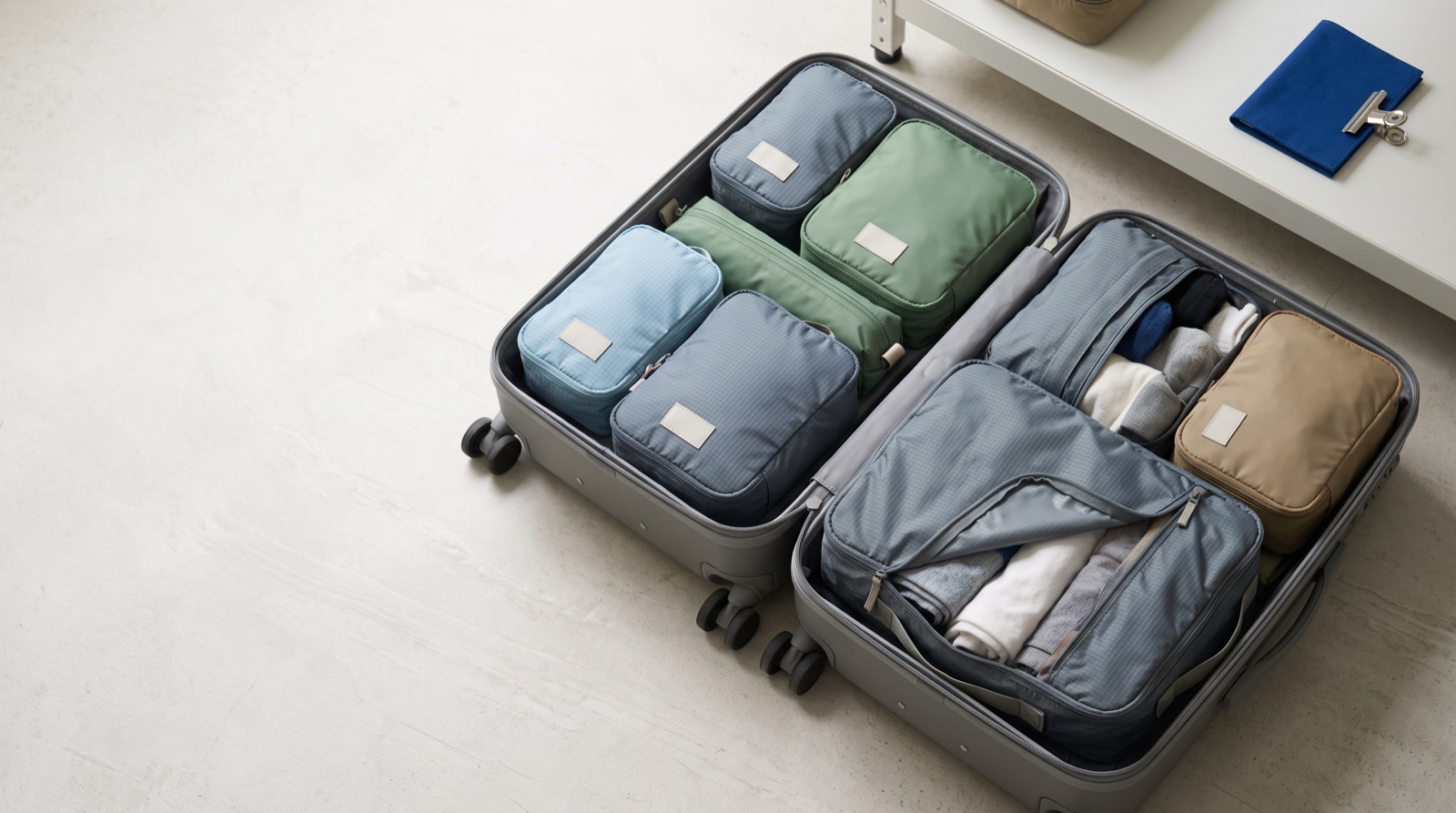
| Sales and travelling teams | Travel organizer or toiletry pouch | Travel adapters, documents, toiletries | Tone-on-tone embroidery |
| Field and site teams | Durable zip pouch | Tools, pens, small kit, gloves | Rubber or woven label |
| Leadership and client-facing | Document folio | Notebook, tablet, cards, pen | Deboss or discreet embroidery |
Designing the interior around real items#
The interior is where an organizer succeeds or fails. Measure the actual items it will hold, such as the company's standard charger, cables, adapters, a mouse or a notebook, rather than working from generic sizes, because chargers and adapters vary widely between models.
Then decide how each item is held. Elastic loops suit cables and pens; mesh pockets let the recipient see what is inside; a padded divider protects a device from hard items; a zipped inner pocket holds small loose items. Leave some space for the recipient's own things, because an organizer filled exactly to the welcome items has no room once it is used day to day.
Ask for the sample to be tested with the real items inside and the organizer closed. A zipper that runs cleanly on an empty organizer can strain when the interior is full.
Branding that people keep using#
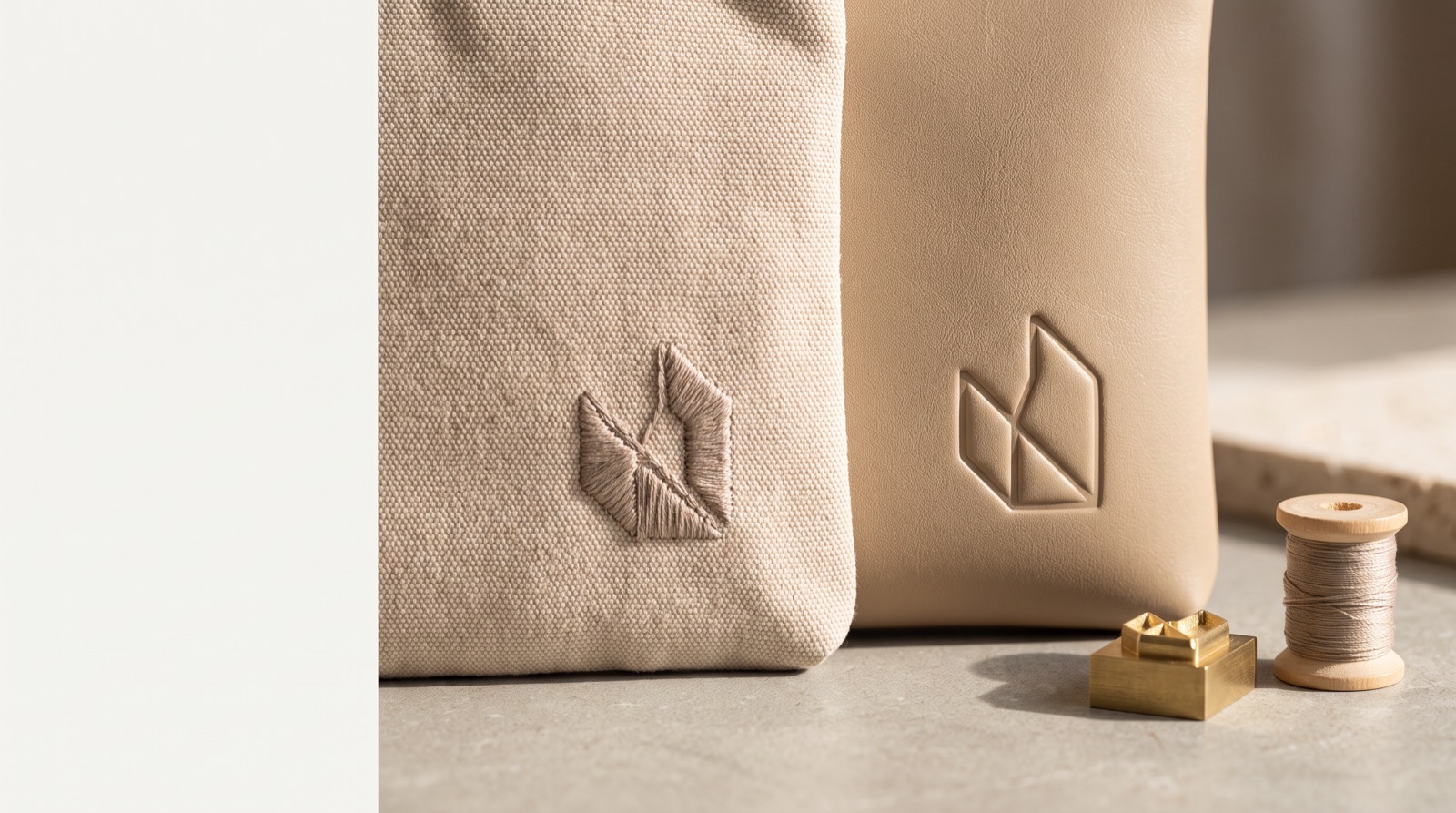
Branding decides whether the organizer is carried in public. A large printed logo can make it feel like a giveaway, while a woven label, a deboss on a PU tab, or tone-on-tone embroidery reads as a finished product that the recipient is happy to use outside work.
One approach is to keep the outside discreet and put a stronger brand moment inside: a printed lining, a message on an inner label, or a contrasting zipper pull. Our comparison of embroidery and debossing explains which methods suit which materials. Whatever the method, approve it on the real material at sample stage.
Working on a programme like this? Send us the brief and we will come back with material and construction options. Contact Us →
Items that bring their own rules#
Some items change how the kit can be packed and shipped. Battery-powered items, such as power banks, wireless earphones or small electronics, carry their own transport rules, and liquids or aerosols bring others. Food items may need ingredient labelling.
Decide early who checks these items and their documents, and keep them out of the organizer design if they make shipping more difficult. A textile organizer without electronics usually avoids these particular questions, though its own labelling and material claims still need checking.
Packing kits for people who work remotely#
When kits are posted to people's homes rather than handed over in an office, the outer mailer becomes part of the design. It has to protect the organizer and its contents, arrive looking intentional, and be easy to dispose of.
In the EU, packaging rules are tightening. Under the Packaging and Packaging Waste Regulation (EU) 2025/40, the operator who fills grouped, transport or e-commerce packaging must keep its empty-space ratio to no more than 50%, and filling materials such as paper cuttings, air cushions and bubble wrap count as empty space. According to the European Commission, this applies from 1 January 2030 or three years after the implementing act on the calculation method enters into force; the Commission is due to adopt that method by 12 February 2028. From 1 January 2030, Article 10(2) also prevents packaging features such as double walls or false bottoms from being used to increase the perceived volume of a product.
Ask your compliance adviser whether your outer mailer counts as transport or e-commerce packaging. In either case, sizing the mailer to the organizer, rather than to a standard gift box, usually reduces both empty space and the filler needed.
Claims on the kit and its card#
Welcome kits often carry a card about the company's values, and sustainability wording is common. From 27 September 2026, Directive (EU) 2024/825 prohibits generic environmental claims, such as "eco-friendly", unless the trader can demonstrate recognised excellent environmental performance. A claim whose specification is given clearly on the same medium is not generic.
If the organizer is made from recycled-content fabric, state what is recycled and by how much, and keep the supplier's certificate on file. Our guide to verifying a recycled material claim covers what to ask for before anything is printed.
What to send the bag maker#
A brief for an organizer-led welcome kit should give the bag maker:
- The organizer types required and the teams each one is for
- The real items each organizer must hold, with dimensions, or samples of them
- How each item should be held: loops, mesh, padded dividers, inner pockets
- Fabric, colour and branding direction, shared across all organizer types
- Whether kits are handed over or posted, and to which countries
- The outer mailer or box requirements, and any packaging limits you have set
- The exact wording of any claim printed on the organizer, label or card
At ROOTSMEN, we make the organizers and their packaging; the other kit items are sourced by the buyer. Send us the items and roles, and we can propose organizer types, interior layouts and materials around them.
Sources#
- EUR-Lex, Regulation (EU) 2025/40 on packaging and packaging waste, Articles 10 and 24: https://eur-lex.europa.eu/eli/reg/2025/40/oj/eng
- European Commission (DG ENV), Packaging and Packaging Waste Regulation (PPWR) – Frequently Asked Questions, August 2026 edition, list of application dates and chapters on minimisation (Article 10) and empty space (Article 24): https://environment.ec.europa.eu/publications/faq-packaging-and-packaging-waste-regulation-ppwr_en
- EUR-Lex, Directive (EU) 2024/825: https://eur-lex.europa.eu/eli/dir/2024/825/oj/eng