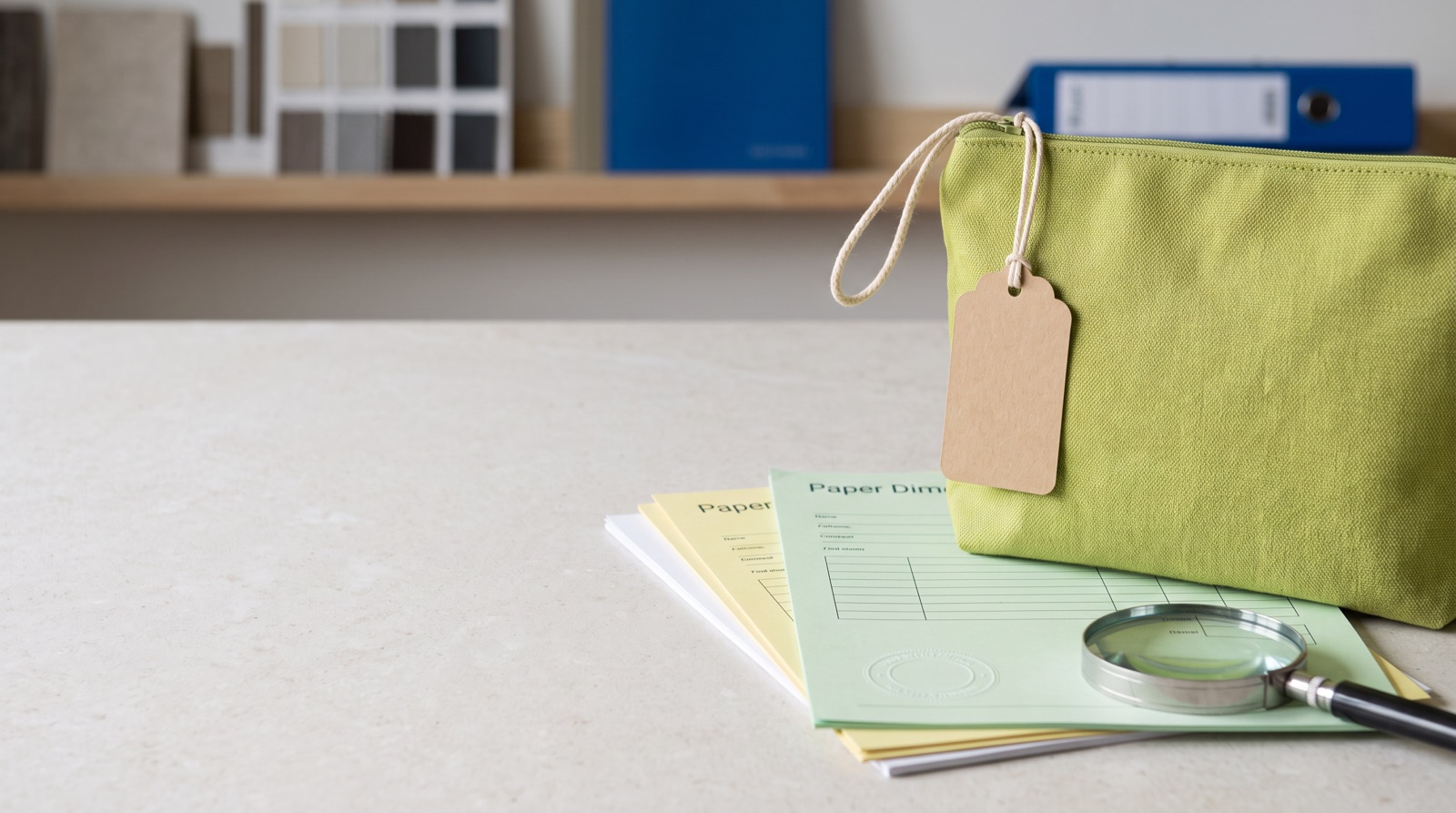
A hotel amenity kit looks like a small decision: a pouch, a logo, a few items inside. For the procurement team buying it across several properties, the decisions come in a fairly fixed order, and the bag is rarely the first one. Getting that order right avoids redrawing the pouch every time the contents change.
This article follows that order and notes what the bag maker needs at each step.
Why procurement starts with the contents list#
The pouch exists to hold something, so its size, internal layout and closure all follow from the contents. Typical soft kits carry dental, shaving, sewing or comfort items such as eye masks and socks, and each property type may want a different mix.
A complete contents list gives each item's dimensions, whether it is liquid, and how it is packed. With that list the bag maker can propose a format and dimensions. Without it, any sample is a guess that will be revised once the real items arrive.
Kept or left behind: deciding the kit's afterlife#
The second decision is whether the guest is expected to take the pouch home and reuse it, or whether it is a container for one stay. This choice sets most of what follows.
A pouch meant to be kept justifies a durable fabric, a proper zipper, finished seams and discreet branding that a guest is happy to carry. A pouch meant for a single stay is a different product, and it is also more likely to be caught by the packaging rules described below. Many programmes run both: a keepsake kit for higher room categories and a simpler presentation for the rest.
The rules on what goes inside#
Rules on single-use toiletries change what goes into the kit, and therefore its size. In California, Assembly Bill 1162 prohibits lodging establishments from providing small plastic bottles of personal care products, defined as bottles with a capacity of less than six ounces that are not intended to be reused; the law limits personal care products to shampoo, hair conditioner and bath soap. It applied from 1 January 2023 to establishments with more than 50 rooms and from 1 January 2024 to those with 50 rooms or fewer.
In the EU, the Packaging and Packaging Waste Regulation (EU) 2025/40 restricts, from 1 January 2030, single-use packaging for cosmetics, hygiene and toiletry products for use in the accommodation sector that is intended for an individual booking and intended to be discarded before the next guest arrives. The regulation's examples are shampoo bottles, hand and body lotion bottles and sachets around bar soap. The European Commission is required to publish guidelines on these restrictions by 12 February 2027.
These rules are aimed at the toiletry packaging, and they matter to the pouch because they change what it has to hold. Unlike the other entries in Annex V, point 5 is not limited to plastic, so a pouch pre-filled with toiletries and meant to be discarded after one stay should be checked against it as well.
Is the pouch itself packaging?#
The question comes up as soon as the pouch is pre-filled. The Commission's guidance, C(2026)3702, says dust bags for shoes and garments are packaging when they are intended to contain, protect, handle, deliver or present products to an end user. It also notes that textile sales packaging is exempt from the recyclability requirements under Article 6(11)(g), though other PPWR obligations still apply.
The guidance stresses that each item has to be assessed against that definition. A pouch handed over empty does not contain or present another product; a pouch pre-filled with the products it presents is closer to the dust-bag case. Ask your compliance adviser how your specific format is classified, especially if the kit is designed for a single stay.
| Order | Decision | What the bag maker needs |
|---|---|---|
| 1 | Contents list | Item dimensions, liquids, how each item is packed |
| 2 | Keep or leave behind | Expected use and life of the pouch, by room type |
| 3 | Rules on the contents | Markets of use; any single-use packaging restrictions that change the contents |
| 4 | Packaging classification | Whether the pouch is handed over empty or pre-filled |
| 5 | Format and closure | Preferred format, how often it is opened, by whom |
| 6 | Material and claims | Fabric, finish, and the exact wording of any claim |
| 7 | Branding | Brand manual, logo files, branding method |
| 8 | Delivery packaging | Flat or shaped, polybag or bundle, carton marks per delivery point |
Format, size and closure#
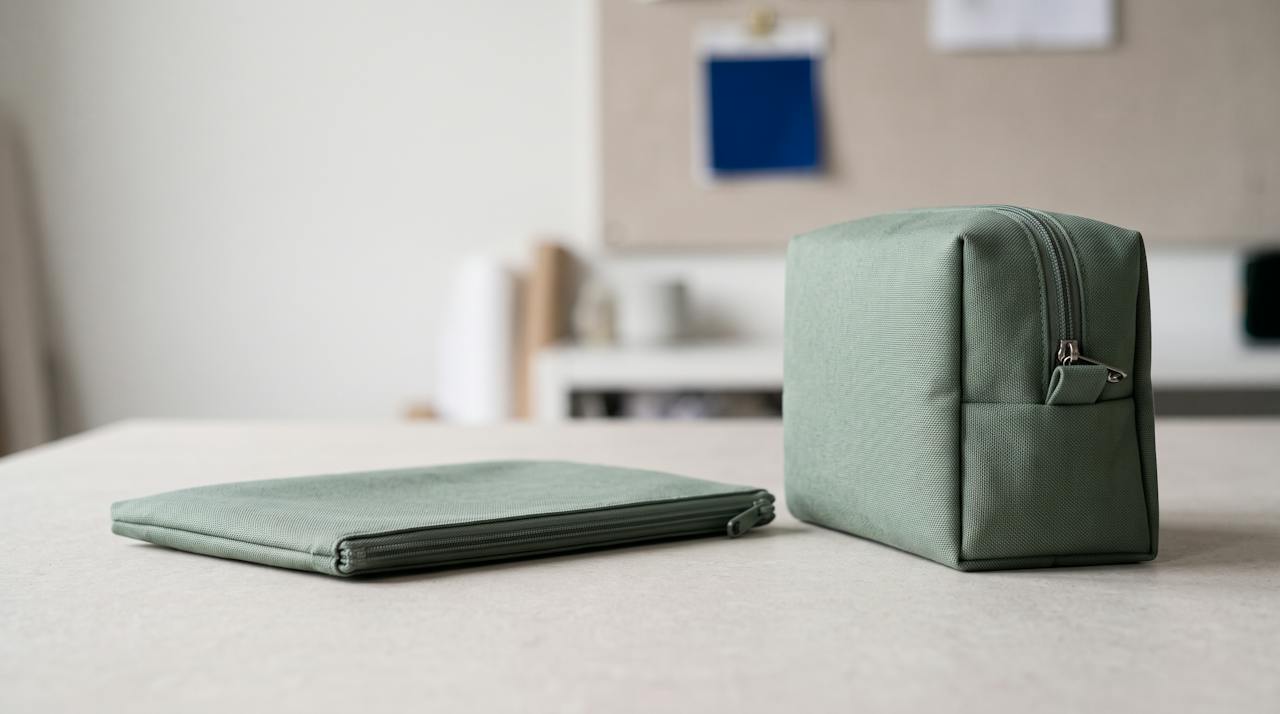
Once the contents and the afterlife are fixed, the format follows. A flat zip pouch suits a few slim items; a box pouch with a gusset holds bulkier items upright; a drawstring bag is quicker for housekeeping to restock but holds contents less securely.
The closure is chosen for how the kit is used. Housekeeping staff may open and close it many times during restocking, while a guest opens it once in the room and again when packing. Ask for the closure to be tested on the sample with the real contents inside, because a zipper that runs freely on an empty pouch can catch on a full one.
Working on a programme like this? Send us the brief and we will come back with material and construction options. Contact Us →
Materials, finishes and claims#
The material follows from the afterlife decision. Woven polyester, nylon, cotton and recycled-content fabrics are all common; the choice depends on how the pouch should feel and how long it should last. If the pouch is likely to sit in a wet bathroom, water-repellent and waterproof constructions behave differently and should be specified as such.
Water-repellent finishes bring a chemical question. From 10 October 2026, PFHxA and its salts are restricted to below 25 ppb, and PFHxA-related substances to below 1,000 ppb, measured in homogeneous material, in textiles in clothing and related accessories for the general public. The regulation's recitals give handbags as an example of a related accessory; other consumer textiles follow from 10 October 2027.
Sustainability wording on the pouch or its card needs the same care. From 27 September 2026, Directive (EU) 2024/825 prohibits generic environmental claims, such as "eco-friendly", unless the trader can demonstrate recognised excellent environmental performance. A claim whose specification is given clearly on the same medium is not generic. If the pouch carries a recycled-content claim, check the documents behind it first; our guide to verifying a recycled material claim sets out what to ask for.
Branding, labels and the brand manual#
Hotel groups usually have a brand manual covering logo use, colour and sometimes the tone of guest-facing items. For a keepsake pouch, discreet branding such as a deboss, a woven label or tone-on-tone embroidery is often preferred to a large print, because guests are more likely to carry a pouch that does not look like an advertisement.
If one pouch design serves several brands or properties, decide early whether the body stays the same and only the label changes. That keeps one approved construction across the programme and limits sampling to the branding.
How the empty pouches are packed and delivered#
The last specification is the pouch's own packaging. Procurement needs to decide whether empty pouches arrive flat or shaped, in bundles or individually bagged, and how cartons are marked when one order is split between properties.
Individual polybags protect a light-coloured pouch but add plastic that the property then has to dispose of. Carton marks should match the receiving instructions of each property or of whoever fills the kits.
What to send a bag maker#
A brief that follows the order above gives the bag maker everything needed to sample once:
- The contents list with dimensions, and which items are liquid
- Whether the pouch is a keepsake or a single-stay container, and for which room types
- The markets where the kit will be used
- Preferred format and closure, or the problem the format must solve
- Material preferences, finish requirements and any claim you intend to print
- The brand manual, logo files and the branding method you have in mind
- How the empty pouches should be packed, labelled and split between delivery points
At ROOTSMEN, we make the organizers and their packaging; the toiletries and other contents are sourced by the buyer. Send us the contents list and the decisions above, and we can propose a construction around them.
Sources#
- California Legislative Information, Assembly Bill 1162 (2021), Chapter 6.1 (commencing with Section 42372) of Part 3 of Division 30 of the Public Resources Code: https://leginfo.legislature.ca.gov/faces/billTextClient.xhtml?bill_id=201920200AB1162
- EUR-Lex, Regulation (EU) 2025/40 on packaging and packaging waste, Article 25 and Annex V point 5: https://eur-lex.europa.eu/eli/reg/2025/40/oj/eng
- European Commission (DG ENV), Packaging and Packaging Waste Regulation (PPWR) – Frequently Asked Questions, August 2026 edition, question on hotel miniatures (Annex V point 5) and Article 25(6): https://environment.ec.europa.eu/publications/faq-packaging-and-packaging-waste-regulation-ppwr_en
- European Commission, C(2026)3702, guidance on the packaging definition: https://eur-lex.europa.eu/legal-content/EN/TXT/?uri=intcom%3AC%282026%293702
- EUR-Lex, Commission Regulation (EU) 2024/2462 (PFHxA): https://eur-lex.europa.eu/eli/reg/2024/2462/oj/eng
- EUR-Lex, Directive (EU) 2024/825: https://eur-lex.europa.eu/eli/dir/2024/825/oj/eng